
La Gomera giant lizard
The La Gomera giant lizard (Gallotia bravoana) is a critically endangered lacertid species native to the island of La Gomera in the Canary Islands. It is distinguished by its intense white coloration on its neck, chest, and around its mouth, contrasting sharply with its dark brown back. This diurnal and primarily herbivorous lizard can grow up to half a meter long and lays a single clutch of three to seven eggs annually, with its population showing an increasing trend since 2001.
Key Facts
- ›Rediscovered in 1999 after being thought extinct.
- ›Found only on inaccessible cliffs in Valle Gran Rey, La Gomera.
- ›Distinctive coloration features white neck, chest, and facial areas against a dark brown body.
- ›Primarily herbivorous and diurnal.
- ›Listed as endangered by the IUCN Red List.
- ›Population trend has been increasing since 2001.

La Gomera Giant Lizard
La Gomera, Canary Islands
Dry Cliffs, Sparse Vegetation
- Intense White Coloration On Neck, Chest, and Area Around the Mouth.
- Contrasting Dark Brown Back.
- Can Grow Up To Half A Metre Long .
Mostly Herbivorous
Diurnal, Active During the Day
Feral Cats, Rats
Overgrazing, Hunting, Predation By Feral Cats, Rock Falls
About La Gomera giant lizard
The La Gomera Giant Lizard
The La Gomera giant lizard (Gallotia bravoana) is a critically endangered lacertid, or wall lizard, endemic to the island of La Gomera in Spain's Canary Islands archipelago. This striking species is easily identified by its vivid white markings on the neck, chest, and around the mouth, which stand in sharp contrast to its otherwise dark brown back. Primarily diurnal and herbivorous, the La Gomera giant lizard can reach a considerable size, with head and body lengths extending up to half a meter.
Rediscovery and Current Status
For a period, the La Gomera giant lizard was believed to be extinct. While noted in reports from La Gomera up to the 19th century, it disappeared from subsequent records. The species was officially described in 1985 from subfossil remains. A remarkable rediscovery occurred in 1999 when Spanish biologists located a small population of only six living individuals. As of 2004, the wild population was estimated at 90 individuals, supplemented by a captive stock of approximately 44 animals. Its current known habitat is extremely limited, confined to two inaccessible cliffs spanning less than one hectare in the Valle Gran Rey, characterized by dry conditions and sparse vegetation.
Conservation Efforts and Threats
Listed as endangered by the IUCN Red List, the La Gomera giant lizard faces significant challenges. Historically, its decline was attributed to overgrazing, hunting, and predation by introduced species like feral cats and rats. Today, the primary threats remain predation by feral cats and the risk of rock falls within its restricted cliffside habitat. To combat these issues, the species is protected under international legislation, and a dedicated recovery plan is in force. A captive breeding program has been initiated on La Gomera to boost numbers and facilitate eventual reintroductions into the wild. Crucially, controlling the feral cat population in the vicinity of the lizard's range is considered essential for its long-term survival.
Source: Wikipedia ↗
Frequently Asked Questions
When was the La Gomera giant lizard rediscovered?
The La Gomera giant lizard was rediscovered in 1999 by Spanish biologists. Prior to this, it was last noted in reports up to the 19th century and was originally described from subfossil remains in 1985, leading to the assumption that it had gone extinct.
Where exactly on La Gomera can the La Gomera giant lizard be found?
Currently, the La Gomera giant lizard is known only from two separate, inaccessible cliffs located approximately 2 km apart near the Valle Gran Rey. Its present range is less than one hectare and is restricted to dry cliffs with sparse vegetation, within the Parque Rural de Valle Gran Rey.
What are the main threats to the La Gomera giant lizard?
Historically, overgrazing, hunting, and predation by feral cats and rats contributed to the decline of the La Gomera giant lizard. Today, the primary threats are predation by feral cats and rock falls within its severely restricted habitat.
What is being done to conserve the La Gomera giant lizard?
The La Gomera giant lizard is protected by international legislation, and a species recovery plan is in place. A captive breeding program has been established on La Gomera to increase its numbers, and efforts are underway to control feral cat populations around its range to aid survival and potential reintroductions.
How large can the La Gomera giant lizard grow?
The La Gomera giant lizard can grow up to half a meter in length, measured from head to body. This size includes the head and body, suggesting a significant overall length for the species.
Related Lizards

Aspidoscelis marmorata marmorata
The marbled whiptail (Aspidoscelis marmoratus) is a slender, diurnal lizard found in the arid and semi-arid regions of the southwestern United States and northern Mexico. It is characterized by its grey or black coloration adorned with 4 to 8 yellow or white stripes, often with dark mottling, creating a marbled effect. This energetic species is known for its speed and wariness, darting into cover when approached.
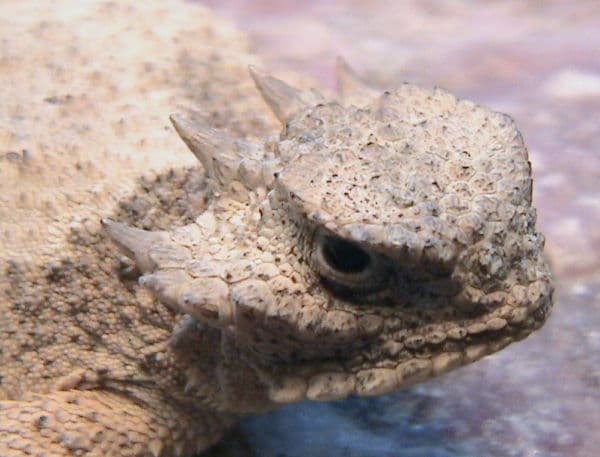
Round-tailed horned lizard
The roundtail horned lizard (Phrynosoma modestum) is a small, flat-bodied lizard native to arid regions of the southwestern United States and northcentral Mexico. It is distinguished by its short limbs, small head, and a unique crest of nearly equal-length horns, lacking the prominent lateral fringe of other horned lizards. This species typically inhabits rocky and sandy areas with sparse vegetation, often found near ant colonies which form the bulk of its diet.

Aspidoscelis laredoensis
The Laredo striped whiptail (Aspidoscelis laredoensis) is a lizard species native to southern Texas and northern Mexico. It is known for its dark green or brown coloration, distinguished by seven yellow or white stripes extending from head to tail, and a white underside. This species is parthenogenic, meaning females reproduce without fertilization, and it is a fast-moving, diurnal insectivore.