
Laudakia tuberculata
The Kashmir rock agama, also known as Laudakia tuberculata, is a species of agamid lizard found in rocky mountain areas across parts of Asia, including northern Pakistan, northern India, Nepal, eastern Afghanistan, and western China. It is characterized by its depressed body, strongly keeled scales, and distinctive coloration that varies between sexes and breeding seasons.
Key Facts
- ›Inhabits rocky mountain areas at elevations ranging from 790 to 3,660 meters.
- ›Found in northern Pakistan, northern India, Nepal, eastern Afghanistan, and western China.
- ›Males develop a blue throat with light spots during the breeding season.
- ›Possesses a depressed body with strongly keeled scales on its back and limbs.
- ›Tail length is typically 2.5 to 3 times the distance from the gular fold to the vent.

Kashmir Rock Agama, Tuberculated Agama
Northern Pakistan, Northern India, Nepal, Eastern Afghanistan, Western China
Rocky Mountain Areas
- Head Much Depressed; Snout Longer Than the Diameter of the Orbit.
- Nostril Lateral, Below the Canthus Rostralis, Slightly Tubular.
- Upper-Head Scales Smooth Or Feebly Keeled; Occipital Not Enlarged.
- Small, Closely Set Spinose Scales On the Sides of the Head Near the Ear and Neck.
- Ear Entirely Exposed, Larger Than the Eye-Opening.
- Throat Strongly Plicate; No Gular Pouch.
- Body Depressed, With A More Or Less Distinct Fold On Each Side of the Back.
- Scales On Neck and Sides Minute, Almost Granular, Keeled, Uniform, Or Intermixed With Scattered Enlarged Scales.
- Scales On the Vertebral Region Enlarged, Equal, Rhomboidal, Imbricate, Strongly Keeled.
- Ventral Scales Smooth, Nearly As Large As the Enlarged Dorsals.
- Limbs Strong, With Compressed Digits.
- Scales On the Upper Surface of the Limbs Much Enlarged and Very Strongly Keeled.
- Third and Fourth Fingers Equal, Or Fourth Very Slightly Longer.
- Fourth Toe Slightly Longer Than Third, Fifth Extending Beyond First.
- Tail Rounded, Much Depressed At the Base, Covered With Moderate-Sized Strongly Keeled Scales Arranged In Rings.
- Tail Length Equals 2.5 To 3 Times the Distance From Gular Fold To Vent.
- Males Have A Large Patch of Thickened Preanal Scales and A Patch of Similar Scales On the Middle of the Belly.
- Olive-Brown Above, Spotted Or Speckled With Blackish, Sometimes With Small Yellowish Spots.
- Breeding Male's Throat Is Blue, With Light Spots.
- Sometimes A Light Vertebral Band.
About Laudakia tuberculata
Laudakia tuberculata, commonly known as the Kashmir rock agama or tuberculated agama, is a species of lizard belonging to the Agamidae family. This reptile is naturally found in the rugged, rocky mountain areas of a significant portion of Asia, with its known distribution encompassing northern Pakistan, northern India (specifically the Western Himalayas, Kashmir, and Punjab regions), Nepal, eastern Afghanistan, and extending into the Tibetan Plateau in western China.
Physical Characteristics
The physical description of Laudakia tuberculata highlights several distinctive features. The head and body are notably depressed. The snout is longer than the diameter of the eye, and the nostrils are located laterally and are slightly tubular. The scales on the upper parts of the head are generally smooth or only feebly keeled, with small, spinose scales found near the ear and neck. The ear opening is fully exposed and larger than the eye. A prominent fold is present on each side of the back. The scales on the neck and sides are minute and granular, while those on the vertebral region are enlarged, rhomboidal, and strongly keeled. The ventral scales are smooth and approximately the same size as the enlarged dorsal scales. The limbs are robust, and the digits are compressed, with the scales on the upper limbs being significantly enlarged and strongly keeled. The tail is rounded and depressed at its base, covered in keeled scales arranged in rings, and its length is typically 2.5 to 3 times the distance from the gular fold to the vent.
Coloration varies, with the dorsal side usually being olive-brown, marked with blackish spots or speckles, and occasionally small yellowish spots. A notable sexual dimorphism occurs during the breeding season, where males develop a blue throat adorned with light spots. Some individuals may also exhibit a light vertebral band.
Habitat and Distribution
Laudakia tuberculata thrives in rocky mountainous environments. Its habitat is characterized by significant elevation, with populations recorded at altitudes ranging from 790 to 3,660 meters (approximately 2,590 to 12,010 feet) above sea level, indicating a strong adaptation to high-altitude, arid conditions.
Source: Wikipedia ↗
Frequently Asked Questions
What is the scientific name for the Kashmir rock agama?
The scientific name for the Kashmir rock agama is Laudakia tuberculata. This binomial nomenclature is used to classify this specific species within the animal kingdom.
Where is the Kashmir rock agama found?
Laudakia tuberculata is found in rocky mountain regions across northern Pakistan, northern India (including Kashmir and Punjab), Nepal, eastern Afghanistan, and the Tibetan Plateau in western China. Its distribution is primarily in high-altitude, rugged terrains.
What are the key physical characteristics of Laudakia tuberculata?
This lizard has a depressed head and body, with a snout longer than its eye diameter. Its scales are generally keeled, particularly on the back and limbs, and it has a rounded tail that is depressed at the base. Males exhibit unique scale patches and a blue throat during breeding.
What kind of habitat does the Kashmir rock agama prefer?
Laudakia tuberculata prefers rocky mountain areas. It is typically found at elevations between 790 and 3,660 meters (2,590 to 12,010 feet) above sea level, indicating an adaptation to arid, high-altitude environments.
How is the coloration of the Kashmir rock agama described?
The dorsal coloration is generally olive-brown, often spotted or speckled with blackish hues. Small yellowish spots may also be present. During the breeding season, males develop a distinctive blue throat marked with light spots.
Related Lizards

Algerian psammodromus
The Algerian psammodromus is a species of lizard recognized for its metallic brownish dorsal coloration often accented by conspicuous white or yellowish stripes. It inhabits dense bushy vegetation in southwestern Europe and northwestern Africa, preying primarily on terrestrial arthropods. This species faces threats primarily from habitat loss.

Amphisbaenidae
Amphisbaenidae, commonly known as worm lizards, are a family of limbless reptiles characterized by their worm-like appearance due to rings of scales. These burrowing creatures possess powerful jaws and specialized sensory adaptations for detecting prey underground. They are found across South America, parts of the Caribbean, Europe, and sub-Saharan Africa.
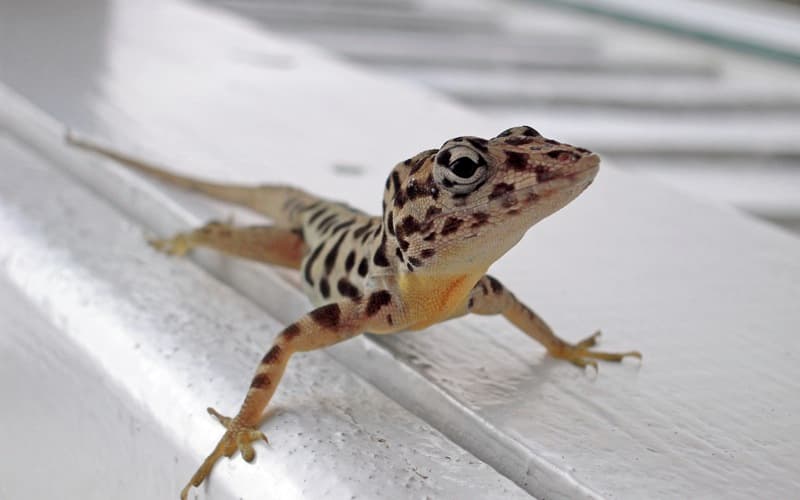
Anolis sabanus
The Saba anole (Anolis sabanus) is a medium-sized lizard endemic to the Caribbean island of Saba. Both males and females have pale bodies, but males display dark dorsal blotches, while females have a lighter hue with a dorsal stripe or mottling. This species is considered near-threatened due to the potential risk of invasive anoles being introduced to its habitat.