
Lophognathus longirostris
Gowidon longirostris, also known as the long-snouted lashtail or long-nosed water dragon, is an arboreal lizard belonging to the Agamidae family. This species is distinguished by its elongated snout and is found across various regions of Australia and New Guinea. It was initially described as Lophognathus longirostris before being transferred to the genus Gowidon.
Key Facts
- ›It is the sole recognized species within the genus Gowidon.
- ›Commonly referred to as the long-snouted lashtail or long-nosed water dragon.
- ›Inhabits arboreal environments.
- ›Found in Northern Territory, Queensland, South Australia, and Western Australia in Australia, as well as New Guinea.
- ›Originally described by George Boulenger in 1883.

Long-Snouted Lashtail, Long-Nosed Water Dragon
Northern Territory, Australia, Queensland, Australia, South Australia, Australia, Western Australia, Australia, New Guinea
Characterized By A Long Snout.
About Lophognathus longirostris
Gowidon longirostris: The Long-Snouted Lashtail
Gowidon longirostris, commonly known as the long-snouted lashtail or long-nosed water dragon, is a species of arboreal lizard belonging to the family Agamidae. It holds the distinction of being the sole recognized species within the genus Gowidon. This lizard is characterized by its notably elongated snout.
Distribution and Habitat
The natural range of Gowidon longirostris extends across significant portions of Australia, including the Northern Territory, Queensland, South Australia, and Western Australia. Its distribution also includes the island of New Guinea. As an arboreal species, it primarily inhabits trees, relying on this environment for shelter and foraging.
Taxonomy and Discovery
The species was first formally described by George Boulenger in 1883, at which time it was classified as Lophognathus longirostris. Later, in 2014, Hal Cogger transferred the species to the genus Gowidon, a taxonomic decision supported by earlier synonymy work by Cogger in 1983. The genus Gowidon is monotypic, meaning it contains only this one species.
Source: Wikipedia ↗
Frequently Asked Questions
What is Gowidon longirostris commonly called?
Gowidon longirostris is commonly known as the long-snouted lashtail or the long-nosed water dragon. These names refer to its distinctive facial features and its habitat preferences.
Where is the long-snouted lashtail found?
This lizard species is found in several regions of Australia, including the Northern Territory, Queensland, South Australia, and Western Australia. It also extends its range to New Guinea.
What type of environment does Gowidon longirostris live in?
Gowidon longirostris is an arboreal lizard, meaning it primarily lives in trees. Its habitat is therefore characterized by environments that support tree-dwelling life.
Who first described Gowidon longirostris?
The species was first described in 1883 by George Boulenger. At that time, it was classified under the scientific name Lophognathus longirostris.
What is the taxonomic classification of the long-snouted lashtail?
It belongs to the genus Gowidon, within the family Agamidae. The genus Gowidon is monotypic, meaning it contains only this single recognized species.
Related Lizards

Indian chameleon
The Indian chameleon (Chamaeleo zeylanicus) is a slow-moving, arboreal lizard native to South Asia, including India, Sri Lanka, and Pakistan. It is characterized by its long, sticky tongue for catching prey, independently moving eyes, and the remarkable ability to change skin color, primarily for communication and thermoregulation rather than camouflage. Its unique physical features include a bony casque on its head, bifurcated feet, and a prehensile tail.
Spotted flying dragon
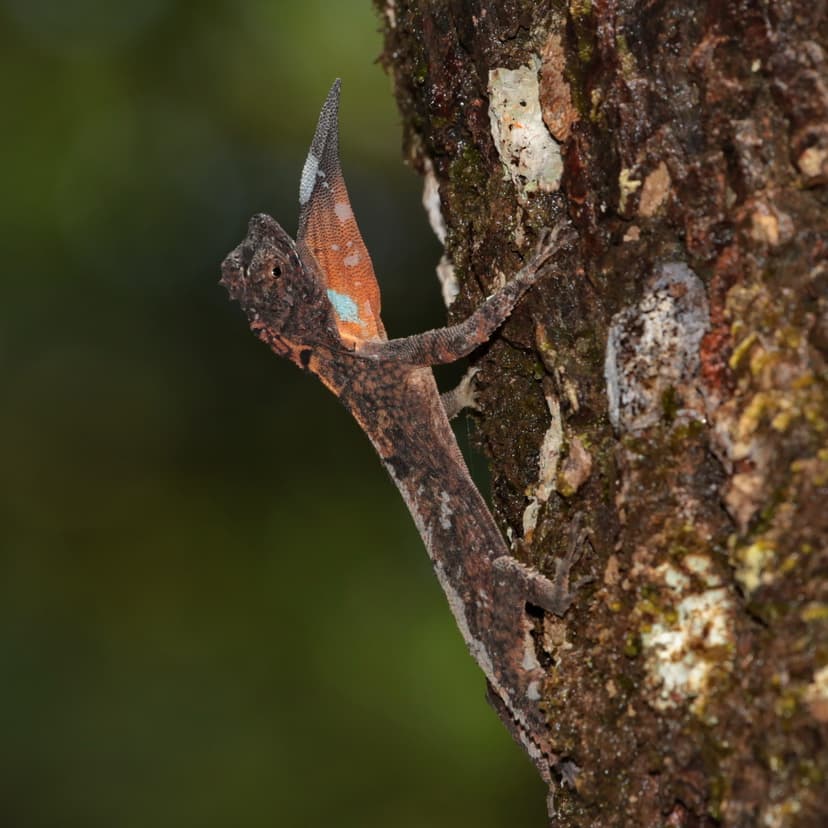
The spotted flying dragon, scientifically known as *Draco maculatus*, is a species of agamid lizard found in Southeast Asia, notable for its ability to glide between trees. It is characterized by its small head, a prominent gular appendage in males, and a body adorned with dark markings and small black spots on its wing membranes. This arboreal species inhabits forests and is an insectivore, playing a role in its ecosystem.

Coastal day gecko
The coastal day gecko, scientifically known as Cnemaspis littoralis, is a species of gecko native to the Western Ghats of India. It primarily inhabits dry teak forests and is found on trees, with historical records indicating its presence near the seacoast.