
Spotted flying dragon
The spotted flying dragon, scientifically known as *Draco maculatus*, is a species of agamid lizard found in Southeast Asia, notable for its ability to glide between trees. It is characterized by its small head, a prominent gular appendage in males, and a body adorned with dark markings and small black spots on its wing membranes. This arboreal species inhabits forests and is an insectivore, playing a role in its ecosystem.
Key Facts
- ›Capable of gliding from tree to tree using patagia (wing membranes).
- ›Males possess a significantly larger gular appendage (throat sac) than females.
- ›Dorsal scales are less prominent than ventral scales, with a series of larger keeled scales along the sides of the back.
- ›Coloration is typically grayish with darker markings, featuring small black spots on the wing membranes.
- ›Found across a wide range in Southeast Asia, from India and China to Malaysia.
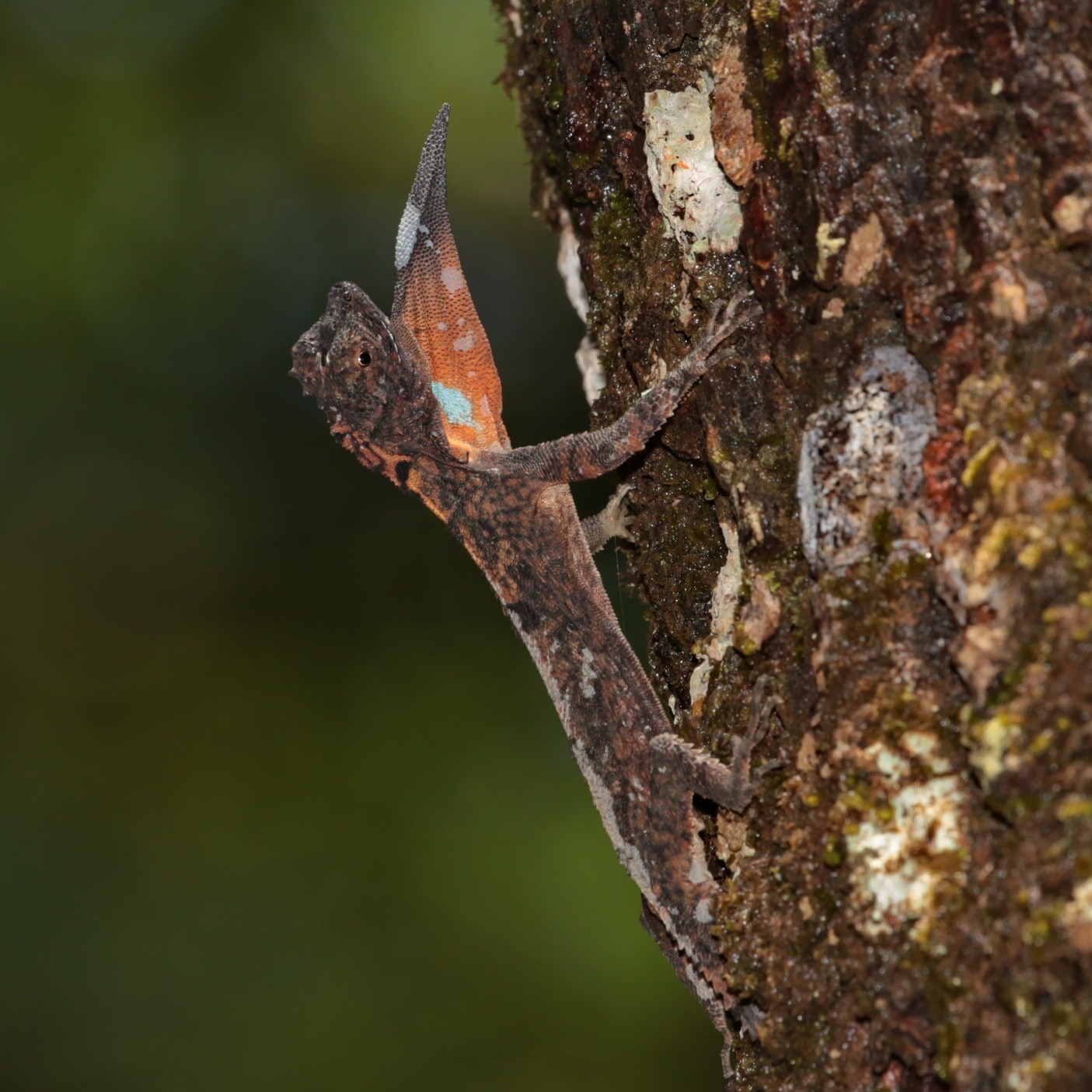
Spotted Gliding Lizard
Assam, Yunnan, Singapore, Southern China, India, Bangladesh, Myanmar, Laos, Vietnam, Thailand, W. Malaysia
- Small Head, Snout Slightly Longer Than Orbit Diameter.
- Males Possess A Very Large Gular Appendage, Often Twice the Length of the Head; Females Have A Smaller Gular Sac.
- Male With A Very Small Nuchal Crest.
- Dorsal Scales Are Only Slightly Larger Than Ventral Scales and Are Irregular, Smooth Or Feebly Keeled.
- A Series of Large, Trihedral, Keeled, Distant Scales On Each Side of the Back.
- Fore Limb Stretched Forward Reaches Beyond the Snout Tip; Adpressed Hind Limb Reaches Beyond the Elbow of the Fore Limb Or To the Axilla.
- Coloration Is Grayish Above With More Or Less Distinct Darker Markings.
- A More Or Less Distinct Darker Interorbital Spot.
- Wing Membranes Are Spotted Above With Numerous Small Round Black Spots, Which Are Seldom Confluent.
- Wing Membranes Are Immaculate Or With A Few Black Spots Beneath.
- A Blue Spot On Each Side of the Base of the Gular Appendage.
- Snout To Vent Length: 82 mm .
- Tail Length: 115 mm .
Insects
Capable of Gliding From Tree To Tree., Arboreal Lifestyle.
About Spotted flying dragon
Spotted Flying Dragon (Draco maculatus)
The spotted flying dragon, scientifically recognized as Draco maculatus, is a distinctive species of agamid lizard native to the diverse forested regions of Southeast Asia. Its most remarkable characteristic is its ability to glide through the air from tree to tree, utilizing specialized skin membranes called patagia. This adaptation is crucial for navigating its arboreal habitat.
Physical Description
The physical appearance of the spotted flying dragon is marked by a relatively small head and a snout that is slightly longer than the diameter of its eye socket. A notable sexual dimorphism is present in the gular appendage, or throat sac; males possess a very large, prominent sac, often extending to twice the length of their head, while females have a smaller but still well-developed version. The body is typically grayish, adorned with indistinct darker markings, and the wing membranes are speckled with numerous small, round black spots above, while the underside is either unspotted or has only a few black spots. A distinctive blue spot is also present on each side at the base of the male's gular appendage.
Geographic Range and Habitat
Draco maculatus is found across a wide geographical expanse, spanning from Assam and Yunnan in India and China, through countries like Bangladesh, Myanmar, Laos, Vietnam, Thailand, and extending to West Malaysia, with its range reaching as far south as Singapore. These lizards are primarily arboreal, inhabiting forest environments where their gliding ability allows them to move efficiently between trees. Their diet consists mainly of insects, fitting the profile of an insectivore within their ecosystem.
Source: Wikipedia ↗
Frequently Asked Questions
What is the scientific name for the spotted flying dragon?
The scientific name for the spotted flying dragon is *Draco maculatus*. This binomial nomenclature is used to distinguish it from other lizard species.
What are the key physical characteristics of the spotted flying dragon?
The spotted flying dragon has a small head with a snout slightly longer than its orbit diameter. Males are distinguished by a very large gular appendage, often twice the length of the head, while females have a smaller, though still well-developed, sac. Their dorsal scales are only slightly larger than ventral scales, and the wing membranes are marked with small, round black spots.
Where is the spotted flying dragon found?
This species has a broad geographic distribution, ranging from Assam and Yunnan in India and China, through Bangladesh, Myanmar, Laos, Vietnam, Thailand, and into West Malaysia, extending as far south as Singapore.
What is the diet of the spotted flying dragon?
The spotted flying dragon is an insectivore. Its diet consists of insects, which it likely preys upon while navigating its arboreal habitat.
How large does the spotted flying dragon get?
The spotted flying dragon reaches a snout-to-vent length of approximately 82 mm (3.2 inches), with a tail that measures around 115 mm (4.5 inches).
Are there different subspecies of Draco maculatus?
Yes, four subspecies of *Draco maculatus* are recognized. These include *Draco maculatus divergens*, *Draco maculatus haasei*, *Draco maculatus maculatus*, and *Draco maculatus whiteheadi*, each with distinct geographic ranges within the species' overall distribution.
Related Lizards

Indian chameleon
The Indian chameleon (Chamaeleo zeylanicus) is a slow-moving, arboreal lizard native to South Asia, including India, Sri Lanka, and Pakistan. It is characterized by its long, sticky tongue for catching prey, independently moving eyes, and the remarkable ability to change skin color, primarily for communication and thermoregulation rather than camouflage. Its unique physical features include a bony casque on its head, bifurcated feet, and a prehensile tail.

Lophognathus longirostris
Gowidon longirostris, also known as the long-snouted lashtail or long-nosed water dragon, is an arboreal lizard belonging to the Agamidae family. This species is distinguished by its elongated snout and is found across various regions of Australia and New Guinea. It was initially described as Lophognathus longirostris before being transferred to the genus Gowidon.

Coastal day gecko
The coastal day gecko, scientifically known as Cnemaspis littoralis, is a species of gecko native to the Western Ghats of India. It primarily inhabits dry teak forests and is found on trees, with historical records indicating its presence near the seacoast.