
Lygodactylus capensis
The Cape dwarf gecko (Lygodactylus capensis) is a small lizard species native to the woodlands and forests of central and southern Africa. It is adaptable, commonly found in urban environments and sometimes kept as a pet. A distinctive feature is its tail, which is covered in adhesive lamellae, aiding its use as a fifth limb and serving as a survival tactic through autotomy.
Key Facts
- ›Found in central and southern Africa, including urban areas.
- ›Possesses a prehensile tail with adhesive lamellae for climbing.
- ›Can detach its tail as a defense mechanism (caudal autotomy).
- ›Adult males reach up to 39 mm snout-to-vent length, females up to 43 mm.
- ›Assists in skin shedding by actively detaching and consuming flakes.
- ›Tail autotomy can temporarily impair climbing ability due to loss of balance and adhesion.

Cape Dwarf Gecko
South Africa, Botswana, Eswatini, Democratic Republic of the Congo, Zambia, Angola, Namibia, Mozambique, Tanzania, Pemba Island
Woodlands, Forests, Urban Areas, Towns, Cities, Garden Walls
- Snout To Vent Length: Up To 39 mm For Males, Up To 43 mm For Females.
- Throat Is Stippled With Grey Or Brown.
- Belly Is Cream-Colored.
- Back Is Grey-Brown With A Dark Streak From Snout To Shoulder Or Beyond.
- Tail Has Adhesive Lamellae On the Underside, Enabling Use As A Fifth Limb.
- Actively Assists In Moulting By Detaching and Consuming Skin Flakes.
- Capable of Caudal Autotomy For Survival.
- Tail Loss Temporarily Impairs Climbing Ability.
- Often Seen On Garden Walls In Urban Environments.
About Lygodactylus capensis
The Cape dwarf gecko, scientifically known as Lygodactylus capensis, is a small lizard species native to the woodlands and forests of central and southern Africa. Its adaptability has led to its common presence in urban areas, including towns and cities, where it can often be observed on garden walls. This species is sometimes kept as a pet.
Physical Characteristics
Adult males typically measure up to 39 millimeters in snout-to-vent length, while females are slightly larger, reaching up to 43 millimeters. The dorsal coloration is generally grey-brown, often featuring a distinct dark streak extending from the snout towards the shoulder. The throat area is marked with grey or brown stippling, and the belly is a contrasting cream color. A remarkable anatomical feature is its tail, which is equipped with adhesive lamellae on its underside, allowing it to function effectively as a fifth limb for gripping surfaces.
Behavior and Survival
Lygodactylus capensis exhibits unique behaviors related to its survival. During the moulting process, the gecko actively participates by detaching skin flakes and consuming them. Perhaps its most notable survival mechanism is caudal autotomy, the ability to detach its tail from the body when threatened by a predator. While this strategy is effective for escape, it comes with a temporary disadvantage: the loss of the tail, which contains adhesive pads, can impair the gecko's balance and its ability to rapidly climb vertical surfaces.
Distribution and Habitat
This species is widely distributed across several African nations, including South Africa, Botswana, Eswatini, the Democratic Republic of the Congo, Zambia, Angola, Namibia, Mozambique, and Tanzania, with occurrences noted on Pemba Island. Within South Africa, its range has notably expanded southwards and westwards towards coastal regions since 1981. While its natural habitat includes woodlands and forests, its prevalence in urban settings highlights its capacity to thrive in human-altered landscapes.
Source: Wikipedia ↗
Frequently Asked Questions
What is the scientific name for the Cape dwarf gecko?
The scientific name for the Cape dwarf gecko is Lygodactylus capensis. The genus name 'Lygodactylus' translates to 'flexible fingers'.
Where can the Cape dwarf gecko be found?
This species is distributed across central and southern Africa, including countries like South Africa, Botswana, Namibia, and Tanzania. It has also expanded its range into coastal areas of South Africa.
What are the physical characteristics of the Cape dwarf gecko?
Adult males typically measure up to 39 mm in snout-to-vent length, while females can reach 43 mm. They have a grey-brown back with a dark streak, a grey or brown stippled throat, and a cream-colored belly. Their tail is notable for its adhesive lamellae on the underside.
Does the Cape dwarf gecko have any special defense mechanisms?
Yes, the Cape dwarf gecko has the ability to detach its tail from its body as a survival tactic, known as caudal autotomy. This helps it escape predators.
What are the consequences of tail loss for this gecko?
While tail autotomy aids in escaping predators, it can temporarily affect the gecko's ability to climb vertical surfaces quickly. This is due to a loss of balance and adhesion caused by the absence of the tail, which has an adhesive pad at its tip.
Where do Cape dwarf geckos typically live?
They inhabit woodlands and forests but are also commonly found in gardens, on walls in towns and cities, indicating a high degree of adaptability to human-modified environments.
Related Lizards
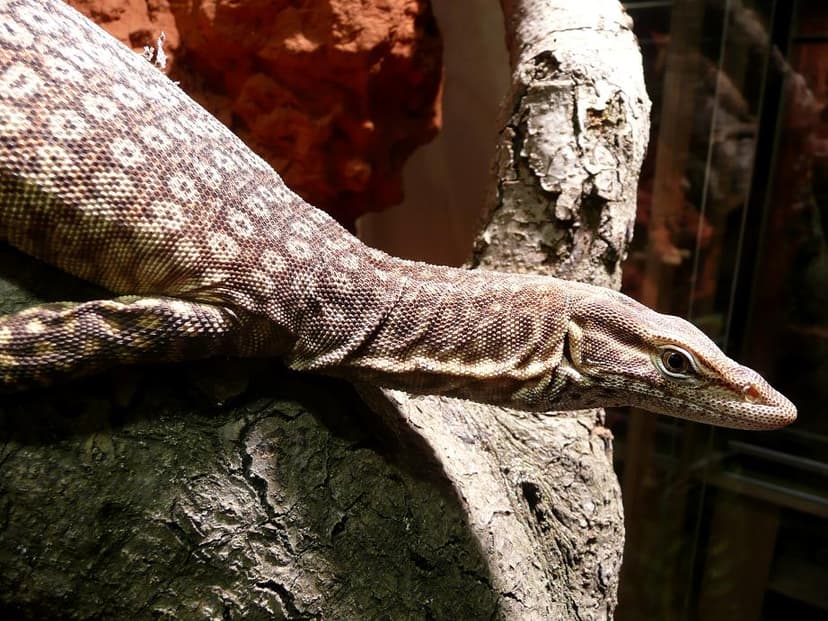
Varanus tristis
The black-headed monitor (Varanus tristis) is a relatively small monitor lizard found across mainland Australia and some northern islands. Known for its speed and ability to inhabit diverse environments from forests to deserts, this species exhibits distinct subspecies with variations in coloration and size. It is an opportunistic predator with a varied diet and a notable reproductive cycle.

Ablepharus
Ablepharus, commonly known as snake-eyed skinks, are small lizards distinguished by fused eyelids that prevent blinking, similar to snakes. They inhabit dry fields, hills, and rocky areas, often concealed within leaf litter. These skinks possess shiny, bronze scales and a characteristic dark stripe along their sides, feeding primarily on small insects and mollusks.

Ctenotus robustus
The Ctenotus robustus, commonly known as the eastern striped skink, is a large, fast-moving skink native to Australia. It is characterized by a distinctive white-edged black stripe running down its back and tail, set against a brown background with broader brown stripes and rows of white spots on its sides. This diurnal reptile prefers open habitats with available shelter and is widely distributed across various Australian states.