
Milos wall lizard
The Milos wall lizard is a small Mediterranean reptile found on several Aegean islands in Greece. It is characterized by its sturdy build, broad head, and distinct coloration, with males typically displaying a brown back and black sides marked with various colored spots, while females have white back stripes and throat spots. These lizards prefer cultivated lands and bask on stone piles, actively hunting among plants and on open ground.
Key Facts
- ›Found on Milos, Kimolos, Falkonera, Antimilos, and Parapola islands in Greece.
- ›Males have brown backs with black flanks and spotted heads; females have white back stripes.
- ›Prefers cultivated areas and basks on stone piles.
- ›Hunts on open ground or amongst vegetation.
- ›The species is becoming rare due to habitat loss.

Milos Wall Lizard
Greece
Cultivated Lands, Banks, Stone Piles, Open Ground, Among Plants
- Small Mediterranean Lizard.
- Body Length Up To 6.5 cm; Tail Is Twice the Body Length.
- Sturdy Build With A Broad Head.
- Males: Back Usually Brown With A Slight Longitudinal Line; Flanks, Throat, and Sides of Head Black With White, Yellow, Blue, Or Light Green Spots; Belly Often Has Black Patterning.
- Females: White Stripes On the Edges of the Back, Some Distinctive Spots In the Throat.
Insects
Basks In the Sun On Banks and Stone Piles., Hunts In Open Ground Or Among Plants.
Habitat Loss
About Milos wall lizard
The Milos wall lizard, scientifically known as Podarcis milensis, is a small reptile native to a few islands in the Greek Aegean Sea. Its physical characteristics are notably different between sexes, with males typically exhibiting a brown back and black-spotted sides, while females feature white stripes along their backs and distinctive throat markings.
Habitat and Behavior
This lizard species thrives in cultivated lands, often observed basking in the sun on stone piles and banks. They are active hunters, seeking out prey in open ground areas as well as amidst vegetation. The Milos wall lizard is diurnal, meaning it is active during the day.
Distribution and Conservation
The natural range of the Milos wall lizard is restricted to the Greek islands of Milos, Kimolos, Falkonera, Antimilos, and Parapola. Unfortunately, the species is facing a decline in numbers and is categorized as Near Threatened. The primary threat to its survival is habitat loss, highlighting the vulnerability of island endemic species to environmental changes.
Source: Wikipedia ↗
Frequently Asked Questions
What are the key physical characteristics of the Milos wall lizard?
The Milos wall lizard has a sturdy body with a broad head. Males typically have a brown back and black flanks with white, yellow, blue, or light green spots. Females often display white stripes along the edges of their backs and distinctive spots on their throat.
Where can the Milos wall lizard be found?
This lizard species inhabits a few Aegean islands in Greece, specifically Milos, Kimolos, Falkonera, Antimilos, and Parapola. They are most commonly found in cultivated lands on these islands.
What is the typical habitat of the Milos wall lizard?
The Milos wall lizard prefers cultivated lands and is often observed basking in the sun on banks and among piles of stones. They also hunt for food in open ground or within plant cover.
Why is the Milos wall lizard becoming rare?
The population of the Milos wall lizard is declining primarily due to habitat loss. This loss of suitable environments poses a significant threat to their survival.
What is the size of a Milos wall lizard?
The body length of the Milos wall lizard is typically no more than 6.5 cm, with its tail being twice the length of its body. This gives it a relatively small overall size.
Related Lizards

Brookesia betschi
Brookesia betschi, also known as Blanc's leaf chameleon or the Marojejy leaf chameleon, is a small lizard species endemic to the forests of northern Madagascar. This diurnal reptile relies on its cryptic coloration for camouflage and inhabits subhumid forests at high altitudes. It is oviparous and faces threats from habitat destruction.
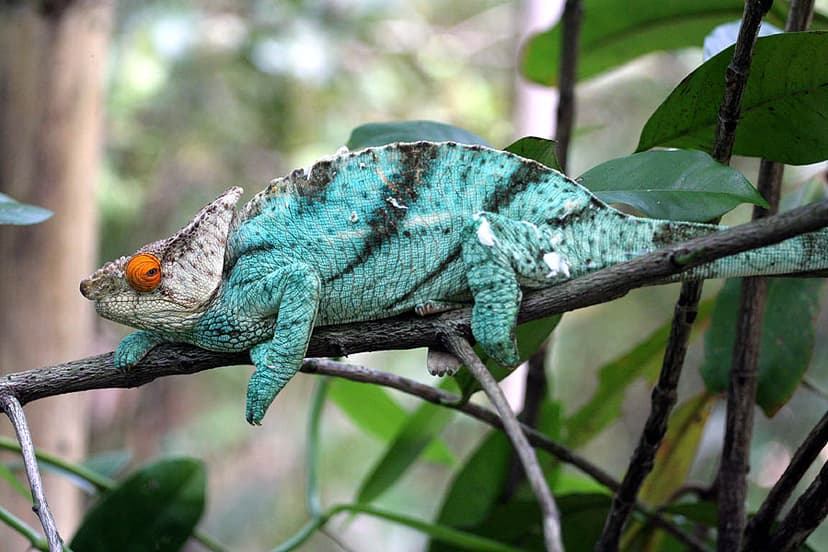
Calumma parsonii
Parson's chameleon (Calumma parsonii) is one of the world's largest chameleons, known for its impressive size, longevity, and slow reproductive rate. Primarily found in the humid primary forests of eastern and northern Madagascar, this species exhibits striking color variations in males and is a slow-moving, sit-and-wait predator. Despite its protected status and large range, it faces threats from habitat loss and the pet trade.

Chalcides bedriagai
Chalcides bedriagai, commonly known as Bedriaga's skink, is a small lizard endemic to the Iberian Peninsula. It typically inhabits sandy areas with sparse vegetation or open woodlands, burrowing into loose soil for shelter. This timid, diurnal species is characterized by its elongated body, short limbs, and a tail that can be regenerated if broken.