
Monopeltis guentheri
The Western Congo worm lizard (Monopeltis guentheri) is a species of amphisbaenian found exclusively in the Democratic Republic of the Congo. This burrowing reptile is characterized by its segmented body and is adapted for a subterranean existence within forest habitats.
Key Facts
- ›Endemic to the Democratic Republic of the Congo.
- ›Prefers forest as its natural habitat.
- ›Can reach a snout-to-vent length of up to 25 cm.
- ›Has 250–254 body annuli.
- ›Named in honor of herpetologist Albert Günther.

Western Congo Worm Lizard
Democratic Republic of the Congo
May Attain A Snout-To-Vent Length of 25 cm ., Tail Length Is Approximately 3 cm ., Possesses 250–254 Annuli On the Body.
About Monopeltis guentheri
Western Congo Worm Lizard (Monopeltis guentheri)
The Western Congo worm lizard, scientifically known as Monopeltis guentheri, is a species of amphisbaenian that inhabits the Democratic Republic of the Congo. These reptiles are part of the Amphisbaenidae family and are distinguished by their limbless, burrowing lifestyle. The species is endemic to the western regions of the Democratic Republic of the Congo, where it has adapted to life beneath the surface.
Habitat and Distribution
Monopeltis guentheri is exclusively found within the Democratic Republic of the Congo. Its preferred natural habitat is forest environments, suggesting a reliance on the soil, leaf litter, and potential food sources found within these ecosystems. As a burrowing species, its presence is intrinsically linked to the characteristics of the forest floor.
Physical Characteristics
This species can reach a notable size, with a snout-to-vent length (SVL) of up to 25 centimeters (approximately 9.8 inches). The tail of the Western Congo worm lizard measures around 3 centimeters (1.2 inches) in length. A key physical characteristic is the presence of 250 to 254 annuli, which are ring-like segments, along its body, contributing to its worm-like appearance and aiding in its subterranean locomotion.
Taxonomy and Naming
The scientific name, Monopeltis guentheri, honors Albert Günther, a distinguished German-born British herpetologist. The species belongs to the family Amphisbaenidae, a group of specialized fossorial reptiles. While its common name reflects its geographic location and morphology, its scientific designation acknowledges a significant figure in herpetological research.
Reproduction and Life History
Details regarding the reproductive methods of Monopeltis guentheri are not extensively documented. The specific mode of reproduction remains unknown, and further scientific investigation is required to understand its breeding patterns, egg-laying or live-bearing status, and other aspects of its life cycle. Information on its lifespan, diet, and natural predators is also limited in current records.
Source: Wikipedia ↗
Frequently Asked Questions
Where is the Western Congo worm lizard found?
The Western Congo worm lizard (Monopeltis guentheri) is found only in the western part of the Democratic Republic of the Congo. It is endemic to this region.
What kind of habitat does Monopeltis guentheri prefer?
The preferred natural habitat for Monopeltis guentheri is forest. This suggests it is well-adapted to environments with soil and leaf litter suitable for burrowing.
How large can Monopeltis guentheri grow?
Monopeltis guentheri can attain a snout-to-vent length of up to 25 cm (approximately 9.8 inches). Its tail adds an additional 3 cm (1.2 inches) to its total length.
What is the reproduction method of Monopeltis guentheri?
The exact mode of reproduction for Monopeltis guentheri is currently unknown. Further research is needed to document how this species reproduces.
What does the name 'guentheri' refer to?
The specific name, guentheri, is an honorific. It was given in recognition of the German-born British herpetologist Albert Günther, who made significant contributions to the study of reptiles.
Related Lizards
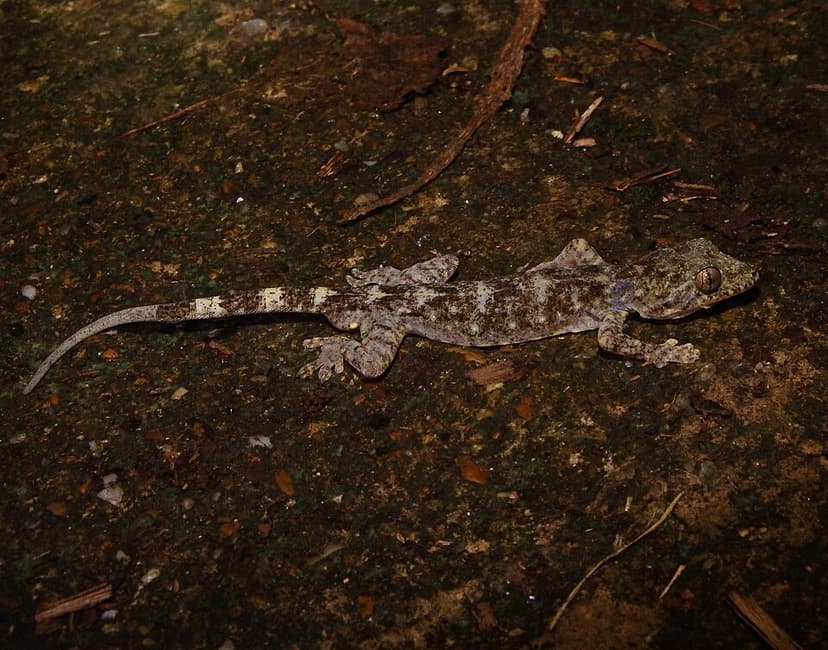
Adler's gecko
Adler's gecko is a moderately-sized lizard native to the forest habitats of southern China and northern Vietnam. Distinguished by its moderate size within its genus, adults typically do not exceed a snout-to-vent length of 8 cm. The species was named in honor of American herpetologist Kraig Adler.

Amphiglossus alluaudi
Flexiseps alluaudi is a skink species found exclusively on the island of Madagascar. Its preferred natural habitat is forest environments. The specific mode of reproduction for this lizard remains unknown.

Amphiglossus crenni
Flexiseps crenni, also known as Crenni's skink, is a species of lizard endemic to Madagascar. It is characterized by its very short legs and reduced number of digits. The preferred habitat for this skink is forest environments.