
Morethia adelaidensis
The saltbush skink (Morethia adelaidensis) is a small skink species endemic to Australia, known for its transparent eye discs and specialized limbs for sand dune traversal. Primarily inhabiting arid shrublands, particularly those with saltbush chenopod shrubs, these diurnal lizards are insectivorous and exhibit a high tolerance for saline environments. They reproduce by laying eggs, with males developing distinctive orange markings during the breeding season.
Key Facts
- ›Endemic to Australia, belonging to the genus Morethia.
- ›Inhabits arid shrublands, often associated with saltbush chenopod shrubs.
- ›Diurnal and insectivorous, with a high tolerance for saline areas.
- ›Reproduces by laying clutches of approximately 5 eggs.
- ›Males develop 'fire-tail' orange markings during the breeding season.
- ›Preyed upon by native snake species, including curl snakes.
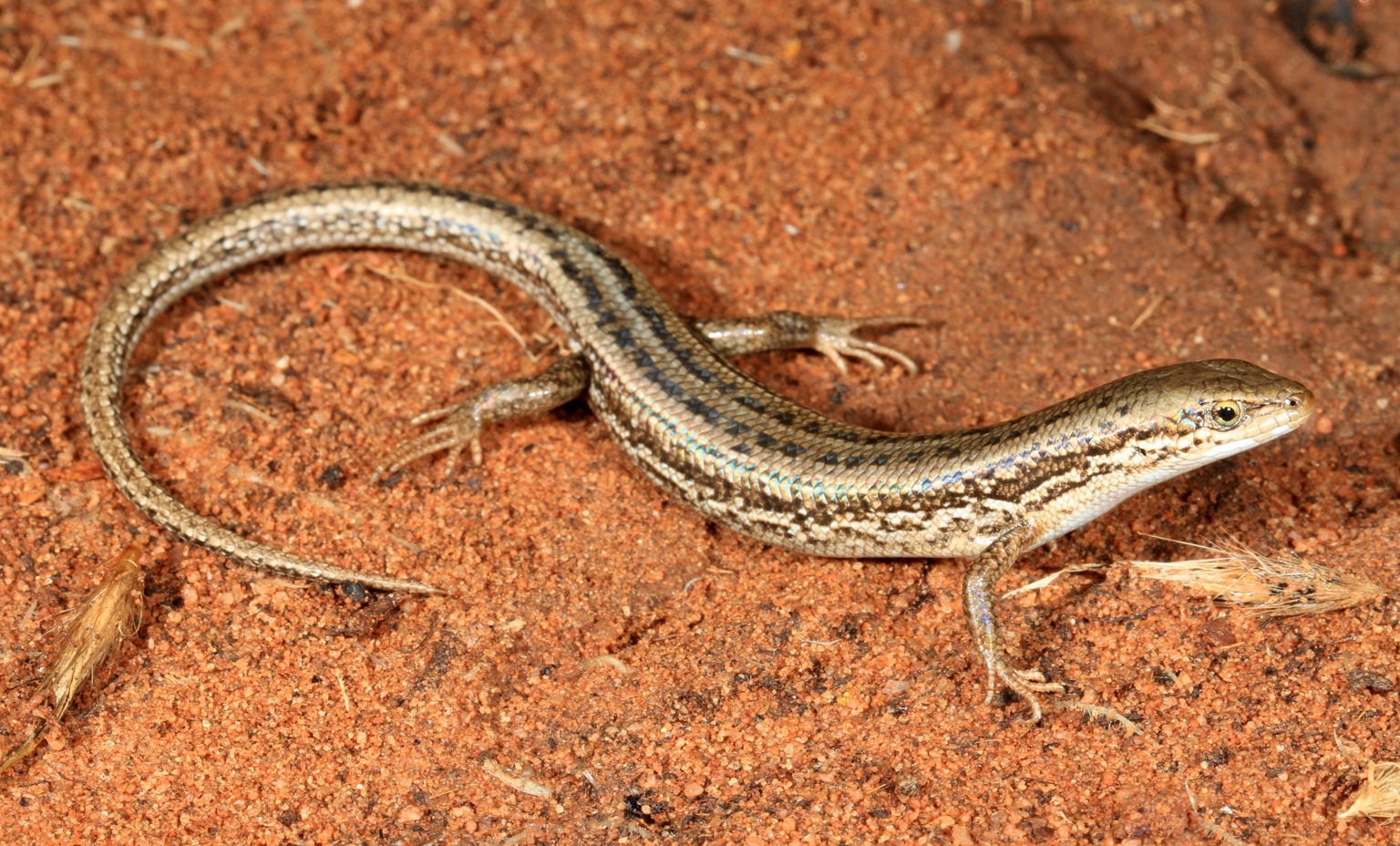
Saltbush Skink
Australia, Lake Eyre Basin, Nullarbor Coastal Regions, Arid Regions of Western Australia, Northern Border of New South Wales
Arid Shrublands, Saltbush Chenopod Shrublands, Temperate Native Grasslands, River Gorges, Rocky Granite Outcrops, Salt Flat Shrublands
- Small-Sized Skinks.
- Adult Males Average 5 cm In Snout-Vent Length.
- Coloration: Grey Or Olive Grey Complexions.
- Two Primary Black Bands Stretch Dorsally and Laterally, Extending To the Tail.
- Upper Black Band Is Darker With Significant Speckled Markings.
- A Single Interrupted, Irregular White Band Is Located Directly Below the Black Bands, Extending Through the Ear and Above the Forelimbs.
- Species From Lake Eyre May Have Paler Markings With Less Visible Lateral Black Lines.
- Visibly Separated Nasal Superiors .
- Eyes Are Surrounded By Granule-Like Scale Clusters.
Insects
- Diurnal, Mostly Active During the Day.
- Require Thermal Heat For Temperature Regulation.
- Burrow Shallow Perturbations In Sandy Soils.
- Exhibit Territorial Behavior, With Males Developing Orange 'Fire-Tail' Markings.
Native Snake Species, Curl Snakes
About Morethia adelaidensis
Saltbush Skink (Morethia adelaidensis)
The saltbush skink, scientifically known as Morethia adelaidensis, is a small lizard species endemic to Australia. Belonging to the genus Morethia, which comprises eight species all found exclusively in Australia, this skink is characterized by its transparent eye discs, stationary eyelids, and specialized limbs that facilitate rapid movement across sand dunes.
Distribution and Habitat
This species is found across a wide range in Australia, from the Lake Eyre Basin to the Nullarbor coastal regions, and extends into the arid zones of Western Australia and the northern border of New South Wales. Saltbush skinks primarily inhabit arid shrublands, with their distribution closely linked to the presence of saltbush chenopod shrubs. While they are often found in areas with observable grass cover, such as temperate native grasslands in South Australia, they also occupy river gorges and rocky granite outcrops, though their arid distribution is not strictly limited to these specific environments.
Physical Characteristics
Adult saltbush skinks are small, with males averaging approximately 5 centimeters in snout-vent length. Their coloration is typically grey or olive grey, marked by two prominent black bands running dorsally and laterally down to the tail. The upper black band is notably darker and features speckled patterns. Below these black bands, a single, interrupted white band extends through the ear region and above each forelimb. While most populations exhibit darker markings, individuals found in the Lake Eyre region may display paler coloration and less distinct lateral black lines. Anatomically, they possess visibly separated nasal superiors and their eyes are encircled by clusters of granule-like scales.
Diet and Behavior
As insectivores, saltbush skinks, like other members of the Morethia genus, feed primarily on insects. They are diurnal, meaning they are most active during daylight hours, and like all reptiles, they rely on external heat sources for thermoregulation. A notable characteristic of this species is its halophytic nature, demonstrating a high tolerance for saline environments. Saltbush skinks also exhibit burrowing behavior, creating shallow depressions in sandy soils, often found among shrubs or rocky outcrops.
Reproduction and Social Behavior
Saltbush skinks reproduce by laying eggs, a characteristic known as being oviparous. Each breeding female typically lays clutches averaging around five eggs, which are usually deposited in sandy substrates or within rocky formations. The size of the clutch is often influenced by the size of the female. During the breeding season, males develop distinctive orange 'fire-tail' markings along their ventral edges, extending under the tail and around their limbs, which are believed to serve a territorial purpose. While detailed breeding observations are limited, anecdotal evidence suggests that communal nesting may occur, with multiple females potentially nesting together.
Conservation and Predators
The International Union for Conservation of Nature (IUCN) currently classifies the saltbush skink as 'Least Concern.' This designation indicates that the species is not currently facing significant threats from general land clearing or grazing activities. However, like many smaller skink species, they are subject to predation by native snakes, including species from the Elapidae genus. Curl snakes (Suta suta) have been documented to prey on saltbush skinks in Western Australia, along with other medium to large snake species that consume smaller reptiles.
Source: Wikipedia ↗
Frequently Asked Questions
What is the scientific name for the saltbush skink?
The scientific name for the saltbush skink is Morethia adelaidensis. It was first classified by German explorer Wilhelm Karl Hartwig in 1871.
Where are saltbush skinks found?
Saltbush skinks are found in Australia, with their recorded habitat range spanning from the Lake Eyre Basin to the coastal regions of Nullarbor. They also inhabit arid regions of Western Australia and the northern border of New South Wales.
What do saltbush skinks eat?
Saltbush skinks are insectivorous, meaning their diet consists primarily of insects. This dietary habit is similar to other species within the Morethia genus.
How do saltbush skinks reproduce?
Saltbush skinks are oviparous, meaning they reproduce by laying eggs. Breeding females typically produce clutches of around 5 eggs, which are usually buried in sandy substrates or among rocky outcrops.
What are the main threats to saltbush skinks?
Currently, the IUCN lists saltbush skinks as 'Least Concern,' indicating they are not significantly threatened by general land clearing and grazing. However, like other small skinks, they are preyed upon by native snake species.
Are saltbush skinks adapted to salty environments?
Yes, saltbush skinks are halophytic, which means they have a high tolerance for saline areas. This adaptation is consistent with their habitat preference for arid shrublands, which often include salt-tolerant vegetation.
Related Lizards

Ctenophorus maculatus
Ctenophorus maculatus, also known as the spotted military dragon or spotted sand-dragon, is a species of agamid lizard found in the semi-arid and arid shrublands and hummock grasslands of Western Australia and a small part of South Australia. It is characterized by its spotted pattern, which aids in camouflage within its natural habitat.

Ctenophorus salinarum
The claypan dragon, scientifically known as Ctenophorus salinarum, is a species of agamid lizard found in the arid and semi-arid regions of southern Western Australia. It typically inhabits chenopod shrublands surrounding salt lakes and claypans, as well as adjacent sandy heaths.

Agama impalearis
Agama bibronii, also known as Bibron's agama or the North African rock agama, is a medium-sized lizard found in northwestern Africa. Characterized by its greyish-green dorsal coloration with brown spots and a blue head with orange eye rims, males exhibit striking coppery-orange and purplish-blue breeding colors. This diurnal species inhabits rocky areas and is an omnivore, feeding on arthropods, small lizards, and plant material.