
Norville's flying lizard
Norville's flying lizard, also known as Alcock's flying dragon, is a species of lizard endemic to India, recognized for its ability to glide between trees up to 50 meters. This agamid lizard inhabits the northeastern regions of India and feeds on insects and other small invertebrates.
Key Facts
- ›Endemic to northeastern India, specifically Assam, Nagaland, and Arunachal Pradesh.
- ›Capable of gliding distances of up to 50 meters between trees.
- ›Feeds on insects and other small invertebrates.
- ›Distinguished by its coloration, with barred patterns on its back and banded tail.
- ›The female possesses a scarlet-based gular pouch, with a yellow, shorter-than-head gular appendage.
- ›Oviparous, meaning it reproduces by laying eggs.

Alcock's Flying Dragon, Norvill's Flying Lizard
India
- Head Is Broader Than Its Length.
- Tympanum Is Partially Scaled Over.
- Nostrils Are Inclined Towards the Vertical.
- Possesses Nine Supralabial Scales.
- Body Is Grayish Above With Light Transverse Lines On the Dorsal Part.
- Neck and Head Regions Have Greenish Markings.
- Tail Is Marked With Alternate White and Black Bands.
- Base of the Gular Pouch Is Scarlet In Females.
- Gular Appendage of the Female Is Yellow and Shorter Than the Head.
- Patagium Is Red On the Lower Half and Black On the Upper Half, Stippled With White and Yellow Broken Lines and Spots In Females; Grayish Upper Side and Orange Lower Half In Juveniles.
- Belly Is Yellow.
- No Caudal Crest Is Present.
- Tail Is Denticulated Towards the Latter Side.
- Hind Limbs Possess Thorny Scutes.
Insects, Other Small Invertebrates
Capable of Gliding From Tree To Tree., Gliding Distances Recorded Up To 50 Meters.
About Norville's flying lizard
Norville's flying lizard, scientifically known as Draco norvillii and also referred to as Alcock's flying dragon, is a species of agamid lizard that is native to India.
Biology and Behavior
This species is characterized by its remarkable ability to glide between trees, with recorded glides extending up to 50 meters. Its diet primarily consists of insects and other small invertebrates, classifying it as an insectivore. Norville's flying lizard is oviparous, meaning it reproduces by laying eggs.
Description
The lizard exhibits distinct physical features. Its head is broader than it is long, with nostrils inclined vertically and the tympanum partially scaled. The body is typically grayish above, marked with light transverse lines, while the neck and head may display greenish patterns. The tail is adorned with alternate white and black bands. A notable feature is the gular pouch, which is scarlet at its base in females, and the female's gular appendage is yellow and shorter than its head. The patagium, or gliding membrane, is patterned with red on the lower half and black on the upper half, speckled with white and yellow broken lines and spots in females. Juveniles have a grayish upper side and an orange lower half to their patagium. The belly is yellow, and the tail is denticulated towards its end. The hind limbs are equipped with thorny scutes.
Distribution and Habitat
Draco norvillii is endemic to northeastern India, specifically found in the states of Assam, Nagaland, and Arunachal Pradesh. The type locality is believed to be near Doom Dooma in Upper Assam. This species inhabits arboreal environments within forests.
Conservation
Norville's flying lizard is considered a rare and endangered species. Its rediscovery in 2012 in the Jeypore Reserve Forest after a gap of 118 years underscores its elusive nature and the importance of conservation efforts for its survival.
Source: Wikipedia ↗
Frequently Asked Questions
What are the common names for Draco norvillii?
Draco norvillii is commonly known as Alcock's flying dragon and Norville's flying lizard. These names often refer to its ability to glide and the collector of its type specimen.
Where is Norville's flying lizard found?
This species is endemic to India, with documented occurrences in the northeastern states of Assam, Nagaland, and Arunachal Pradesh. Its type locality is believed to be in the Doom Dooma area of Upper Assam.
What are the physical characteristics of Norville's flying lizard?
Norville's flying lizard has a grayish upper body marked with light transverse lines, and its tail features alternate white and black bands. Females have a scarlet-based gular pouch and a yellow gular appendage. The patagium, or gliding membrane, is red on the lower half and black on the upper half, speckled with white and yellow in females.
How does Norville's flying lizard reproduce?
Norville's flying lizard is oviparous, which means it reproduces by laying eggs. Specific details about its nesting or egg-laying behavior are not extensively documented.
What does Norville's flying lizard eat?
The diet of Norville's flying lizard consists of insects and other small invertebrates. They are insectivores, preying on small arthropods found in their arboreal habitat.
Is Norville's flying lizard endangered?
The species is described as rare and endangered. Its rediscovery after 118 years in 2012 highlights its elusive nature and potential vulnerability.
Related Lizards
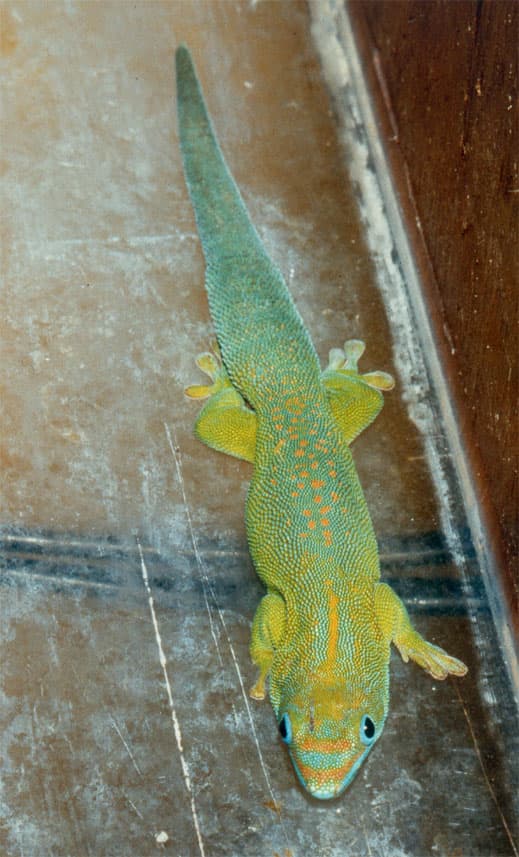
Phelsuma flavigularis
The yellow-throated day gecko (Phelsuma flavigularis) is an endangered, diurnal gecko native to eastern Madagascar's rainforests. This medium-sized species is characterized by its bluish-green body, red snout bars, and a distinctive yellow throat. It primarily inhabits trees and feeds on insects and nectar.

Furcifer balteatus
The Furcifer balteatus, also known as the two-banded chameleon or the rainforest chameleon, is a chameleon species native to southeast Madagascar. It is characterized by its green coloration with darker diagonal stripes and paler bands, often featuring a buff-colored diagonal streak, and males possess distinctive horny projections on their heads. This arboreal species inhabits rainforests at elevations between 800 and 1,050 meters.

Phelsuma seippi
Phelsuma seippi, also known as Seipp's day gecko, is a medium-sized, diurnal lizard native to the rainforests of northern Madagascar. Characterized by its slender, long-snouted body, it exhibits green or yellowish-green coloration with distinctive red or rust-colored spots and markings, including a rust-colored eye stripe and potential v-shaped stripes on the throat. This arboreal species primarily feeds on insects and nectar, and is considered endangered.