
Paroedura bastardi
Least Concern (as of 2011, prior to species complex clarification)·Oviparous
Mocquard's Madagascar ground gecko (Paroedura bastardi) is a moderately-sized lizard endemic to southeastern Madagascar. It is characterized by its tawny brown coloration with scattered grayish spots and lighter crossbands, and a distinctive triangular head. This ground-dwelling species is known to climb tree trunks and can be quick to bite when handled as a defense mechanism.
Key Facts
- ›Endemic to the extreme southeast of Madagascar.
- ›Can reach a snout-to-vent length of approximately 7.1–7.3 cm.
- ›Has a tawny brown body with grayish spots and lighter crossbands.
- ›Possesses enlarged keeled scales on its dorsal surface and spiny tubercles on its tail.
- ›Is oviparous, laying eggs that are buried in substrate.
- ›Known to be quick to bite when handled as a defense mechanism.
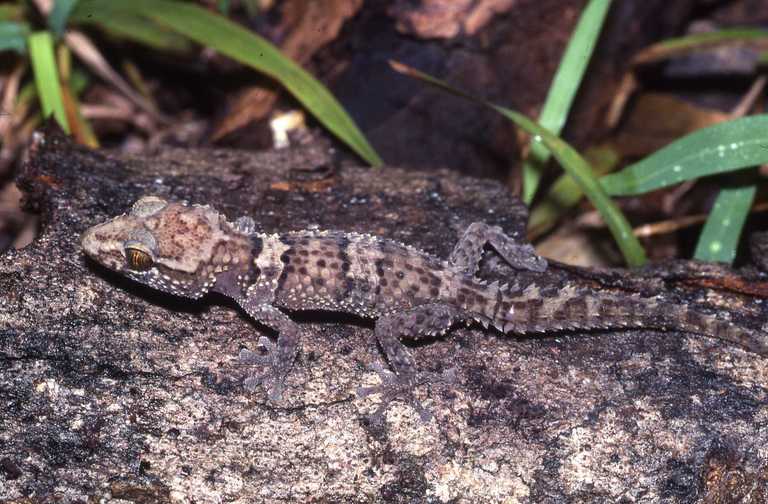
Mocquard's Madagascar Ground Gecko
Madagascar
- Moderately-Sized Reptile Reaching Approximately 7.1–7.3 cm In Snout-To-Vent Length.
- Triangular Head Distinctly Wider Than the Neck.
- Dorsal Surface Features Enlarged Keeled Scales In Longitudinal Rows.
- Tail Has Spiny Tubercles.
- Robust Limbs With Lamellae-Lined Toe Pads.
- Body Coloration Is Tawny Brown With Scattered Grayish Spots and Three Lighter Crossbands.
- Juveniles Have More Prominent White Bands With Dark Borders and A Distinct 'Butterfly Or Bat-Shaped' Head Pattern.
Insects, Other Small Invertebrates
- Terrestrial and Capable of Climbing Tree Trunks.
- Quick To Bite When Handled As A Defense Mechanism.
- Oviparous .
Habitat Loss, International Pet Trade
About Paroedura bastardi
Mocquard's Madagascar Ground Gecko (Paroedura bastardi)
Mocquard's Madagascar ground gecko, scientifically known as Paroedura bastardi, is a reptile species belonging to the Gekkonidae family. This lizard is endemic to the extreme southeastern region of Madagascar. It is a moderately-sized gecko, typically reaching a snout-to-vent length of around 7.1 to 7.3 centimeters.
Physical Characteristics and Habitat
The species is characterized by its tawny brown coloration, adorned with scattered grayish spots and three lighter crossbands, which are more pronounced in younger individuals. It possesses a distinctive triangular head that is wider than its neck, enlarged keeled scales along its dorsal surface, and a tail covered in spiny tubercles. Paroedura bastardi is a terrestrial species, meaning it lives on the ground, but it is also capable of climbing tree trunks in its natural habitat.
Behavior and Reproduction
When handled, Mocquard's Madagascar ground gecko is known for its defensive behavior, often biting quickly. Its reproductive strategy is oviparous, with females laying eggs that are subsequently buried in the substrate. While it may coexist with closely related species, molecular evidence suggests reproductive isolation between them.
Taxonomy and Distribution
Historically, Paroedura bastardi was considered to have a widespread distribution across much of Madagascar. However, recent morphological and genetic analyses have revealed that this definition encompassed a species complex comprising several cryptic species. Consequently, the true range of Paroedura bastardi is now understood to be restricted to the southeastern part of the island, with records from other areas representing distinct lineages.
Conservation Status
In 2011, Paroedura bastardi was listed as Least Concern by the IUCN, largely due to its previously assumed extensive distribution. This assessment was made before the species complex was delineated. While severe habitat loss, driven by deforestation and slash-and-burn agricultural practices, significantly impacts related species in Madagascar, the direct effects on Paroedura bastardi are not yet definitively confirmed. The species is also known to be collected for the international pet trade, though the extent of this impact has not been fully assessed.
Source: Wikipedia ↗
Frequently Asked Questions
What is the scientific name for Mocquard's Madagascar ground gecko?
The scientific name for Mocquard's Madagascar ground gecko is Paroedura bastardi. It was first described by François Mocquard in 1900 under the scientific name Phyllodactylus bastardi.
Where is Paroedura bastardi found?
Paroedura bastardi, in the strict sense, is known only from the extreme southeast of Madagascar. Older classifications mistakenly included populations from across much of western and southern Madagascar, which are now recognized as distinct cryptic species.
What does Paroedura bastardi look like?
This gecko is moderately-sized, reaching about 7 cm in snout-to-vent length. It has a triangular head, enlarged keeled scales on its back, and a tail with spiny tubercles. Its coloration is tawny brown with scattered grayish spots and three lighter crossbands, which are more prominent in juveniles.
How does Paroedura bastardi behave?
It is a terrestrial species that can also climb tree trunks. When handled, it is known to be quick to bite as a defense mechanism. It reproduces by laying eggs, which the female buries in the substrate.
Is Paroedura bastardi endangered?
Historically, it was assessed as Least Concern due to a presumed wide distribution. However, with the recognition of the species complex, its actual range is now known to be more restricted. While habitat loss is a threat to related species, it is not yet confirmed that Paroedura bastardi itself is negatively affected or declining.
What is the conservation status of Paroedura bastardi?
The IUCN listed Paroedura bastardi as Least Concern in 2011. This assessment predates the clarification of the species complex, and its range is now understood to be more limited. Current confirmed impacts on this specific species are not detailed.
Related Lizards

Brown anole
The brown anole (Anolis sagrei) is a small to medium-sized lizard native to Cuba and surrounding islands, known for its light brown coloration and ability to change shades. It is a highly invasive species, particularly in the United States, where it outcompetes and consumes native lizards. The brown anole primarily inhabits the ground and low vegetation in urban and suburban areas.

Chamaeleonidae
Chamaeleonidae, commonly known as chameleons, are a family of Old World lizards renowned for their distinctive color-shifting abilities, used for camouflage and social signaling. They possess specialized zygodactylous feet, prehensile tails, and independently mobile eyes, along with projectile tongues for capturing prey. These diurnal reptiles inhabit diverse environments across Africa, Madagascar, southern Europe, and southern Asia, ranging from rainforests to deserts.

Rhampholeon spectrum
The spectral pygmy chameleon (Rhampholeon spectrum), also known as the western pygmy chameleon or Cameroon stumptail chameleon, is a small "dwarf" or "leaf" chameleon found in forested areas of mainland Africa. They are characterized by their small size, reaching no more than 10 cm, short prehensile tails, and a tendency to frequent the ground and low shrubbery. While capable of color change, they typically display somber shades of tan to gray, though they can exhibit striking streaks and blotches.