
Petrosaurus mearnsi
Petrosaurus mearnsi, commonly known as the banded rock lizard, is a distinctive, flat-bodied lizard native to the arid regions of southern California and Baja California, Mexico. Its coloration typically includes olive, brown, or gray with white or bluish spots, a prominent black collar, and a banded tail. This omnivorous species is often found in rocky areas and chaparral, feeding on insects, spiders, buds, and flowers.
Key Facts
- ›Endemic to extreme southern California and Baja California, Mexico.
- ›Characterized by a very flat body and olive, brown, or gray coloration with white/bluish spots.
- ›Possesses a single black collar and a banded tail.
- ›Omnivorous diet includes insects, spiders, buds, and flowers.
- ›Gravid females lay between 2 and 6 eggs from June to August.
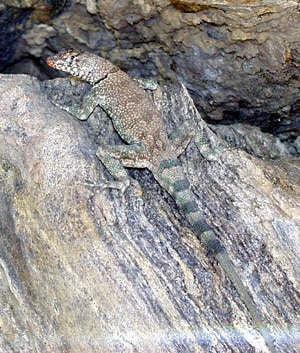
Banded Rock Lizard, Mearns' Rock Lizard
Extreme Southern California, Baja California, Mexico, Isla El Muerto
Boulder Hillsides, Chaparral, Pinyon-Juniper Woodlands
- Extremely Flat-Bodied Lizard.
- Dorsum Is Olive, Brown, Or Gray With White Or Bluish Spots.
- Has A Single Black Collar.
- Possesses A Banded Tail.
- Granular Scales On the Body, With Keeled Tail and Limb Scales.
- Snout-To-Vent Length Ranges From 6.2–8.7 cm .
- Males Have More Pronounced Throat Patterns and Brighter Blue Coloring Than Females.
Insects, Spiders, Buds, Flowers
Not Specified In Text
About Petrosaurus mearnsi
Petrosaurus mearnsi: The Banded Rock Lizard
Petrosaurus mearnsi, also known as the banded rock lizard or Mearns' rock lizard, is a species of lizard belonging to the family Phrynosomatidae. This species is endemic to the extreme southern regions of California in the United States and extends into Baja California, Mexico, also occurring on Isla El Muerto. The lizard is named in honor of American naturalist Edgar Alexander Mearns, who collected some of the earliest specimens.
Physical Characteristics and Habitat
The banded rock lizard is distinguished by its remarkably flat body. Its dorsal coloration typically ranges from olive, brown, to gray, often adorned with white or bluish spots. Key features include a distinct single black collar and a tail marked with bands. The scales on its body are granular, while those on its tail and limbs are keeled. Adult individuals generally measure between 6.2 and 8.7 centimeters in snout-to-vent length. Males are notable for exhibiting more pronounced throat patterns and brighter blue coloration compared to females.
Petrosaurus mearnsi is primarily associated with boulder-strewn hillsides. In Baja California, its habitat preference broadens to include chaparral and pinyon-juniper woodlands, indicating an adaptation to arid and semi-arid environments.
Diet and Reproduction
As an omnivorous species, Petrosaurus mearnsi sustains itself on a varied diet. This includes animal prey such as insects and spiders, supplemented by botanical matter like buds and flowers. The reproductive cycle sees gravid females laying eggs between June and August. The number of eggs in a clutch typically ranges from 2 to 6.
Source: Wikipedia ↗
Frequently Asked Questions
What is another common name for Petrosaurus mearnsi?
Petrosaurus mearnsi is also commonly referred to as the banded rock lizard or Mearns' rock lizard. These names reflect its appearance and the naturalist it was named after.
Where can Petrosaurus mearnsi be found?
This species is native to extreme southern California in the United States and Baja California in Mexico. It has also been recorded on Isla El Muerto.
What kind of habitat does the banded rock lizard prefer?
The banded rock lizard is typically found in boulder hillsides. In Baja California, its habitat can extend to chaparral and pinyon-juniper woodlands.
What does Petrosaurus mearnsi eat?
Petrosaurus mearnsi has an omnivorous diet. It consumes insects and spiders, as well as plant matter such as buds and flowers.
When do female banded rock lizards lay their eggs?
Gravid females of Petrosaurus mearnsi lay their eggs during the months of June through August. Each clutch typically contains between 2 and 6 eggs.
Are there any notable physical characteristics of this lizard?
Yes, Petrosaurus mearnsi is known for its extremely flat body. It has an olive, brown, or gray dorsum with white or bluish spots, a black collar, and a banded tail. Males tend to have more noticeable throat patterns and brighter blue coloration than females.
Related Lizards
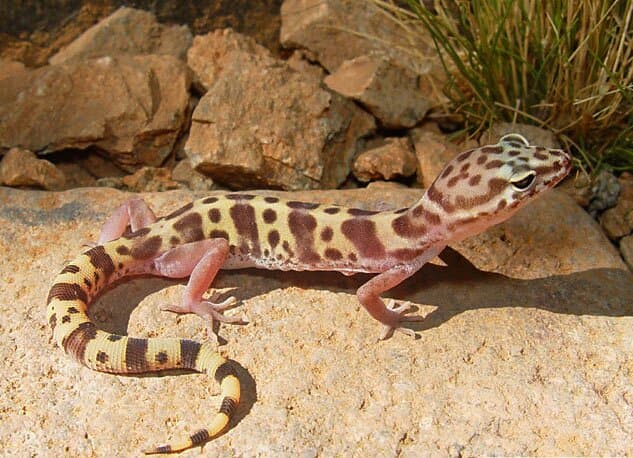
Coleonyx variegatus
The western banded gecko (Coleonyx variegatus) is a small, terrestrial lizard native to the southwestern United States and northwestern Mexico. It is characterized by its sandy coloration with dark crossbands, silky skin texture, and prominent eyes with movable lids. This nocturnal species inhabits arid deserts, woodlands, and grasslands, preying on invertebrates and occasionally small scorpions.

Sceloporus magister
The Sceloporus magister, commonly known as the desert spiny lizard, is a species found in the Chihuahuan and Sonoran Deserts of North America. Adult males display striking blue/violet patches on their underside, while females and juveniles have less vibrant coloring. This lizard is primarily arboreal and known for its thermoregulatory behavior of changing skin color.

Tiger whiptail
The western whiptail is a lizard species found across the southwestern United States and northern Mexico, inhabiting diverse arid and semi-arid environments. Characterized by its long, slender body, small grainy back scales, and larger belly scales, it often displays light stripes and a pinkish or orange throat. This species is known for its unique tail-dropping defense mechanism and its bisexual reproduction, unlike many of its all-female relatives.