
Phelsuma serraticauda
The flat-tailed day gecko (Phelsuma serraticauda) is a diurnal lizard native to the rainforests of eastern Madagascar. This species is characterized by its dark green or yellowish-green coloration and a distinctive broad, flattened tail with serrated edges. It faces endangerment primarily due to illegal collection for the international pet trade.
Key Facts
- ›Found exclusively on the east coast of Madagascar, near Toamasina.
- ›Distinctive features include a broad, flattened tail with serrated edges and red tear-shaped markings on the lower back.
- ›Inhabits rainforests, primarily dwelling on coconut palms and banana trees.
- ›Feeds on insects, invertebrates, soft fruits, pollen, and nectar.
- ›Lives in social groups consisting of one male and up to five females with a dominance hierarchy.
- ›Endangered due to illegal collection for the international pet trade.
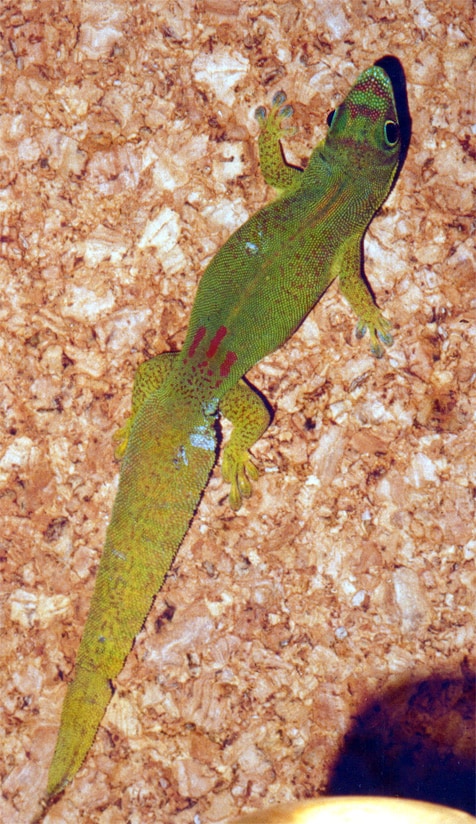
Flat-Tailed Day Gecko
Madagascar
- Average Total Length of About 13 cm, With Males Potentially Reaching 15 cm.
- Females Are Slightly Smaller Than Males.
- Body Coloration Is Dark Green Or Yellowish Green.
- Possesses A Broad, Flattened Tail With Serrated Edges.
- Three Red Tear-Shaped Markings On the Lower Back.
- Two Longitudinal Yellow Stripes On the Neck, Which May Appear Bluish.
- Three Transversal Red Bars On the Snout and Head.
Insects, Invertebrates, Soft Fruits, Pollen, Nectar
- Diurnal
- Lives In Groups With One Male and Up To Five Females
- Well-Developed Dominance Hierarchy Among Females
- Juveniles Are Tolerated Up To A Certain Size
- Illegal Collection For the International Pet Trade
About Phelsuma serraticauda
The Flat-Tailed Day Gecko: A Unique Reptile of Madagascar
The flat-tailed day gecko, scientifically known as Phelsuma serraticauda, is a striking diurnal lizard native to the eastern rainforests of Madagascar. Its most distinctive physical characteristic is its broad, flattened tail, which features serrated edges, setting it apart from many other gecko species. The gecko's body is typically a vibrant dark green or yellowish-green, often marked with three red, tear-shaped spots on its lower back and transverse red bars on its head.
Habitat and Distribution
This species is highly localized, with its known range confined to the east coast of Madagascar, specifically in the area approximately 12 kilometers north of Toamasina. The flat-tailed day gecko primarily inhabits arboreal environments, showing a strong preference for coconut palms and also being found on banana trees within its rainforest habitat.
Diet and Behavior
The diet of Phelsuma serraticauda is varied, encompassing insects and other invertebrates, alongside a liking for soft, sweet fruits, nectar, and pollen. Behaviorally, these geckos are social creatures, often found living in groups. These groups typically consist of one male and up to five females, among whom a distinct dominance hierarchy is maintained. Juveniles are generally tolerated within the group until they reach a certain size.
Reproduction and Conservation
Reproductively, females can lay up to four pairs of eggs per year. Under optimal conditions of 28°C, the incubation period lasts approximately 53 to 58 days, with hatchlings measuring around 40 mm in length. Unfortunately, the flat-tailed day gecko is classified as endangered. This precarious status is largely due to the detrimental impact of illegal collection for the international pet trade, which significantly threatens its wild populations.
Source: Wikipedia ↗
Frequently Asked Questions
What are the key physical characteristics of the flat-tailed day gecko?
The flat-tailed day gecko typically measures around 13 cm in total length, with females being slightly smaller. It has a dark green or yellowish-green body. Its most remarkable feature is a broad, flattened tail with serrated edges. Red, tear-shaped markings are present on the lower back, and longitudinal yellow stripes run along the neck, which may appear bluish. The snout and head are adorned with three transversal red bars.
Where is the flat-tailed day gecko found?
This species is geographically restricted to the east coast of Madagascar. It is specifically known from a region approximately 12 kilometers north of Toamasina.
What kind of habitat does the flat-tailed day gecko prefer?
The flat-tailed day gecko is largely found on coconut palms. It can also be observed inhabiting banana trees within its rainforest environment.
What does the flat-tailed day gecko eat?
The diet of these day geckos consists of various insects and other invertebrates. They also show a preference for licking soft, sweet fruits, pollen, and nectar.
How do flat-tailed day geckos interact socially?
This species exhibits social behavior, living in groups composed of one male and as many as five females. Within these female groups, a well-developed dominance hierarchy is established. Juveniles are tolerated within the group up to a certain size.
How does reproduction occur in Phelsuma serraticauda?
Female flat-tailed day geckos can lay up to four pairs of eggs annually. If kept at a temperature of 28 °C, the young geckos typically hatch after about 53 to 58 days. The newly hatched juveniles measure approximately 40 mm in length.
What is the conservation status of the flat-tailed day gecko?
The flat-tailed day gecko is considered endangered. This status is largely attributed to illegal collection for the international pet trade, which poses a significant threat to its wild populations.
Related Lizards
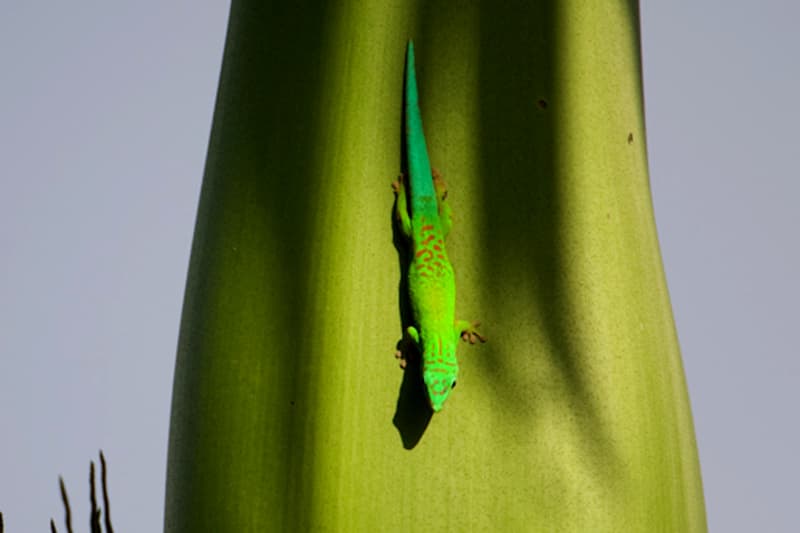
Andaman day gecko
The Andaman day gecko is a small, slender lizard endemic to the Andaman Islands of India, recently introduced to the Nicobar Islands. It is characterized by its bright green coloration, red dots and stripes on its back, and a reddish-brown stripe from its nostrils to its ears. This generalist species thrives in domestic gardens and on various plants, demonstrating a rare benefit from human-induced environmental changes.
Phelsuma andamanense
The Andaman day gecko (Phelsuma andamanensis) is a small, slender lizard endemic to the Andaman Islands of India, with a recent introduction to the Nicobar Islands. It is characterized by its bright green coloration, often adorned with red dots and stripes, and its generalist habitat preference, thriving in domestic gardens and on various plants. This species is known for its shy yet aggressive behavior towards its own kind.
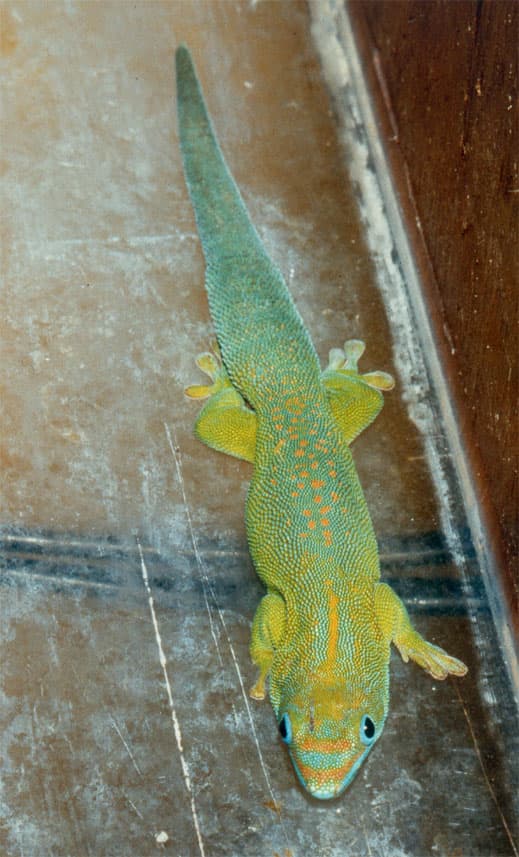
Phelsuma flavigularis
The yellow-throated day gecko (Phelsuma flavigularis) is an endangered, diurnal gecko native to eastern Madagascar's rainforests. This medium-sized species is characterized by its bluish-green body, red snout bars, and a distinctive yellow throat. It primarily inhabits trees and feeds on insects and nectar.