
Plestiodon fasciatus
Special Concern (Great Lakes - St. Lawrence population in Ontario/Canada); Endangered (Carolinian population in Ontario/Canada)·Oviparous (egg-laying)
The American five-lined skink (Plestiodon fasciatus) is a common lizard species found throughout eastern North America. Juveniles are characterized by a dark body with five distinct stripes and a bright blue tail, which fades with age. This skink is a ground-dwelling species that prefers moist hardwood areas and is known for its complex social behaviors and dedicated maternal care of eggs.
Key Facts
- ›Found in eastern North America, it is one of the most common lizards in the Eastern United States.
- ›Juveniles have a dark body with five white or yellowish stripes and a bright blue tail, which adults may lose.
- ›Females exhibit significant parental care, brooding and protecting their eggs.
- ›Their diet consists mainly of arthropods, but they may also consume small vertebrates and fruits.
- ›The Great Lakes - St. Lawrence population in Canada is listed as 'special concern' and 'endangered' respectively.
- ›Can live for 5-10 years in captivity with adequate care.

American Five-Lined Skink, Blue-Tailed Skink, Red-Headed Skink
North America, Eastern United States, Canada, Colombia
Moist Hardwood Forests, Areas With Permanent Water Sources, Broken, Rocky Areas, Under Logs, Rocks, and Leaf Litter
- Small To Medium-Sized Lizard, Total Length 12.5 To 21.5 cm .
- Juveniles: Dark Brown To Black With Five White To Yellowish Stripes and A Bright Blue Tail.
- Adults: Blue Tail Color Fades, Stripes May Disappear, Overall Color Becomes Brownish.
- Females More Likely To Retain Blue Tail Color With Age.
- Males May Be Larger Than Females and Develop A Swollen Red Head.
- Claws Are Short and Curved Downward, Forming A Right Angle At the Axis of Each Toe.
Arthropods, Newborn Mice, Frogs, Other Lizards, Fruits, Vegetables
- Ground-Dwelling
- Adult Males Defend Territories Against Other Males.
- Blue Tail Coloration May Serve As Intraspecific Communication To Prevent Attacks.
- Juveniles Show Aggressive Behavior Towards Other Juveniles At Close Range.
- Utilize Vomeronasal Analysis and Visual Cues For Sex Identification.
- Females Exhibit High Levels of Parental Care: Brooding, Guarding, Nest Defense, and Egg Retrieval.
- Employ Tail Autotomy As An Antipredation Mechanism.
- Biting As A Defensive Strategy.
Snakes, Crows, Hawks, Shrews, Moles, Opossums, Skunks, Raccoons, Domestic Cats
Habitat Disturbance, Collection For Pet Trade, Edge Habitat Vulnerability
About Plestiodon fasciatus
American Five-Lined Skink (Plestiodon fasciatus)
The American five-lined skink, scientifically known as Plestiodon fasciatus, is a widely distributed and common lizard species found throughout eastern North America. It is a familiar sight in the Eastern United States and is one of the few native lizard species in Canada.
Description and Appearance
This species is characterized by its distinct coloration, which changes significantly from youth to adulthood. Young skinks are typically dark brown to black with five prominent white or yellowish stripes running along their body and a strikingly bright blue tail. As they mature, the blue hue of the tail often fades to a lighter shade, and the body stripes may become less apparent or disappear entirely. Older individuals are generally a uniform brownish color, though females are more likely to retain some blue on their tails. Adult males of the species can sometimes be distinguished by their larger size and a noticeably swollen, reddish head.
Habitat and Distribution
The American five-lined skink is primarily a ground-dwelling species that thrives in moist, hardwood environments. It prefers areas with consistent water sources, such as rivers or streams, and readily utilizes sites where it can bask in the sun. At the northern edges of its range, the skink can also be found in broken, rocky terrains. They are known to shelter in cavities beneath decaying logs, stumps, loose bark, rocks, or abandoned rodent burrows, especially during winter months when they are presumed to be dormant.
Diet and Behavior
The diet of Plestiodon fasciatus predominantly consists of various arthropods, including spiders, crickets, and beetles. However, they are opportunistic feeders and have been observed consuming small vertebrates like newborn mice, frogs, and other lizards. Captive care often involves supplementing their diet with fruits and vegetables. Behaviorally, the species exhibits complex social interactions. Adult males are territorial and defend their space against other males, with juvenile blue tails possibly serving as a signal to mitigate aggression. Females are known for their dedicated maternal care, brooding their eggs and protecting them from predators. When threatened, these skinks can detach their tails as a defense mechanism, a process known as autotomy, which distracts predators while the skink escapes.
Source: Wikipedia ↗
Frequently Asked Questions
What are the common names for Plestiodon fasciatus?
Plestiodon fasciatus is commonly known as the American five-lined skink. It is also referred to as the blue-tailed skink when young, and the red-headed skink in its adult phase. These names help distinguish it from similar species and highlight its changing appearance.
What does the American five-lined skink look like?
Adults typically measure between 12.5 to 21.5 cm in total length. Young skinks are dark brown to black with five prominent stripes and a vibrant blue tail. As they mature, the blue tail color and stripes often fade, and older individuals are usually uniformly brownish. Adult males can develop a reddish head.
Where does the American five-lined skink live?
This species is native to North America, with its range extending from southern Ontario in Canada down to Florida and Texas in the United States. It is abundant in the southeastern United States, particularly along the coast, and has also been observed as far south as Colombia.
What is the habitat of the American five-lined skink?
American five-lined skinks are ground-dwelling and prefer moist hardwood environments with access to water sources like rivers or streams. They also require basking sites and can be found in rocky areas at the northern limits of their range. They often shelter under rocks, logs, or leaf litter, especially during colder months.
What do American five-lined skinks eat?
Their diet primarily consists of a variety of arthropods, including spiders, crickets, and beetles. They have also been known to eat small prey such as newborn mice, frogs, and other lizards. Captive individuals may benefit from supplements of fruits and vegetables.
How do American five-lined skinks reproduce?
Reproduction involves internal fertilization, with females laying 15 to 18 eggs in secluded cavities beneath logs, stumps, or in abandoned burrows. Females exhibit significant parental care, brooding the eggs for 24 to 55 days and defending them against predators. Young skinks become sexually mature within two to three years.
What are the conservation concerns for this species?
The population in the Great Lakes - St. Lawrence region of Canada faces conservation challenges, with specific populations listed as 'special concern' and 'endangered.' These areas represent the extreme edge of the species' habitat, making them particularly vulnerable to environmental changes.
Are American five-lined skinks venomous?
No, American five-lined skinks are not venomous. While they may bite defensively, their bite is not medically significant to humans.
Related Lizards

Gray's spiny-tailed iguana
Gray's spiny-tailed iguana, also known as the black iguana, is a sizable iguanid lizard native to Mexico and Central America. It is characterized by its distinctive black, keeled scales on its tail and a crest of spines running down its back. Primarily herbivorous, these diurnal lizards inhabit rocky areas with nearby trees and are known for their remarkable speed.

Italian wall lizard
The Italian wall lizard (Podarcis siculus), also known as the ruin lizard, is a common and adaptable lizard native to southern and southeastern Europe. It is characterized by a green or brown back and a white or green belly, with variations across its numerous subspecies. This species is a habitat and dietary generalist, capable of thriving in diverse environments and consuming a wide range of invertebrates and plant matter, contributing to its extensive geographic distribution.
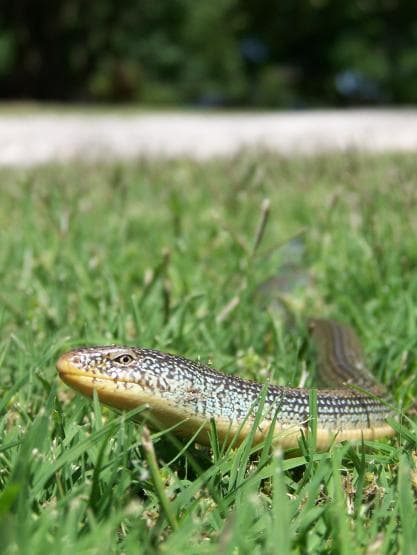
Ophisaurus ventralis
The eastern glass lizard (Ophisaurus ventralis) is a species of legless lizard endemic to the Southeastern United States, often mistaken for a snake due to its lack of limbs. It is characterized by its streamlined body, moveable eyelids, external ear openings, and a lateral groove separating its scales. This species inhabits wetlands, moist flatwoods, and even coastal dunes, and is known for its opportunistic diet and remarkable tail autotomy defense mechanism.