
Italian wall lizard
The Italian wall lizard (Podarcis siculus), also known as the ruin lizard, is a common and adaptable lizard native to southern and southeastern Europe. It is characterized by a green or brown back and a white or green belly, with variations across its numerous subspecies. This species is a habitat and dietary generalist, capable of thriving in diverse environments and consuming a wide range of invertebrates and plant matter, contributing to its extensive geographic distribution.
Key Facts
- ›Native to southern and southeastern Europe, with introductions elsewhere including North America.
- ›Possesses a generally green or brown back and a white or green belly, with significant subspecies variation.
- ›A habitat and dietary generalist, consuming invertebrates, small vertebrates, and a notable amount of plant matter.
- ›Oviparous, with females laying 3-4 clutches of 4-7 eggs per year.
- ›Known for rapid adaptation and evolution, with distinct subspecies evolving quickly under geographic isolation.
- ›Males typically have larger heads and stronger jaws than females.

Ruin Lizard
Italy, Bosnia and Herzegovina, Croatia, France, Montenegro, Serbia, Slovenia, Switzerland, Spain, Turkey, United States, Canada
- Snout-Vent Length Averages 150–250 mm .
- Generally Has A Green Or Brown Back and A White Or Green Belly.
- Coloration and Size Vary Significantly Among Subspecies.
- Some Island Subspecies Are Melanic, With Parts of the Back and Belly Showing Hints of Blue.
- Males Possess Larger Heads and Stronger Jaws Than Females, A Trait Linked To Diet and Aggression.
Invertebrates, Small Vertebrates, Plant Matter, Mechanically Resistant Foods, Occasional Cannibalism, Carrion
- Habitat Generalist, Thriving In Diverse Environments.
- Exhibit Rapid Adaptation To Environmental Pressures.
- Males Are More Aggressive and Have A More Diverse Diet Than Females.
- Can Learn Various Tasks and Engage In Social Learning.
- Possess Anti-Predatory Behaviors, Including Detecting Chemical Cues and Modifying Movement.
- Gravid Females Balance Predation Threat With Thermoregulatory Needs For Embryo Development.
- High Incidence of Missing Toes In Some Populations Suggests Intraspecific Competition and Aggression.
Snakes, Birds, Feral Cats
- Competition With Introduced Species
- Potential Invasive Species Status In North America
About Italian wall lizard
The Italian wall lizard, scientifically known as Podarcis siculus and sometimes referred to as the ruin lizard, is a highly adaptable species of lizard native to southern and southeastern Europe. Its remarkable ability to thrive in both natural and human-modified environments, coupled with a generalized diet, has contributed to its extensive range, which includes introductions to other parts of Europe and North America.
Physical Characteristics and Variation
Italian wall lizards generally exhibit a green or brown back and a white or green belly. However, significant variation exists across its numerous subspecies, with some populations displaying melanic coloration featuring hints of blue. Males are distinguished by larger heads and stronger jaws compared to females. The snout-to-vent length typically ranges from 150 to 250 mm (5.9 to 9.8 inches).
Habitat and Diet
This species is a habitat generalist, found in diverse environments such as forests, grasslands, shrublands, rocky areas, and farmland. Its diet is equally generalized, consisting of a wide array of invertebrates, small vertebrates, and a notable proportion of plant matter, particularly in island populations. This dietary flexibility allows it to exploit various ecological niches.
Reproduction and Evolution
The Italian wall lizard is oviparous, with females laying 3 to 4 clutches of 4 to 7 eggs annually. The species is renowned for its capacity for rapid evolution and adaptation. Studies have documented distinct morphological and behavioral changes in subspecies that have become geographically isolated, demonstrating how quickly new traits can emerge in response to environmental pressures.
Behavior and Adaptations
Italian wall lizards display complex behaviors, including learning capabilities and social learning. They possess sophisticated anti-predatory strategies, responding to chemical cues from predators and modifying their behavior accordingly. Aggression, particularly among males, is observed, with high rates of missing toes in some populations suggesting intense intraspecific competition. The species also demonstrates its adaptive prowess through the evolution of novel features, such as cecal valves that aid in digesting plant matter, a trait rarely seen in scaled reptiles.
Source: Wikipedia ↗
Frequently Asked Questions
What is the Italian wall lizard's scientific name and family?
The Italian wall lizard's scientific name is Podarcis siculus. It belongs to the family Lacertidae.
Where is the Italian wall lizard found naturally?
The Italian wall lizard is native to Italy and its range includes Bosnia and Herzegovina, Croatia, France, Montenegro, Serbia, Slovenia, and Switzerland. It has also been introduced to other regions.
What does the Italian wall lizard eat?
This lizard has a generalized diet that includes a wide variety of invertebrates, such as arthropods, and also small vertebrates. Plant matter constitutes a larger portion of its diet compared to related lizards.
How does the Italian wall lizard reproduce?
The Italian wall lizard is oviparous, meaning females lay eggs. They typically lay 3 to 4 clutches per year, with each clutch containing 4 to 7 eggs.
Are there different types of Italian wall lizards?
Yes, the Italian wall lizard is notable for having many subspecies, with over 50 described. These subspecies can exhibit distinct morphological and behavioral differences due to geographic isolation and rapid evolution.
What are the physical characteristics of the Italian wall lizard?
Generally, it has a green or brown back and a white or green belly. Snout-to-vent length averages between 150–250 mm (5.9–9.8 in). Some island populations can exhibit melanic coloration with hints of blue.
What are the main predators of the Italian wall lizard?
Common predators of the Italian wall lizard include snakes, birds, and feral cats.
Does the Italian wall lizard exhibit rapid evolution?
Yes, studies have shown that Italian wall lizard subspecies can become distinguishable very rapidly, with distinct morphological and behavioral changes observed in populations experiencing geographic isolation. This rapid adaptation is a key characteristic of the species.
Related Lizards

Podarcis siculus
The Italian wall lizard, or Podarcis siculus, is a common lizard species native to southern and southeastern Europe, known for its adaptability to various environments, from natural habitats to human-modified landscapes. It exhibits significant subspecies variation, often displaying a green or brown back with a white or green belly, and males can be distinguished by larger heads and stronger jaws. This species is oviparous, laying multiple clutches of eggs annually, and its generalized diet contributes to its widespread distribution and success.

Trioceros cristatus
The crested chameleon (Trioceros cristatus) is a species native to Central African forests and semi-open wooded areas. Females are typically larger than males, reaching up to 28 cm in total length. This species is currently classified as Least Concern by the IUCN due to its widespread distribution and ability to tolerate disturbed habitats.
Chalcides ocellatus
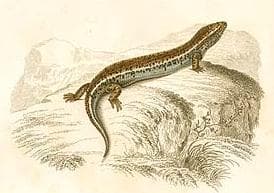
The ocellated skink, scientifically known as Chalcides ocellatus, is a agile lizard species found across the Mediterranean and parts of Asia. Adults typically reach 15 to 30 cm in length and are characterized by their cylindrical bodies, small heads, and distinctive ocelli (eye-like spots) which contribute to a wide variety of coloration patterns. Primarily insectivorous, they inhabit diverse environments from farmland to gravel deserts and are known for their 'sand-swimming' ability, though their limbs are not highly adapted for burrowing.