
Plestiodon skiltonianus
The western skink (Plestiodon skiltonianus) is a small, agile lizard characterized by its smooth scales and distinctive striped coloration. It inhabits a variety of open habitats across western North America, from sea level to high elevations. Known for its secretive nature and defensive tail-dropping ability, this diurnal reptile plays a role in controlling invertebrate populations.
Key Facts
- ›Measures between 100 to 210 mm in total length.
- ›Features a broad brown back stripe edged with black, bordered by pale dorsolateral stripes.
- ›Juveniles possess bright blue tails that turn grey in adulthood.
- ›Found in diverse habitats from sea level to 2,130 m, preferring open areas over dense forests.
- ›Diet primarily consists of spiders and various insects.
- ›Females exhibit parental care, guarding their nests until the young hatch.
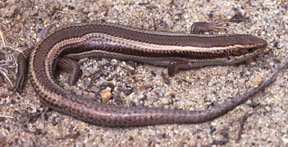
Western Skink, Skilton's Skink
Southern British Columbia, Canada, Washington, Oregon, Nevada, Utah, Idaho, Wyoming, Western Montana, Northern Arizona, Missouri, Texas, Northern California, Central California, Southern California, Baja California, Mexico
Grassland, Broken Chaparral, PiñOn-Juniper Woodland, Juniper-Sage Woodland, Open Pine-Oak Forest, Open Pine Forest, Early Successional Stages, Open Areas
- Small, Smooth-Scaled Lizard With Relatively Small Limbs.
- Total Length Ranges From 100 To 210 mm .
- Adults Have A Broad Brown Stripe Down the Back, Edged With Black.
- Dorsolateral Stripes Are Conspicuous, Whitish To Beige, Extending From the Nose To the Tail.
- A Second Pale Stripe Starts On the Upper Jaw, Low On the Sides.
- A Broad Dark Brown Or Black Band Originates On the Side of the Head, Separated From the Dorsolateral Stripe.
- Juveniles Have Bright Blue Tails That Turn Grey In Adulthood.
- Breeding Season May Show Reddish Or Orange Coloration On the Side of the Head, Chin, and Occasionally the Tail.
- Usually Possesses Seven Supralabial Scales and Four Enlarged Nuchals.
- Young Skinks Have More Vivid Coloration Than Adults.
Spiders, Beetles, Crickets, Moths, Grasshoppers, Other Arthropods, Sow Bugs
- Secretive and Agile
- Forages Actively Through Leaf Litter and Dense Vegetation
- Stalks Prey
- Cannibalism Has Been Reported
- Good Burrower, Constructing Burrows Several Times Its Body Length
- Females Exhibit Parental Care, Guarding Nests
- Defends Nests From Predators
- Repairs Nests
- Basks To Regulate Nest Temperature
- Diurnal Activity During Warm Seasons
- Activity Concentrated In Morning and Late Afternoon
- Juveniles Extend Activity Period Longer Than Adults
- Hibernates Communally In Dens
- Drops Tail When Seized By A Predator
- May Play Dead, Though Rarely Observed
Night Snakes, Striped Whipsnakes, Raptors, Black Bear Cubs, Bobcats, Coyotes, Gray Foxes, Red Foxes, Swift Foxes, Least Weasels, Pumas, Domestic Cats, Feral Cats, Domestic Dogs, Feral Dogs, Carnivorous Birds, Cooper's Hawk, Harris Hawks, Kestrels, Red-Tailed Hawks, Shrikes, Kingsnakes, Other Reptile-Consuming Squamates
About Plestiodon skiltonianus
Western Skink (Plestiodon skiltonianus)
The western skink, scientifically known as Plestiodon skiltonianus, is a small, agile lizard recognized by its smooth scales and distinctive striped pattern. It is one of seven lizard species found in Canada and is common throughout much of western North America. These diurnal reptiles are active during the warmer months, often seen basking in the sun.
Habitat and Distribution
Western skinks are found in a variety of habitats, ranging from sea level up to approximately 2,130 meters (7,000 feet). They are most prevalent in early successional or open areas within late successional stages, generally avoiding dense forests and heavy brush. Their habitat preferences include grasslands, chaparral, and open woodlands. The species' range extends from southern British Columbia, Canada, south through the western United States to Baja California, Mexico, and across the Great Basin.
Physical Characteristics and Diet
Adult western skinks typically measure between 100 to 210 mm (about 4 to 8.25 inches) in total length. Their coloration features a broad brown stripe down the back, edged with black, and bordered by conspicuous whitish or beige dorsolateral stripes. Juveniles are notable for their bright blue tails, which fade to grey in adulthood. During the breeding season, reddish or orange hues may appear on their heads and chins. Their diet consists primarily of small invertebrates, including spiders, beetles, crickets, and other insects.
Behavior and Reproduction
Western skinks are secretive and quick, foraging through leaf litter and vegetation. They are capable burrowers and exhibit parental care, with females guarding their nests until the young hatch. A key defensive behavior is autotomy, where they can shed their tail to distract predators, allowing for escape. Reproduction involves females laying 2 to 6 eggs in June or July, with hatching occurring in July or August. Western skinks reach sexual maturity around three years of age and can live for up to nine years.
Source: Wikipedia ↗
Frequently Asked Questions
What is the scientific name for the western skink?
The scientific name for the western skink is Plestiodon skiltonianus. It was first described by Baird and Girard in 1852 and named in honor of Dr. Avery Judd Skilton.
What does the western skink look like?
Adult western skinks have a broad brown stripe down their backs, bordered by conspicuous whitish or beige dorsolateral stripes. Young skinks are notable for their bright blue tails, which fade to grey with age. Reddish or orange coloration may appear on the head and chin during the breeding season.
Where does the western skink live?
The western skink's range extends from southern British Columbia, Canada, south to the tip of the Baja California Peninsula. It is found throughout the Great Basin and into northern Arizona, and along the Pacific Coast, though it avoids certain inland valleys and deserts in California.
What is the habitat of the western skink?
This lizard is found in a variety of habitats, most commonly in early successional stages or open areas within late successional stages. They generally avoid heavy brush and densely forested areas, preferring grasslands, chaparral, and open pine-oak or pine forests, often in somewhat moist environments.
What do western skinks eat?
The diet of the western skink is varied and includes small invertebrates. They are known to prey on spiders, beetles, crickets, moths, grasshoppers, and other arthropods. Cannibalism has also been reported.
How do western skinks defend themselves?
When threatened, western skinks are agile and will flee. If grasped, they may bite. A notable defense mechanism is autotomy, where they can shed their tail to distract predators, allowing them to escape. They may also play dead, though this is rarely observed.
What is the lifespan and reproduction of the western skink?
Western skinks reach sexual maturity around 3 years of age and can live up to 9 years. Females lay 2 to 6 eggs in June and July, which hatch in July and August. The female guards the nest diligently until the young emerge.
Related Lizards

Western skink
The Western skink is a small, agile lizard known for its smooth scales and distinctive striped coloration. It inhabits a variety of open habitats across western North America, from sea level to high elevations. This diurnal reptile is an active forager, preying on small invertebrates, and exhibits complex parental care for its eggs.

Ablepharus
Ablepharus, commonly known as snake-eyed skinks, are small lizards distinguished by fused eyelids that prevent blinking, similar to snakes. They inhabit dry fields, hills, and rocky areas, often concealed within leaf litter. These skinks possess shiny, bronze scales and a characteristic dark stripe along their sides, feeding primarily on small insects and mollusks.

Ctenotus robustus
The Ctenotus robustus, commonly known as the eastern striped skink, is a large, fast-moving skink native to Australia. It is characterized by a distinctive white-edged black stripe running down its back and tail, set against a brown background with broader brown stripes and rows of white spots on its sides. This diurnal reptile prefers open habitats with available shelter and is widely distributed across various Australian states.