
Podarcis
Podarcis, commonly known as wall lizards, are a genus of reptiles belonging to the Lacertidae family. Historically grouped with the genus Lacerta, they are distinguished by specific cranial and hemipenial structures, as well as caudal vertebral processes. These lizards are primarily found across Europe and North Africa, with a significant concentration in the Mediterranean region, and are known for their ecological similarities to Lacerta species.
Key Facts
- ›Podarcis lizards are characterized by distinct skull and hemipenis structures compared to the genus Lacerta.
- ›They are native to Europe and northern Africa, with most species concentrated in the Mediterranean.
- ›The genus diversified and hybridized during the Messinian salinity crisis.
- ›Some species, like the Italian and common wall lizards, have been introduced to North America.
- ›Wall lizards are known to serve as intermediate hosts for certain Acuariidae larvae in introduced regions.
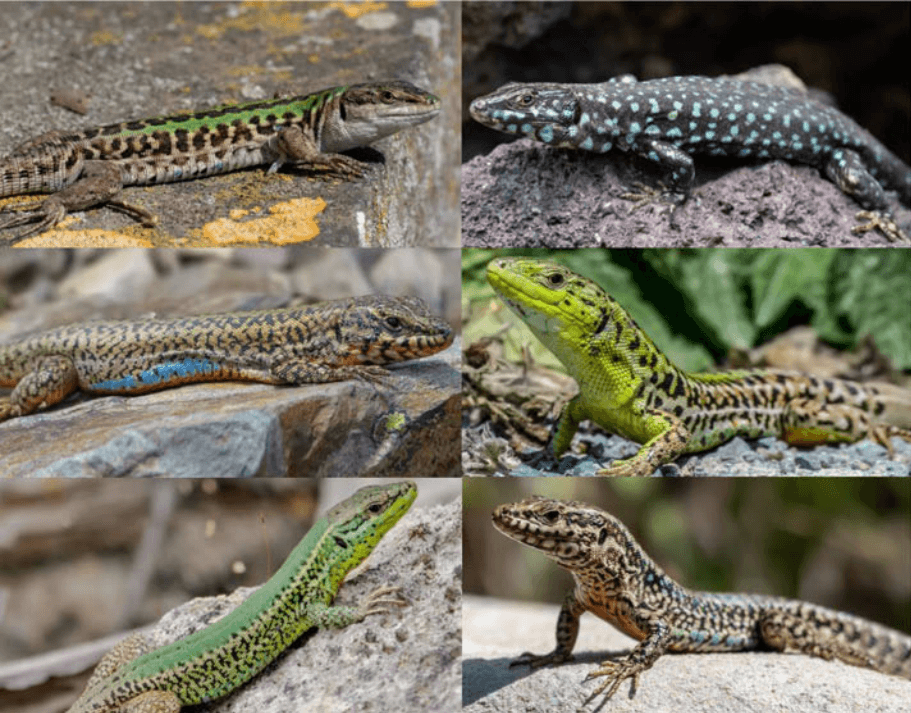
Wall Lizards
Europe, Northern Africa, Mediterranean Region
About Podarcis
The genus Podarcis, commonly referred to as wall lizards, comprises a group of reptiles within the family Lacertidae. For a period, these lizards were considered part of the genus Lacerta, but were distinguished as a separate group in the 1970s. While externally and ecologically similar to Lacerta species, Podarcis lizards possess unique differences in their cranial construction, hemipenial morphology, and caudal vertebral processes.
Geographic Distribution and Habitat
Wall lizards are indigenous to Europe and northern Africa, with the majority of species being endemic to the Mediterranean region. Their habitats are varied, often including rocky areas, walls, and open landscapes characteristic of Mediterranean environments.
Evolutionary History
The evolutionary trajectory of Podarcis lizards was significantly influenced by the Messinian salinity crisis, a period during which they diversified and hybridized. This event likely contributed to the speciation and genetic makeup of the various species within the genus.
Introduced Populations and Ecological Impact
Certain species of Podarcis, notably the Italian wall lizard (Podarcis siculus) and the common wall lizard (Podarcis muralis), have been introduced to North America. In these new environments, they have been observed to act as intermediate hosts for the larvae of some Acuariidae nematodes, indicating potential ecological impacts on native parasite cycles.
Source: Wikipedia ↗
Frequently Asked Questions
What are wall lizards?
Wall lizards are a genus of lizards, scientifically known as Podarcis, that belong to the family Lacertidae. They are often colloquially referred to as wall lizards due to their common habitats.
Where are Podarcis lizards found?
Podarcis lizards are native to Europe and northern Africa. The majority of the species are specifically found within the Mediterranean region.
How are Podarcis lizards different from Lacerta lizards?
Although they appear similar externally and ecologically, Podarcis lizards are distinguished from the genus Lacerta by the construction of their skull, the structure of their hemipenis, and the processes of their caudal vertebrae.
Have wall lizards been introduced to other continents?
Yes, some species of wall lizards, such as the Italian wall lizard (Podarcis siculus) and the common wall lizard (Podarcis muralis), have been introduced to North America. In these introduced populations, they can act as intermediate hosts for certain parasite larvae.
What is the significance of the Messinian salinity crisis for Podarcis?
The Messinian salinity crisis played a role in the diversification and hybridization of Podarcis lizards. This geological event likely influenced their evolutionary pathways and genetic makeup.
Related Lizards

Iberian worm lizard
The Iberian worm lizard, also known as the Mediterranean or European worm lizard, is a limbless reptile resembling a worm, found in Portugal and central and southern Spain. It possesses small, underdeveloped eyes and relies heavily on chemosensory signaling for navigation, prey detection, and predator avoidance. This fossorial species inhabits diverse Mediterranean environments, burrowing in loose soil and utilizing rocks for thermoregulation.
Blanus cinereus
The Iberian worm lizard (Blanus cinereus) is a limbless reptile resembling a worm, characterized by its small, underdeveloped eyes and smooth scales. It inhabits a variety of Mediterranean habitats across Portugal and central and southern Spain, where it lives a subterranean life. This species relies heavily on chemosensory signaling to navigate, detect prey, and avoid predators, compensating for its near-complete inability to see.

Cyprus rock agama
The Cyprus rock agama is a species of agamid lizard endemic to the island of Cyprus. It inhabits a variety of rocky environments, from arid to Mediterranean habitats, and has adapted well to human presence in towns and agricultural areas. This diurnal lizard is primarily insectivorous but also consumes small vertebrates and fruits.