
Podarcis carbonelli
Podarcis carbonelli, commonly known as Carbonell's wall lizard, is a species of lizard native to Portugal and Spain. It is characterized by its grey or brown dorsal coloration, often speckled with dark markings, and typically greenish flanks. This species inhabits temperate shrublands and sandy shores, with a declining population facing threats from habitat loss.
Key Facts
- ›Reaches a total length of up to 20 cm (8 in).
- ›Feeds primarily on small invertebrates like insects, arachnids, and snails.
- ›Natural habitats include temperate shrublands and sandy shores.
- ›Dorsal surface is usually grey or brown, sometimes green, with dark markings.
- ›Two subspecies are recognized: P. C. carbonelli and P. C. berlengensis.
- ›Assessed as a 'Vulnerable species' by the IUCN due to population decline.

Carbonell's Wall Lizard
Portugal, Spain
- Total Length Up To 20 cm .
- Snout-To-Vent Length Up To 6.5 cm .
- Tail Is Approximately Twice the Length of the Snout-To-Vent Length.
- Dorsal Surface Is Typically Grey Or Brown, Sometimes Green .
- Dorsal Surface Is Copiously Speckled With Rows of Dark Markings.
- Flanks May Be Greenish With Reticulated, Dark Markings.
- Underparts Are Whitish.
- May Have Small Blue Spots Along the Edge of the Belly.
- Differs From Other Iberian Wall Lizards By Generally Showing Greenish Flanks But Not Green Backs.
Small Invertebrates, Insects, Arachnids, Snails
Often Seen On Dry Banks., May Be Present In Large Numbers., Takes Refuge In Cracks and Among Tree Roots.
Habitat Loss, Habitat Degradation, Global Warming
About Podarcis carbonelli
Podarcis carbonelli: Carbonell's Wall Lizard
Podarcis carbonelli, commonly known as Carbonell's wall lizard, is a species of lizard belonging to the family Lacertidae. This species is native to specific regions within Portugal and Spain. It is distinguished by its physical characteristics, including a typical snout-to-vent length of 6.5 cm and a total length that can reach up to 20 cm. Its coloration often features a grey or brown dorsal surface, frequently speckled with dark markings, and sometimes exhibits greenish flanks, a trait differentiating it from closely related species.
Habitat and Distribution
Carbonell's wall lizard is found in isolated populations across Portugal and Spain. Its natural habitats are temperate shrublands and sandy shores, particularly sand dunes with sparse vegetation. Inland populations inhabit mountainous areas, such as the Sistema Central in Portugal, at elevations up to 1,200 meters. A distinct subspecies, Podarcis carbonelli berlengensis, is found on the Berlenga Islands, showcasing island gigantism.
Diet and Behavior
The diet of Podarcis carbonelli primarily consists of small invertebrates, including insects, arachnids, and snails. These lizards are diurnal and are often observed basking on dry banks. When threatened or seeking shelter, they retreat into cracks in rocks or among tree roots.
Reproduction and Conservation
Podarcis carbonelli is oviparous, laying eggs that typically take ten to fifteen weeks to hatch. Clutch sizes vary, with one clutch of two eggs common in mainland Portugal and multiple clutches of up to four eggs laid on the Berlenga Islands. The species faces threats from habitat loss and degradation, and its population is believed to be declining. Consequently, the International Union for Conservation of Nature (IUCN) has assessed Carbonell's wall lizard as a 'Vulnerable species'.
Source: Wikipedia ↗
Frequently Asked Questions
What is the scientific name for Carbonell's wall lizard?
The scientific name for Carbonell's wall lizard is Podarcis carbonelli. It belongs to the family Lacertidae.
What are the main physical characteristics of Podarcis carbonelli?
Carbonell's wall lizard typically has a snout-to-vent length of 6.5 cm (2.6 in) with a tail about twice that length. Its dorsal surface is usually grey or brown, often speckled with dark markings, and its flanks may be greenish. Small blue spots can sometimes be seen along the edge of its belly.
Where is Carbonell's wall lizard found?
This lizard is native to Portugal and Spain. It has isolated populations in western and central Portugal, a population in Coto Doñana in southwestern Spain, and a subspecies found on the Berlenga Islands off the coast of Portugal.
What kind of habitat does Podarcis carbonelli prefer?
Carbonell's wall lizard is adapted to Mediterranean climates and is found in temperate shrublands and sandy shores. Coastal populations inhabit sand dunes with minimal vegetation, while inland populations are found in mountainous areas.
What does Carbonell's wall lizard eat?
Its diet primarily consists of small invertebrates. This includes insects, arachnids, and snails, particularly on the Berlenga Islands.
What are the reproduction methods of Podarcis carbonelli?
Podarcis carbonelli is oviparous, meaning it lays eggs. In central Portugal, females typically lay one clutch of two eggs annually. On the Berlengas Islands, multiple clutches of up to four eggs can be laid, and these eggs take ten to fifteen weeks to hatch.
What is the conservation status of Carbonell's wall lizard?
The International Union for Conservation of Nature (IUCN) has assessed Carbonell's wall lizard as 'Vulnerable'. This status is due to its fragmented geographic range and declining population, which is impacted by habitat degradation.
Related Lizards
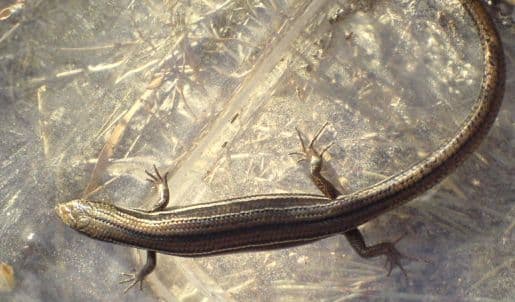
Bassiana duperreyi
The eastern three-lined skink, also known as Bassiana duperreyi, is a species of skink endemic to Australia. It is distinguished by its prominent stripes and has been the subject of extensive research into lizard learning, viviparity, and sex determination. This species inhabits a variety of environments across southeastern Australia and is classified as 'Least Concern' by the IUCN.

Short-legged japalure
The short-legged japalure (Diploderma brevipes) is a lizard species native to Taiwan, found in mountain forest edges between 1100 and 2200 meters elevation. Adults typically reach a total length of 25 cm, with males displaying a black back adorned with yellow-green spots and stripes, while females are primarily green. This diurnal species feeds on insects and other small invertebrates.

Acanthodactylus erythrurus
The spiny-footed lizard, Acanthodactylus erythrurus, is a medium-sized lizard known for the comb-like spines on its hind toes. Endemic to northwestern Africa and the Iberian Peninsula, it is recognized as one of the fastest lizards in the Lacertidae family. This species inhabits dry, sparsely vegetated areas with loose soil and low scrub, often in mountainous regions, and is primarily active during daylight hours.