
Pogona minor
Pogona minor, commonly known as the western bearded dragon, is a species of agamid lizard native to the southwest coast and interior of Western Australia. This species is characterized by its chameleon-like coloration, which aids in camouflage or can be used for display during social interactions. It is distinguished from similar species by its smaller head and the arrangement of spines on its underside and neck.
Key Facts
- ›Found in the southwest coast and interior of Western Australia.
- ›Includes three recognized subspecies: Pogona minor minor, Pogona minor minima, and Pogona minor mitchelli.
- ›Displays behaviors like foreleg waving and head-bobbing for communication.
- ›Reproduction is oviparous, with females laying clutches of 5-9 eggs.
- ›Likely insectivorous due to its small size, unlike many other bearded dragons.
- ›Can adjust its coloration to blend with the environment or for social signaling.

Western Bearded Dragon
Western Australia
- Chameleon-Like Coloration, Capable of Blending Into Environments Or Displaying Brighter Colors.
- Smaller Head Compared To Similar Species.
- Distinctive Arrangement of Spines On the Underside and Neck.
- Snout-To-Vent Length Varies By Subspecies: P. M. Minor ~15 cm, P. M. Minima ~11 cm, P. M. Mitchelli ~16 cm.
- Total Length For P. M. Minor Is Approximately 38 cm Including the Tail.
Insects
- Foreleg Waving For Communication With Rivals Or Mates.
- Head-Bobbing Among Males, Potentially For Dominance.
- Basking Behavior, Often Observed On Elevated Surfaces Like Fence Posts.
- Coloration Can Change For Camouflage Or Display.
About Pogona minor
Pogona minor: The Western Bearded Dragon
Pogona minor, commonly referred to as the western bearded dragon, is a species of lizard belonging to the agamid family. It is native to the southwest coast and interior regions of Western Australia. This species is recognized for its ability to alter its coloration, either to blend seamlessly with its surroundings or to exhibit brighter displays during social interactions with other individuals.
Description and Distribution
The western bearded dragon is distinguished from similar species by a smaller head and a unique arrangement of spines on its underside and neck. The snout-to-vent length (SVL) varies among its subspecies, with Pogona minor minor measuring around 15 cm and Pogona minor mitchelli slightly larger at 16 cm SVL. Pogona minor minima, found on islands, is typically smaller, with an SVL of about 11 cm. The species inhabits a range of environments, including semiarid woodlands, heathlands, desert areas, and coastal dunes across Western Australia.
Behavior and Diet
Behaviorally, Pogona minor exhibits characteristic actions within the bearded dragon genus. It is known to wave one of its forelegs as a signal to potential rivals or mates, and males often engage in head-bobbing, likely as a display of dominance. The western bearded dragon is frequently observed basking, often on elevated perches like fence posts. Due to its relatively small size compared to other bearded dragon species, Pogona minor is presumed to be primarily insectivorous.
Reproduction
This species is oviparous, meaning it reproduces by laying eggs. Adult females typically lay clutches ranging from 5 to 9 eggs, although larger clutches of up to 15 eggs have been recorded. The subspecies of Pogona minor include Pogona minor minor, Pogona minor minima, and Pogona minor mitchelli.
Source: Wikipedia ↗
Frequently Asked Questions
What are the different subspecies of Pogona minor?
The three recognized subspecies of Pogona minor are Pogona minor minor (western bearded dragon), Pogona minor minima (found on islands of the Wallabi Group), and Pogona minor mitchelli (found in the Kimberley region).
What is the typical size of Pogona minor?
Pogona minor minor has a snout-to-vent length (SVL) of about 15 cm and a total length of 38 cm. Pogona minor minima is slightly smaller at 11 cm SVL, while Pogona minor mitchelli is slightly larger at 16 cm SVL.
What kind of behaviors does Pogona minor exhibit?
Pogona minor exhibits behaviors such as waving one of its forelegs to communicate with rivals or potential mates. Males also engage in head-bobbing, likely related to establishing dominance within their social structure.
What is the diet of Pogona minor?
Due to its smaller size, Pogona minor is believed to be primarily insectivorous. This contrasts with many other bearded dragon species that are predominantly herbivorous.
How does Pogona minor reproduce?
Pogona minor is oviparous, meaning it reproduces by laying eggs. Adult females typically lay clutches containing 5 to 9 eggs, though larger clutches of up to 15 eggs have been documented.
Where can Pogona minor be found?
The western bearded dragon (Pogona minor minor) is widespread in Southwest Australia and central deserts, inhabiting semiarid regions, woodlands, heathlands, and desert dunes. Pogona minor minima is found on islands of the Houtman Abrolhos.
Related Lizards
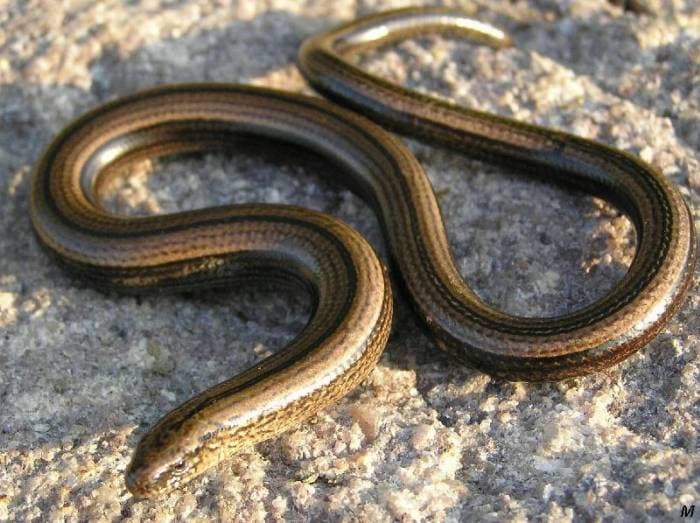
Anguis
Anguis, commonly known as slow worms, are a genus of legless lizards that are often mistaken for snakes. They are characterized by their grey-brown coloration, with females often exhibiting a coppery sheen and males displaying blue spots, especially during breeding season. These lizards inhabit a variety of warm, protected environments across Europe and parts of Asia, feeding primarily on invertebrates.

Viviparous lizard
The viviparous lizard (Zootoca vivipara), also known as the common lizard, is a Eurasian reptile renowned for its ability to give birth to live young, though it can also lay eggs. This small lizard inhabits a wide range of cold climates, extending farther north than most non-marine reptiles, and is adept at thermoregulation to survive harsh conditions. It exhibits sexual dimorphism, with males often having larger heads and brighter undersides, while females display more color polymorphism.

Lerista praepedita
The western worm lerista (Lerista praepedita) is a slender skink species found in coastal heath and woodlands of Western Australia. It is characterized by its lack of front legs, extremely small hind legs, and distinctive dark brown stripes along its sides.