
Pseudemoia pagenstecheri
Pseudemoia pagenstecheri, also known as the southern grass tussock skink, is a species of lizard endemic to Australia. It primarily inhabits tussock grasslands and is notable for being viviparous. While generally listed as 'Least Concern,' populations are declining in specific regions of Australia.
Key Facts
- ›Endemic to Australia, found in New South Wales, Tasmania, and Victoria.
- ›Inhabits tussock grasslands, preferring medium to tall tussock grass.
- ›Reproduces via viviparity, meaning it gives birth to live young.
- ›Known to hybridize with other species within the Pseudemoia genus.
- ›Listed as 'Least Concern' by the IUCN, but considered 'Endangered' in specific Australian regions under the Flora and Fauna Guarantee Act.

Southern Grass Tussock Skink, Southern Tussock Grass Skink
Australia
Tussock Grassland
About Pseudemoia pagenstecheri
Pseudemoia pagenstecheri: The Southern Grass Tussock Skink
Pseudemoia pagenstecheri, commonly referred to as the southern grass tussock skink or southern tussock grass skink, is a species of lizard native to Australia. It belongs to the subfamily Eugongylinae within the family Scincidae.
Habitat and Distribution
The preferred natural habitat for Pseudemoia pagenstecheri is tussock grassland, with a particular fondness for areas featuring medium to tall tussock grass. Geographically, this species is found in eastern New South Wales, Tasmania, and northeastern Victoria.
Reproduction and Hybridization
This skink is viviparous, meaning it gives birth to live young. Pseudemoia pagenstecheri is also known to interbreed with other species within its genus, specifically Pseudemoia cryodroma and Pseudemoia entrecasteauxii.
Conservation Status
While the southern grass tussock skink is listed as 'Least Concern' on the IUCN Red List of Threatened Species, its population is experiencing a decline in certain areas. This decline is particularly noted in the Western Volcanic Plains of Melbourne. Furthermore, under the Flora and Fauna Guarantee Act, the species is listed as 'Endangered' in the Volcanic Plains and alpine regions of the High Country, indicating localized conservation concerns despite its broader status. The specific name, pagenstecheri, honors the German zoologist Heinrich Alexander Pagenstecher.
Source: Wikipedia ↗
Frequently Asked Questions
What is Pseudemoia pagenstecheri?
Pseudemoia pagenstecheri is a species of lizard belonging to the subfamily Eugongylinae. It is commonly known as the southern grass tussock skink or southern tussock grass skink.
Where is the southern grass tussock skink found?
This species is endemic to Australia and is found in eastern New South Wales, Tasmania, and northeastern Victoria.
What kind of habitat does Pseudemoia pagenstecheri prefer?
Its preferred natural habitat is tussock grassland, particularly areas with medium to tall tussock grass.
How does Pseudemoia pagenstecheri reproduce?
Pseudemoia pagenstecheri is viviparous, which means that the females give birth to live young rather than laying eggs.
What is the conservation status of the southern grass tussock skink?
Globally, it is listed as 'Least Concern' by the IUCN. However, it is recognized as 'Endangered' in specific areas of Australia, such as the Western Volcanic Plains of Melbourne and alpine regions, according to the Flora and Fauna Guarantee Act.
Can Pseudemoia pagenstecheri hybridize with other species?
Yes, Pseudemoia pagenstecheri is known to hybridize with two other species within its genus: Pseudemoia cryodroma and Pseudemoia entrecasteauxii.
Related Lizards

Chalcides colosii
Chalcides colosii, also known as the Riffian skink, is a moderate-sized lizard native to Morocco and some Spanish territories in northwestern Africa. Distinguished from similar species by its lack of ocelli and dark lateral bands, it inhabits semi-arid to sub-humid rocky areas, stone heaps, slopes with loose soil and grass cover, and coastal sand dunes. Females of this viviparous species give birth to live young.

Egernia stokesii
Egernia stokesii, also known as the Gidgee skink or spiny-tailed skink, is a gregarious lizard species native to Australia. It is distinguished by its spiny tail and complex social structures, forming stable, long-term aggregations. This diurnal species inhabits semi-arid environments and exhibits an omnivorous diet. While the species as a whole is listed as Least Concern, one subspecies is considered endangered.
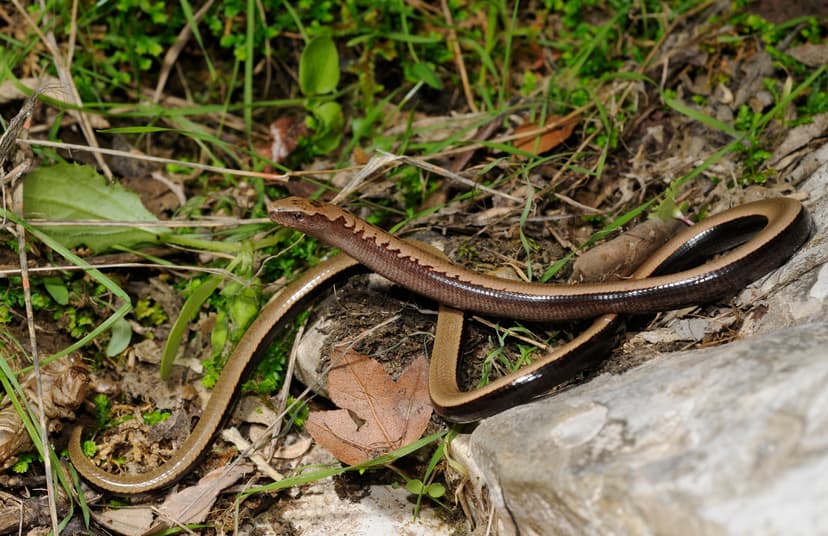
Peloponnese slowworm
The Peloponnese slow worm (Anguis cephallonica) is a legless lizard endemic to specific regions of Greece, including the Peloponnese peninsula and the Ionian islands of Cephalonia, Ithaca, and Zakynthos. This species is distinguished by a higher number of scale rows around its body and a unique chocolate-brown lateral stripe, and it gives birth to live young.