
Scelarcis perspicillata
The Moroccan rock lizard (Scelarcis perspicillata) is a medium-sized, flattened lizard native to northwestern Africa, primarily Morocco and Algeria, with an introduced population in Menorca, Spain. Characterized by a transparent "window" in its lower eyelid and often a bluish tail, it inhabits diverse environments from rocky areas and shrubland to urban settings. This agile species is a common sight climbing on various surfaces, foraging on the ground.
Key Facts
- ›Found in Algeria, Morocco, and introduced to Menorca, Spain.
- ›Has a transparent 'window' in its lower eyelid.
- ›Tail is fragile and often bluish, especially in juveniles.
- ›Inhabits rocky areas, shrubland, sea coasts, and urban environments.
- ›Females lay small clutches of 1-3 eggs.
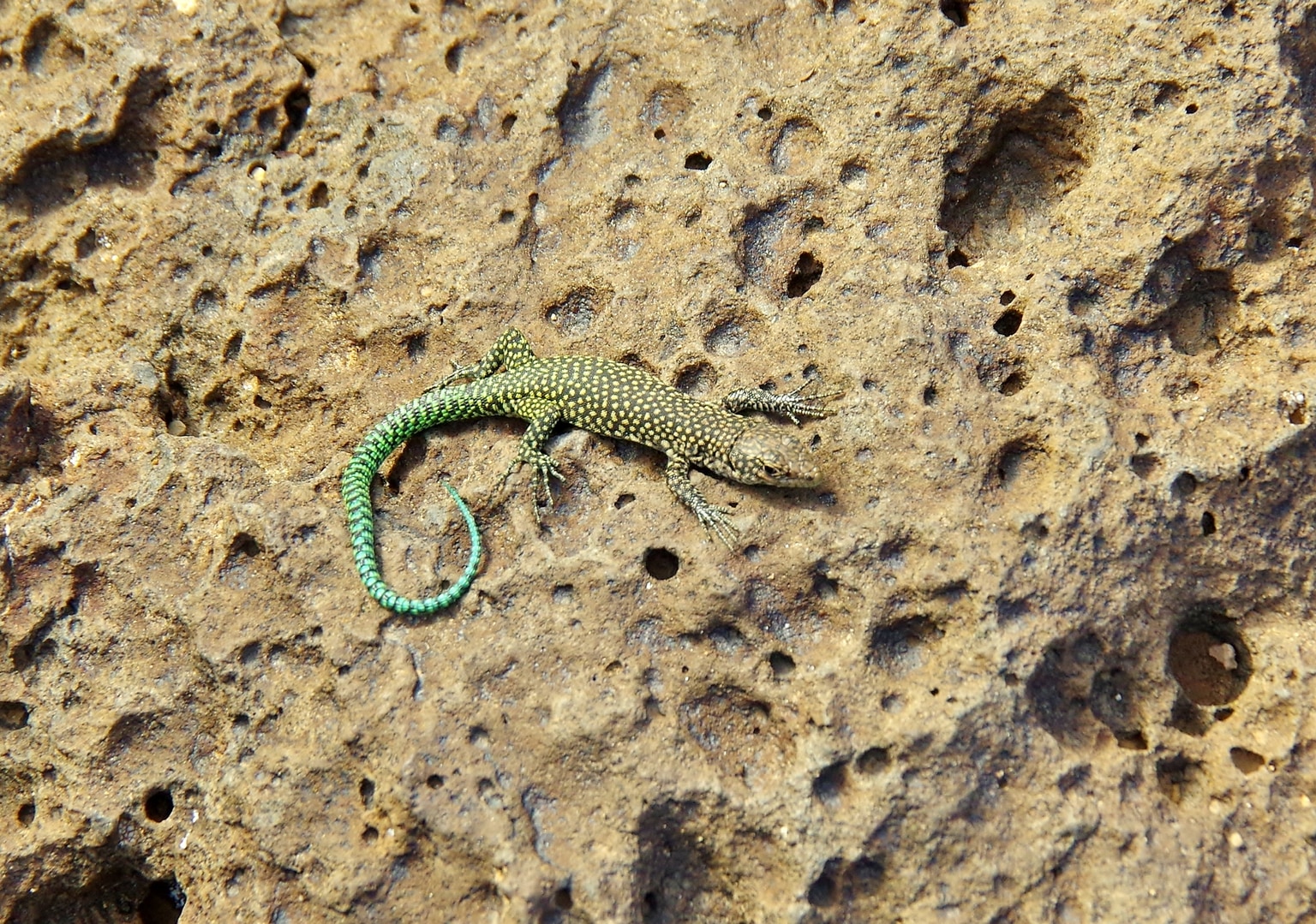
Moroccan Rock Lizard
Algeria, Morocco, Spain
Mediterranean-Type Shrubland, Rocky Areas, Sea Coasts, Urban Areas
- Medium-Sized and Rather Flattened.
- Snout-To-Vent Length Up To 6 cm .
- Tail Approximately 1.7 Times Its Body Length.
- Coloration Varies: Greyish-Brown With Pale Stripes , Buff, Grey, Or Greyish-Green With Dark Net-Like Markings .
- Tail Often Bluish, Especially In Smaller Individuals.
- Distinctive Transparent 'Window' In the Lower Eyelid.
- Underparts Are White Or Bluish.
- Occasional Completely Dark Individuals Are Observed.
Forages On the Ground.
- Agile Species.
- Climbs On Rocks, Walls, Cliffs, Boulders, and Tree Trunks.
- Forages On the Ground and On Rocks.
- Tail Is Fragile.
About Scelarcis perspicillata
The Moroccan rock lizard, scientifically known as Scelarcis perspicillata, is a species of lizard belonging to the Lacertidae family. Its precise taxonomic placement has seen it assigned to various genera over time, including Teira, Podarcis, Lacerta, and its current classification within Scelarcis. This agile reptile is native to northwestern Africa, predominantly found in Morocco and Algeria, and has also established an introduced population on the island of Menorca in Spain, where it was first recorded in 1928.
Description and Habitat
Scelarcis perspicillata is characterized by its medium size and a rather flattened body, typically reaching a snout-to-vent length of about 6 cm, with a tail that is roughly 1.7 times its body length. Its coloration exhibits variation across its range; individuals in Morocco are often greyish-brown, frequently featuring two broad, pale stripes along the back. In contrast, those found in Menorca tend to be buff, grey, or greyish-green, densely covered with dark, net-like markings. A distinctive feature across all populations is the presence of a transparent 'window' in the lower eyelid, which aids in identification. The tail is notably fragile and is often a striking bluish color, particularly in younger specimens. The underparts are typically white or bluish. Occasional entirely dark individuals have also been documented.
The natural habitats of the Moroccan rock lizard are diverse, encompassing Mediterranean-type shrubby vegetation, rocky terrains, and coastal areas. They have also demonstrated a remarkable ability to adapt to urban environments, where they can be found on walls, cliffs, boulders, and around human structures. Their agility allows them to readily climb and navigate these varied landscapes.
Behavior and Reproduction
Behaviorally, Scelarcis perspicillata is an active species, frequently observed climbing on various surfaces such as rocks, walls, cliffs, boulders, and even tree trunks. They forage both on the ground and on rocky outcrops. The fragility of their tails is a notable trait, with individuals often found possessing regenerating tails. Reproduction involves females laying small clutches, typically consisting of one to three eggs. These eggs are relatively small, measuring between 12 to 17 mm in length and 6 to 8 mm in width.
While detailed information regarding their lifespan, diet specifics beyond foraging habits, and natural predators is not extensively detailed in historical accounts, their presence in varied natural and human-altered landscapes highlights their adaptability. The species is not considered venomous.
Source: Wikipedia ↗
Frequently Asked Questions
What are the natural habitats of the Moroccan rock lizard?
The Moroccan rock lizard thrives in Mediterranean-type shrubby vegetation, rocky areas, and along sea coasts. They are also adaptable to urban environments, often found on walls and around buildings.
How can I distinguish a Moroccan rock lizard from similar species?
A key distinguishing feature of Scelarcis perspicillata is the presence of a transparent 'window' in its lower eyelid. This unique characteristic helps differentiate it from other similar-looking lizards.
What does the Moroccan rock lizard look like?
This species is medium-sized and rather flattened, reaching a snout-to-vent length of about 6 cm. Coloration varies, but it is often greyish-brown with pale stripes in Morocco, while in Menorca it can be buff, grey, or greyish-green with dark markings. Their tails are frequently bluish, particularly in younger individuals.
Where is the Moroccan rock lizard found?
Its natural range includes northwestern Africa, specifically in the mountains of Morocco and down to sea level in Algeria. It has also been successfully introduced and established on the island of Menorca in Spain, first being recorded there in 1928.
What is the behavior of the Moroccan rock lizard?
Scelarcis perspicillata is an agile lizard, frequently observed climbing on rocks, walls, cliffs, boulders, and tree trunks. They forage both on the ground and on rocky surfaces. Their tails are noted to be quite fragile.
How do Moroccan rock lizards reproduce?
Females of the species lay small clutches, typically consisting of one to three eggs. These eggs measure approximately 12 to 17 mm in length and 6 to 8 mm in width.
Related Lizards

Algyroides fitzingeri
Fitzinger's algyroides (Algyroides fitzingeri) is the smallest and most slender member of its genus, native to Corsica and Sardinia. This lizard is distinguished by the sharp demarcation between its side and underside scales and the absence of pale lines above its eyes. It inhabits a variety of temperate and Mediterranean environments, from sea level to high altitudes.

Maltese wall lizard
The Maltese wall lizard (Podarcis filfolensis) is a species of lizard found in Malta and the Pelagian Islands of Italy. It inhabits Mediterranean-type shrubland, rocky areas, shores, arable land, pasture, and rural gardens. Distinguishing features vary by subspecies, with males generally exhibiting brighter colors than females and juveniles.

Anatololacerta oertzeni
Anatololacerta oertzeni, commonly known as the rock lizard, is a species of lizard found in Greece and Turkey. It inhabits a variety of Mediterranean-type environments, including shrubland, rocky areas, and pastures.