
Sceloporus olivaceus
The Texas spiny lizard (Sceloporus olivaceus) is a common lizard found in the south-central United States and northeastern Mexico, often seen in trees or on fences. It is characterized by its distinctly spiny scales, grey coloration with dark blotching for camouflage, and long toes with sharp claws for climbing. These diurnal and arboreal lizards are insectivorous and known for their shy behavior, often retreating to trees or leaf litter when disturbed.
Key Facts
- ›Commonly found in trees, fences, and telephone poles.
- ›Possesses distinctly spiny scales and sharp claws for climbing.
- ›Adults typically range from 19-28 cm in total length.
- ›Primarily insectivorous, feeding on beetles and other insects.
- ›Males may exhibit 'push-up' displays to establish dominance.
- ›Can lay up to four clutches of approximately 20 eggs per year.
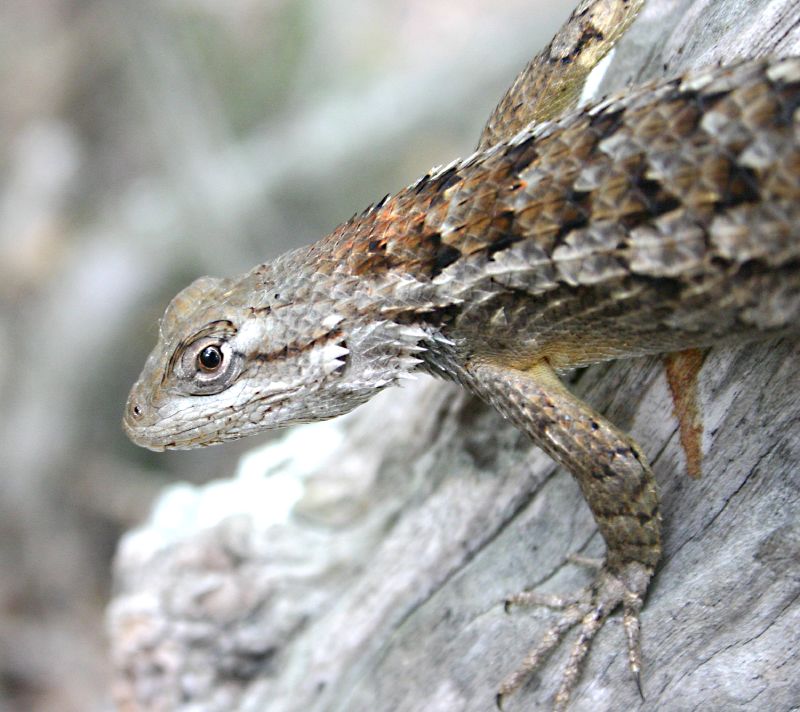
Texas Spiny Lizard
Texas, Arizona, Oklahoma, Coahuila, Nuevo LeóN, Tamaulipas, San Luis Potosí
Mesquite Trees, Areas With Ground Leaf Litter, Suburban Areas, Trees, Fences, Telephone Poles
- Adults Measure 7.5–11 Inches In Total Length.
- Typically Grey In Color With Black, White, Or Red-Brown Blotching Down the Back.
- Coloration and Patterns Provide Camouflage Against Tree Bark.
- Underside Is Usually Uniformly Light Grey.
- Males Typically Have Blue Patches On Either Side of the Belly.
- Scales Have A Distinctly Spiny Texture.
- Possess Long Toes and Sharp Claws Suited For Climbing.
Beetles, Other Insects
Diurnal, Arboreal, Shy, Nervous, Retreats When Approached, Performs 'Push-Up' Displays For Dominance, Males May Compete Physically
Hawks, Snakes, Mammals
About Sceloporus olivaceus
The Texas Spiny Lizard (Sceloporus olivaceus)
The Texas spiny lizard, scientifically classified as Sceloporus olivaceus, is a commonly encountered reptile native to the south-central United States and northeastern Mexico. Its range encompasses states such as Texas, Arizona, and Oklahoma, as well as several northeastern Mexican states including Coahuila, Nuevo León, Tamaulipas, and San Luis Potosí.
Physical Characteristics and Habitat
Adult Texas spiny lizards typically measure between 19 and 28 centimeters in total length. Their coloration is generally grey, often adorned with blotches of black, white, or red-brown along the back, which serve as effective camouflage against the bark of trees. This camouflage is crucial for their survival in their preferred habitats, which include mesquite trees and areas rich with leaf litter on the ground. They are also frequently observed in suburban environments, basking on fences or climbing telephone poles. A notable feature is their distinctly spiny scales, along with long toes and sharp claws, perfectly adapted for arboreal life.
Diet and Behavior
As insectivores, the Texas spiny lizard's diet primarily consists of beetles and other insects. These lizards are diurnal, meaning they are active during daylight hours, and are strongly arboreal, preferring to spend their time in trees. They are known for their shy and nervous disposition, typically fleeing from perceived threats by retreating into trees or rustling through ground-level leaf litter. In social interactions, particularly between males, 'push-up' displays are observed as a method to establish dominance for territory or mating rights, with physical confrontations occurring if visual displays are insufficient.
Reproduction
Reproduction for the Texas spiny lizard occurs throughout the summer months. A female is capable of laying multiple clutches within a single year, provided sufficient nutrients are available. Each clutch averages around 20 eggs. Interestingly, on average, males tend to be larger in size following birth compared to females.
Source: Wikipedia ↗
Frequently Asked Questions
What is the Texas spiny lizard?
The Texas spiny lizard, scientifically known as Sceloporus olivaceus, is a species of lizard native to the south-central United States and northeastern Mexico. They are frequently observed in trees and on fences within their habitat.
What do Texas spiny lizards look like?
Adult Texas spiny lizards are typically grey with black, white, or red-brown blotching along their backs, providing camouflage against tree bark. They have a distinctly spiny texture to their scales and long toes with sharp claws, suited for climbing. Males often display blue patches on their undersides.
Where can I find Texas spiny lizards?
These lizards are common in Texas, Arizona, and Oklahoma in the United States, as well as in the northeastern Mexican states of Coahuila, Nuevo León, Tamaulipas, and San Luis Potosí. They prefer mesquite trees with ample ground leaf litter but are also found in suburban areas.
What do Texas spiny lizards eat?
The Texas spiny lizard is insectivorous. Its diet consists of a variety of insects, including beetles. They forage for their food within their preferred arboreal and ground-level habitats.
How do Texas spiny lizards behave?
They are diurnal and arboreal, meaning they are active during the day and live in trees. They are generally shy and will flee from perceived threats, often retreating up trees or through leaf litter. Males engage in 'push-up' displays to assert dominance.
How do Texas spiny lizards reproduce?
Texas spiny lizards breed throughout the summer. A female can lay up to four clutches annually, with each clutch containing around 20 eggs. On average, males are larger than females after birth.
What are the predators of the Texas spiny lizard?
Natural predators of the Texas spiny lizard include hawks, snakes, and certain mammals. They rely on their camouflaged coloration to avoid detection by these predators.
Related Lizards

Puerto Rican crested anole
The Puerto Rican crested anole, also known as the common Puerto Rican anole, is a small to medium-sized lizard native to Puerto Rico and the Virgin Islands, with introduced populations elsewhere. Males are distinguished by a prominent fin-like crest running down their tail, while females possess a smaller version of this feature. These lizards are commonly found in a variety of habitats, including urban areas, and are known for their ability to change color.

Anolis cristatellus
Anolis cristatellus, commonly known as the crested anole or common Puerto Rican anole, is a small to moderately-sized lizard native to Puerto Rico and the Virgin Islands. Males are distinctive for their prominent caudal crest and colorful dewlap, used in dominance displays and mating rituals. This adaptable species thrives in various habitats, including urban environments, and is known for its ability to change color.

Sceloporus occidentalis
The western fence lizard (Sceloporus occidentalis), also known as the blue-belly, is a common lizard found across the western United States and northern Mexico, easily recognizable by its bright blue ventral abdomen. It inhabits diverse environments from grasslands to forests and is known for its diurnal basking behavior and a diet primarily consisting of terrestrial invertebrates. Its unique blood composition also plays a role in reducing Lyme disease transmission.