
Schlegel's Japanese gecko
Gekko japonicus·Gekkonidae
Schlegel's Japanese gecko, scientifically known as Gekko japonicus and commonly referred to as yamori in Japanese, is a species of gecko native to Japan, eastern China, and South Korea. These geckos are primarily insectivores and are known for their ability to shed their tails as a defense mechanism against predators.
Key Facts
- ›Found across the main islands of Japan, as well as in eastern China and South Korea.
- ›Feeds primarily on insects.
- ›Possesses the ability to detach its tail (autotomy) to escape predators.
- ›In Japanese culture, geckos are considered symbols of good luck and are called 'yamori', meaning 'home-protector'.
- ›The specific epithet 'japonicus' is Modern Latin for Japan.

Yamori
Japan, China, South Korea
Insects
Capable of Autotomy For Predator Escape.
Unspecified Predators
About Schlegel's Japanese gecko
Schlegel's Japanese Gecko (Gekko japonicus)
Schlegel's Japanese gecko, known scientifically as Gekko japonicus and by the Japanese name yamori, is a species of gecko native to East Asia. Its distribution spans the main islands of Japan, extending from northern Honshu to southern Kyushu, and it is also found in eastern China and South Korea. The species was first classified by Hermann Schlegel in 1836, with the specific epithet 'japonicus' being the Modern Latin term for Japan.
Ecology and Behavior
As is characteristic of many gecko species, Gekko japonicus primarily sustains itself by consuming insects. A notable behavioral adaptation of this gecko is its capacity for autotomy, the ability to shed its tail as a defense mechanism to evade predators. While this process is effective in escaping immediate danger, and the gecko's blood vessels constrict to prevent significant blood loss, the loss of the tail also means the depletion of a stored fat reserve, which can be crucial for survival during periods of food scarcity.
Cultural Significance
In Japanese culture, the presence of a gecko in a home is traditionally regarded as a sign of good luck. The common Japanese name for the gecko, 'yamori', directly translates to 'home-protector', reflecting this auspicious association and its perceived role in safeguarding dwellings.
Source: Wikipedia ↗
Frequently Asked Questions
What is the scientific name for Schlegel's Japanese gecko?
The scientific name for Schlegel's Japanese gecko is Gekko japonicus. This binomial nomenclature follows the standard system for classifying species.
Where can Schlegel's Japanese gecko be found?
Schlegel's Japanese gecko is distributed across the main islands of Japan, from northern Honshu to southern Kyushu. It can also be found in eastern China and South Korea.
What does Schlegel's Japanese gecko eat?
Like many gecko species, Gekko japonicus primarily feeds on insects. This diet likely provides them with the necessary nutrients for survival.
Does Schlegel's Japanese gecko have any special defense mechanisms?
Yes, Schlegel's Japanese gecko is capable of autotomy, which means it can shed its tail to escape predators. While this prevents immediate harm, the gecko does lose a valuable fat reserve stored in the tail.
What is the cultural significance of the yamori in Japan?
In Japanese culture, seeing a yamori, or gecko, on one's home is associated with good luck. The name 'yamori' itself translates to 'home-protector', highlighting this positive association.
Related Lizards

Anguidae
Anguidae is a large and diverse family of lizards found across the Northern Hemisphere. They are characterized by osteoderms beneath their scales, often a lateral skin fold, and reduced or absent limbs in the Anguinae subfamily, giving them a snake-like appearance. This family includes slow worms, glass lizards, and alligator lizards, inhabiting a wide range of environments from arid to tropical.
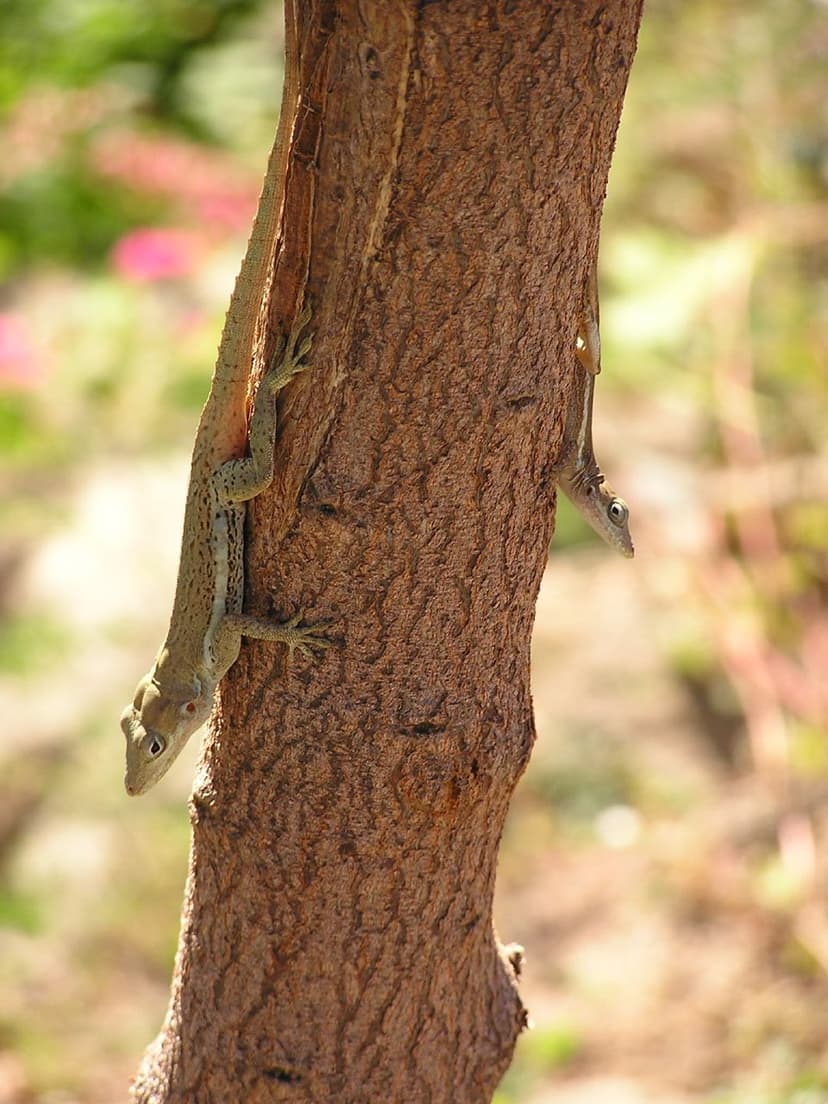
Anolis gingivinus
The Anolis gingivinus, also known as the Anguilla Bank tree anole, is a lizard species endemic to the northern Lesser Antilles islands of Anguilla, Saint Martin, and Saint Barthélemy. It is characterized by its olive to light grey coloration, bold stripes along the back, and a vivid orange chinflap, with males sometimes exhibiting dark marbled spotting. This adaptable species inhabits diverse mesic to xeric environments, including woods, coastal scrub, and overgrown fields, and can be found both in trees and on the ground.

Chamaeleo
Chamaeleo is a genus of chameleons known for their slow movement, independently movable eyes, color-changing abilities, long tongues, and prehensile tails. Primarily found in sub-Saharan Africa, with some species extending into northern Africa, southern Europe, and southern Asia, they are predominantly arboreal, inhabiting trees and bushes. Males are typically larger and more vibrantly colored than females.