
Sharma's mabuya
Sharma's mabuya is a species of skink endemic to India, first described from Andhra Pradesh. It is distinguished from similar species by specific scale arrangements and coloration, often appearing dark brown or black with white longitudinal stripes. This skink inhabits areas near the Krishna River and has been found in a few additional districts within Andhra Pradesh.
Key Facts
- ›Distinguished from Eutropis beddomei by separated supranasals and prefrontals, and three pairs of nuchals.
- ›Dorsal scales feature 5-7 keels, and the fourth toe has 16-22 lamellae.
- ›Typically dark brown or black with white longitudinal stripes on the back, which may fade on the tail.
- ›Some specimens exhibit an orangish-red stripe on the neck, potentially indicating a sex-specific trait.
- ›The type specimen was rediscovered in the collections of the Zoological Survey of India in 2007.
- ›Found in Andhra Pradesh, India, including areas south of Vijaypuri near the Krishna River.

Sharma's Mabuya
India
Hills, Riverine Areas
- Dark Brown Or Black Body Coloration.
- Three White Longitudinal Stripes On the Back, Becoming Indistinct On the Tail.
- Head Scales With Brown Centers and Light Brown Margins.
- Legs Dark Brown Above; Hind Limbs Sculpted With White Above.
- Underside Is White.
- Some Specimens Display An Orangish-Red Stripe On Either Side of the Neck.
- Supranasals Are Separated By Frontonasal.
- Prefrontals Are Separate.
- Three Pairs of Nuchals.
- Presence of A Post Nasal.
- Dorsal Scales Have 5-7 Keels.
- 16-22 Lamellae Beneath the Fourth Toe.
- Oval Ear Opening, Twice the Size of Lateral Scales.
Insects, Other Small Invertebrates
- Likely Terrestrial Or Semi-Arboreal Based On Habitat Description.
About Sharma's mabuya
Sharma's mabuya, scientifically known as Eutropis nagarjuni, is a species of skink native to India. It was first described in 1969 by Sharma, based on specimens collected from the hills south of Vijaypuri, situated on the right bank of the Krishna River in Andhra Pradesh.
Description and Identification
This skink is characterized by several distinctive physical traits that differentiate it from closely related species like Eutropis beddomei. Key distinguishing features include its supranasal scales, which are separated by the frontonasal scale, and its prefrontal scales, which are also separate. Sharma's mabuya possesses three pairs of nuchal scales, whereas E. beddomei has only a single pair. Furthermore, the presence of a post nasal scale and dorsal scales bearing 5-7 keels are notable characteristics. The species exhibits 16-22 lamellae beneath the fourth toe, and its ear opening is oval and approximately twice the size of the lateral scales.
Coloration and Morphology
The typical coloration of Sharma's mabuya is dark brown or black, marked by three prominent white longitudinal stripes on its back, with the central vertebral stripe being the most evident. These stripes tend to fade on the tail. The scales on the head feature brown centers and lighter brown margins. The legs are dark brown dorsally, and the hind limbs are sculpted with white markings on their upper surfaces, while the underside of the body is white. Some individuals have been observed with an orangish-red stripe on either side of the neck, which may potentially be a sex-specific characteristic.
Distribution and Rediscovery
Sharma's mabuya has been documented in several locations within Andhra Pradesh, India, including the Nalgonda and Mahbubnagar districts. A significant event in the study of this species was the rediscovery of its type specimen in the collections of the Zoological Survey of India in 2007. This rediscovery helped to confirm the species' existence and taxonomic classification.
Source: Wikipedia ↗
Frequently Asked Questions
How is Sharma's mabuya different from Eutropis beddomei?
Sharma's mabuya can be identified by its separated supranasals and prefrontals, and three pairs of nuchal scales, unlike Eutropis beddomei which has these scales in contact and only a single pair of nuchals. Additionally, Sharma's mabuya has 5-7 keels on its dorsal scales compared to 3-5 in E. beddomei, and 16-22 lamellae under the fourth toe versus 12-15.
What is the typical coloration of Sharma's mabuya?
Sharma's mabuya is described as dark brown or black with three white longitudinal stripes on its back. These stripes are most prominent on the back, with the middle vertebral stripe, and tend to become indistinct on the tail. The head scales have brown centers and light brown margins.
Where has Sharma's mabuya been found?
The species was originally described from hills south of Vijaypuri on the right bank of the Krishna River in Andhra Pradesh, India. It has since been recorded from additional localities in the Nalgonda and Mahbubnagar districts of Andhra Pradesh.
Are there any distinctive physical features of Sharma's mabuya regarding its ears or legs?
Sharma's mabuya possesses an oval ear opening that is twice the size of the lateral scales. Its legs are dark brown on the upper side, and the hind limbs are sculpted with white markings above, while the underside of the body is white.
What is the significance of the rediscovery of the type specimen?
The type specimen of Sharma's mabuya, originally described by Sharma in 1969, was rediscovered in the collections of the Zoological Survey of India in 2007. This rediscovery was important for confirming the species' identity and taxonomic status.
Related Lizards

Ablepharus
Ablepharus, commonly known as snake-eyed skinks, are small lizards distinguished by fused eyelids that prevent blinking, similar to snakes. They inhabit dry fields, hills, and rocky areas, often concealed within leaf litter. These skinks possess shiny, bronze scales and a characteristic dark stripe along their sides, feeding primarily on small insects and mollusks.
Blanford's rock agama
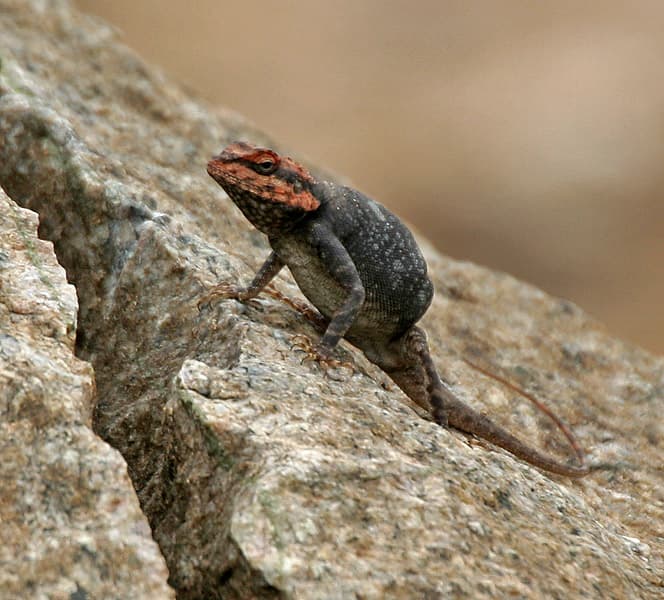
Blanford's rock agama is a species of lizard endemic to Peninsular India, easily recognized by its distinct coloration during the breeding season. Males develop a scarlet or red head and anterior body, while the rest of their body turns nearly black. This species primarily inhabits rocky areas and is known for its insectivorous diet and oviparous reproduction.
Blanford's rock lizard (Psammophilus blanfordanus)
Blanford's rock lizard (Psammophilus blanfordanus) is a species of agamid lizard found in Peninsular India, primarily east of its relative, P. dorsalis. This species is distinguished by physical features like a deeper fold on the front of the humerus and scale characteristics. Males exhibit striking scarlet or red coloration on their heads and anterior bodies during the breeding season.