
Spotted house gecko
The spotted house gecko (Hemidactylus parvimaculatus) is a South Asian and Indian Ocean gecko species known for its light grey to tan coloration, marked by three rows of dark blotches along its back. Reaching up to 13 cm in length, it features a tuberculated body and a spiny-tailed tail, with a distinctive pinkish-cream belly. This adaptable species inhabits various environments across Sri Lanka, India, and several Indian Ocean islands, and has established introduced populations in Thailand and the southern United States.
Key Facts
- ›Can grow up to 13 cm (5 inches) in total length.
- ›Characterized by a light grey to tan body with three rows of dark blotches on its back.
- ›Possesses a tuberculated body and a tail with rings of small spines.
- ›Native to South Asia and islands in the Indian Ocean, including Sri Lanka and southern India.
- ›Diet consists of insects and small frogs, and it is also known to be cannibalistic.

Spotted House Gecko, Sri Lankan House Gecko
Sri Lanka, Southern India, Reunion, Mauritius, Rodrigues, Moheli, Maldives, Mascarene Islands, Bangkok, Thailand, Southern United States
House, South Asia, Indian Ocean Islands
- Can Grow Up To 13 cm In Length.
- Body Has Many Tubercles.
- Tail Has Rings of Small Spines.
- Coloration Is Light Grey To Tan.
- Features Dark Blotches That Form Three Rows Along the Back.
- Belly Is Pinkish-Cream.
Insects, Ramanella Variegata Frogs, Cannibalistic
Can Be Cannibalistic
About Spotted house gecko
The spotted house gecko, scientifically known as Hemidactylus parvimaculatus, is a species of gecko native to South Asia and various islands within the Indian Ocean. It is also recognized by the common name Sri Lankan house gecko.
Description and Appearance
This gecko is characterized by its distinctive coloration and physical features. It typically measures up to 13 centimeters (approximately 5 inches) in length. The body of the spotted house gecko is adorned with numerous tubercles, and its tail is segmented by rings of small spines. Its overall coloration ranges from light grey to tan, prominently featuring dark blotches that are arranged in three distinct rows along its back. The underside of the gecko, its belly, presents a contrasting pinkish-cream hue.
Distribution and Habitat
The natural range of Hemidactylus parvimaculatus encompasses Sri Lanka and southern India, extending to several Indian Ocean islands including Reunion, Mauritius, Rodrigues, Moheli in the Comoro Islands, the Maldives, and the Mascarene Islands. Beyond its native territories, the species has also established introduced populations in Bangkok, Thailand, and in the southern United States, indicating its adaptability to new environments.
Ecology and Diet
In its natural habitat, the spotted house gecko is an active predator. Its diet primarily consists of insects and small amphibians, such as the Ramanella variegata frog. Notably, the species is also known to exhibit cannibalistic behavior, occasionally preying on other geckos.
Source: Wikipedia ↗
Frequently Asked Questions
What is the scientific name of the spotted house gecko?
The scientific name of the spotted house gecko is Hemidactylus parvimaculatus. This binomial nomenclature identifies it within the scientific classification of reptiles.
What does the spotted house gecko look like?
The spotted house gecko has a light grey to tan body with dark blotches arranged in three rows along its back. Its body is covered in many tubercles, and its tail features rings of small spines. The belly is typically pinkish-cream, and it can grow up to 13 cm in length.
Where can spotted house geckos be found?
Naturally, the spotted house gecko is found in Sri Lanka, southern India, Reunion, Mauritius, Rodrigues, Moheli, the Maldives, and the Mascarene Islands. Introduced populations also exist in Bangkok, Thailand, and the southern United States.
What do spotted house geckos eat?
The diet of the spotted house gecko primarily includes insects and small frogs, such as Ramanella variegata. They are also known to engage in cannibalism, preying on other geckos.
Related Lizards

Algerian sand racer
The Algerian sand racer, scientifically known as Psammodromus algirus, is a lizard species found in southwestern Europe and northwestern Africa. It typically inhabits dense bushy vegetation and can be found at high elevations, though it is more common at lower altitudes. This species is characterized by its metallic brownish dorsal coloration with conspicuous white or yellowish stripes.
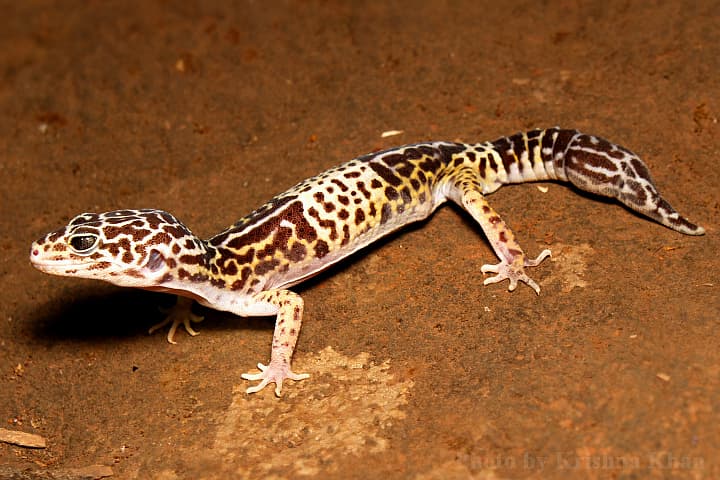
Eublepharis fuscus
The West Indian leopard gecko (Eublepharis fuscus) is a robust gecko species found in western India and potentially extending into southeastern Pakistan. Known for its dusky coloration, it inhabits forested hill tracts, scrub, and rocky areas. This nocturnal, terrestrial lizard primarily preys on scorpions and other arthropods.

Leposternon polystegum
The Bahia worm lizard (Leposternon polystegum) is a species of amphisbaenian endemic to Brazil. It is characterized by sexual dimorphism, with males exhibiting larger and longer bodies than females. Its diet primarily consists of ants, earthworms, and termites.