
Tarentola boehmei
Böhme's gecko, scientifically known as Tarentola boehmei, is a medium-sized lizard found in western North Africa. This species inhabits rocky areas like cliffs and walls, as well as ruins and urban environments. It is distinguished by its vertical slit pupils, flattened digits with enlarged tips, and a unique rosette of tubercles on its flanks.
Key Facts
- ›Native to western North Africa, including southern Morocco and northern Western Sahara.
- ›Inhabits rocky areas, cliffs, walls, ruins, and urban environments.
- ›Medium-sized with a snout-to-vent length of up to 7.5 cm.
- ›Features vertical slit pupils and flattened digits with enlarged tips.
- ›Classified as 'Least Concern' by the IUCN due to its commonality and tolerance to habitat disturbance.
- ›Reproduction is oviparous, meaning it lays eggs.

BöHme's Gecko, Morocco Wall Gecko
Southern Morocco, Northern Western Sahara, Algeria, Mauritania
Rocky Areas, Cliffs, Walls, Ruins of Buildings, Urban Areas, Subtropical Dry Shrublands, Tropical Dry Shrublands, Rural Gardens
- Medium-Sized Lizard With A Snout-To-Vent Length of Up To 7.5 cm .
- Total Length, Including Tail, Is Approximately 11 cm .
- Possesses A Vertical Slit Pupil.
- Eyelids Are Fused and Replaced By A Transparent Membrane, Preventing Full Closure.
- Digits Are Flattened With Enlarged Tips.
- Features A Distinctive Rosette of Secondary Tubercles Surrounding Primary Tubercles On the Flanks.
- Nostrils Are United On the Snout.
About Tarentola boehmei
Böhme's Gecko (Tarentola boehmei)
Böhme's gecko, scientifically classified as Tarentola boehmei, is a species of lizard belonging to the Phyllodactylidae family. This gecko is commonly referred to as the Morocco wall gecko due to its prevalence in that region.
Description and Characteristics
This is a medium-sized gecko, typically measuring around 7.5 cm (3.0 in) in snout-to-vent length, with a total length reaching approximately 11 cm (4.3 in) including the tail. A notable characteristic is its vertical slit pupil, accompanied by fused eyelids that are replaced by a transparent membrane. The digits of Tarentola boehmei are flattened and possess enlarged tips, aiding in its arboreal or climbing activities. A unique feature is the presence of a rosette of secondary tubercles encircling the primary tubercles on its flanks. The nostrils are also united on the snout.
Distribution and Habitat
The natural range of Böhme's gecko is western North Africa. It is found in southern Morocco and northern Western Sahara, with potential occurrences noted in Algeria and Mauritania. Within these regions, the species thrives in rocky environments such as cliffs and walls. It has also adapted well to human-modified landscapes, frequently inhabiting ruins of buildings, rural gardens, and urban areas. Its preferred natural habitats include subtropical and tropical dry shrublands.
Reproduction and Conservation
Tarentola boehmei is an oviparous species, meaning it reproduces by laying eggs. Despite its relatively restricted geographic range, Böhme's gecko is considered common in many parts of its distribution. The species demonstrates a tolerance to habitat disturbance, and its population trend appears steady. Consequently, the International Union for Conservation of Nature (IUCN) has assessed its conservation status as 'Least Concern', indicating no immediate threats to its survival.
Etymology
The specific name, boehmei, and the common name, Böhme's gecko, were chosen in honor of the German herpetologist Wolfgang Böhme.
Source: Wikipedia ↗
Frequently Asked Questions
What is Tarentola boehmei commonly called?
Tarentola boehmei is commonly known as Böhme's gecko. It is also frequently referred to as the Morocco wall gecko.
Where can Böhme's gecko be found?
Böhme's gecko is native to western North Africa. Its range includes southern Morocco, northern Western Sahara, with possible occurrences in Algeria and Mauritania.
What kind of habitat does Böhme's gecko prefer?
This species prefers subtropical or tropical dry shrublands and rocky areas. It is also commonly found in ruins of buildings, rural gardens, and urban areas.
What are the distinguishing physical features of Böhme's gecko?
Böhme's gecko has a vertical slit pupil and eyelids that cannot close, protected by a transparent membrane. Its digits are flattened with enlarged tips, and its flanks have a distinctive rosette of secondary tubercles around primary ones.
What is the conservation status of Böhme's gecko?
The International Union for Conservation of Nature (IUCN) has assessed Böhme's gecko as 'Least Concern'. This is due to its relatively common presence in many parts of its range and its tolerance to habitat disturbance.
How does Böhme's gecko reproduce?
Tarentola boehmei is oviparous, which means it reproduces by laying eggs.
Related Lizards

Sharp-snouted rock lizard
The sharp-snouted rock lizard, scientifically known as *Dalmatolacerta oxycephala*, is a slender, flattened lizard characterized by its pointed snout and distinctive hind toes. It inhabits diverse rocky and shrubby environments across the Balkans, exhibiting color variations adapted to its specific altitude and locale. This hardy species is well-camouflaged and known for its climbing abilities.
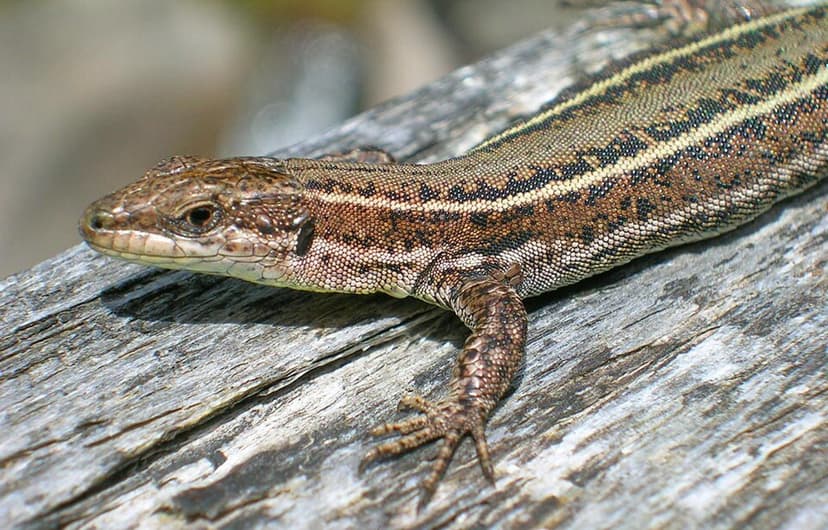
Podarcis hispanicus
The Iberian wall lizard (Podarcis hispanicus) is a small, agile lizard found across the Iberian Peninsula, parts of northwestern Africa, and coastal France. Characterized by its brown or grey-brown coloration with darker spots and a slender, flattened body, it is known for its territorial behavior, especially among males. This species is oviparous, laying clutches of eggs that hatch after approximately eight weeks, and has a lifespan of about four years.

Gecko gecko
The tokay gecko is a large, nocturnal, and arboreal lizard native to Asia and some Pacific Islands. It is known for its striking blue-gray skin with red or orange spots, its strong bite, and the distinctive "tokay" call made by males. These geckos inhabit rainforests and have adapted to human habitations, often found on walls and ceilings.