
Podarcis hispanicus
The Iberian wall lizard (Podarcis hispanicus) is a small, agile lizard found across the Iberian Peninsula, parts of northwestern Africa, and coastal France. Characterized by its brown or grey-brown coloration with darker spots and a slender, flattened body, it is known for its territorial behavior, especially among males. This species is oviparous, laying clutches of eggs that hatch after approximately eight weeks, and has a lifespan of about four years.
Key Facts
- ›Small, slender, and flattened wall lizard species.
- ›Found in the Iberian Peninsula, northwestern Africa, and southern France.
- ›Males are territorial and exhibit intrasexual aggression.
- ›Females lay clutches of 1-5 oval eggs.
- ›Juveniles have a snout-to-vent length of 2-2.5 cm at birth.
- ›Lifespan averages around four years.
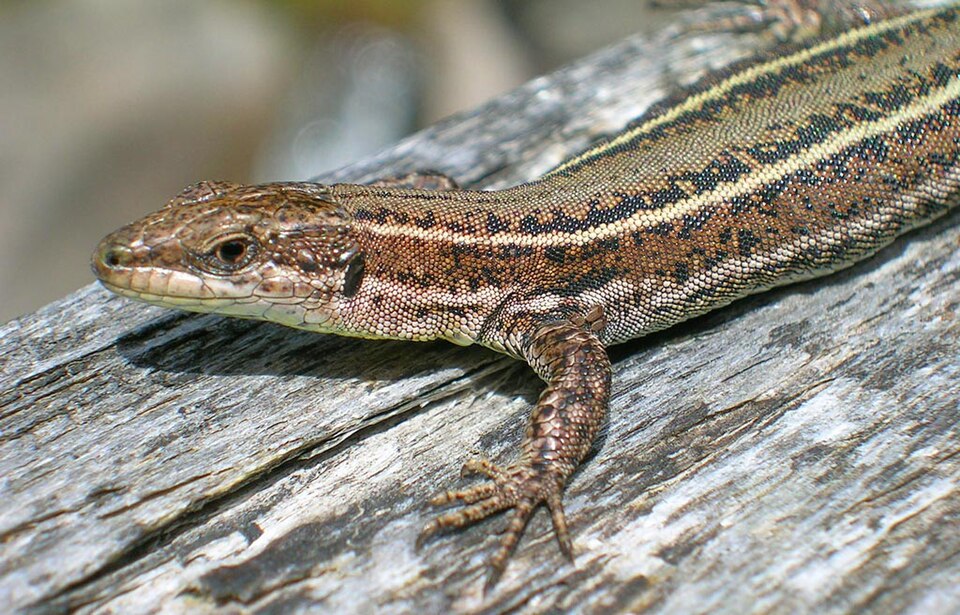
Iberian Wall Lizard, Lagartija IbéRica
Iberian Peninsula, Northwestern Africa, Southwestern France
Rocks, Cliffs, Walls, Parapets, Road Cuttings, Tree Trunks, Urban Sites
- Small, Slender, and Somewhat Flattened Species.
- Snout-To-Vent Length Averages 50–70 mm .
- Tail Is Approximately Twice the Length of the Body.
- Adults Have Brown Or Grey-Brown Skin With Darker Spots Or Patterns On Their Back and Side Flanks.
- Can Have Stripes Or Reticulations; Striped Individuals Are Darker With More Black Coloration.
- Background Color Is Usually Grey Or Brown, Occasionally Greenish.
- Most Individuals Have Three Narrow Longitudinal Stripes.
- Throat Is Pale With Small Spots; Belly Is Usually Whitish But Can Be Pink, Orange, Red, Or Buff.
- Juveniles May Have Blue Tails.
- Lizards In Cooler Regions Are Typically Heavier, Larger, and Have Darker Back Coloration Than Those In Warmer, Humid Environments.
Insects, Worms, Other Invertebrates, Tail of Another Member of the Same Species
- Very Agile and Moves Rapidly.
- Males Are Somewhat Territorial.
- Exhibit Intrasexual Aggression, Motivated By Resources and Potential Mates.
- Employ Strategies To Minimize Injury and Energy Expenditure During Conflicts.
- Recognize Past Competitors Through Memory of Physical Features Or Chemosensory Cues.
- Sociability Depends On Conspecific Recognition of Sex, Reproducibility, Social Ranking, and Group Membership.
- Use Scent Marks For Communication and To Assess Threats.
- Territorial and Readily Explore New Environments.
- Tongue Flicking Is Used To Collect Substrate Chemicals, Recognize Scent Marks, and Detect Predators.
- Exhibit 'Dear Enemy' Behavior, Being Less Aggressive Towards Neighbors Than Intruders.
- Polygynandrous Mating System With Multiple Mating Partners.
- Males Are Often More Territorial and Defensive of Resources Than Mating Partners.
- Females Use Chemosensory Mechanisms To Identify Suitable Territories.
- Adapt To Urban Environments, Spending Less Time Hidden After Attacks.
- Adjust Risk Assessment According To Environmental Conditions and Predatory Pressures.
About Podarcis hispanicus
Podarcis hispanicus: The Iberian Wall Lizard
The Iberian wall lizard, scientifically known as Podarcis hispanicus, is a small and agile species recognized for its adaptability and widespread presence across diverse habitats. This lizard is commonly found throughout the Iberian Peninsula, extending into northwestern Africa and coastal regions of southern France. Its common Spanish name is lagartija Ibérica.
Physical Characteristics and Description
Podarcis hispanicus is characterized by its slender, somewhat flattened body, typically measuring between 50–70 mm in snout-to-vent length, with a tail that is roughly twice the length of its body. Adults usually display a brown or grey-brown coloration, often adorned with darker spots or patterns across their back and flanks. While color diversity is somewhat limited compared to other species, they may exhibit stripes or reticulations, with striped individuals tending to be darker. The background coloration can range from grey or brown to occasional greenish hues. A common feature is the presence of three narrow longitudinal stripes, though these can sometimes appear as broken streaks. The ventral side is typically whitish, though it can also be pink, orange, red, or buff, and the throat is pale with scattered small spots. Notably, juveniles may possess vibrant blue tails, which are autotomizable and can serve as a decoy or escape mechanism.
Habitat and Distribution
This species thrives in a variety of environments, demonstrating its versatile nature. It is frequently observed on rocks, cliffs, walls, parapets, road cuttings, and occasionally on tree trunks, often at altitudes reaching up to 2,500 meters. Its distribution spans the Iberian Peninsula (Spain and Portugal), northwestern Africa (including Morocco, Algeria, and Tunisia), and southwestern France. A distinct subspecies, Podarcis hispanicus atratus, inhabits the Columbretes Islands off the eastern coast of the Iberian Peninsula. Studies indicate some gene flow and hybridization occur where their ranges overlap with other closely related species.
Behavior and Ecology
Iberian wall lizards are known for their rapid movements and territorial nature, particularly among males. These males engage in intrasexual aggression, driven by competition for resources and mates, often employing strategies to minimize injury. They possess a remarkable ability to recognize past competitors and neighbors through memory and chemosensory cues, which helps in quickly determining conflict outcomes. Their social interactions are heavily influenced by conspecific recognition, allowing for the establishment of long-term partnerships and mating possibilities. The lizards utilize scent marks, secreted from femoral glands in males, to communicate sex, identity, and territorial status, even in the absence of visual contact. This chemosensory communication is crucial for courtship and assessing potential threats.
Exploratory behavior, including tongue flicking, is integral to how Podarcis hispanicus gathers environmental information, recognizes scent marks, and detects predators like snakes. They exhibit a "dear enemy" strategy, displaying less aggression towards familiar neighbors than unknown intruders, which conserves energy. During the reproductive season, coloration can shift; lowland individuals may lighten ventrally to maximize visibility for mates, while dorsal coloration can brighten for thermoregulation or darken at higher altitudes for UV protection. They also adapt their coloration for camouflage, blending with their surroundings to avoid detection.
Reproduction
Podarcis hispanicus reproduces oviparously, with females laying clutches of one to five oval eggs. These eggs typically hatch after about eight weeks. The species engages in a polygynandrous mating system, where males often have multiple mating partners due to their dominance and territorial behaviors. Females use chemosensory cues to select territories offering refuge, resources, and reduced predation, often choosing those with dominant conspecific males. While intersexual aggression is uncommon, females may sometimes prefer smaller males to avoid harassment. Males maximize reproductive success by preferentially mating with females within their own territories.
Conservation and Human Interaction
The Iberian wall lizard is classified as "Least Concern" by the IUCN due to its wide distribution, large population, and adaptability. It faces no particular threats, though its habitats are subject to alteration by increasing human activities. Lizards inhabiting urban areas show notable adaptations, such as spending less time hidden after predatory attacks and habituating more quickly to environmental changes, indicating a capacity to adjust their risk assessment and wariness in response to human presence.
Source: Wikipedia ↗
Frequently Asked Questions
What is the scientific name for the Iberian wall lizard?
The scientific name for the Iberian wall lizard is Podarcis hispanicus. It is also sometimes referred to by its common name, the Iberian wall lizard.
Where can I find Iberian wall lizards?
Iberian wall lizards are naturally found in the Iberian Peninsula (Spain and Portugal), northwestern Africa, and in coastal districts of Languedoc-Roussillon in France.
What do Iberian wall lizards eat?
The Iberian wall lizard is primarily insectivorous, feeding on insects, worms, and other invertebrates. Isolated cases of cannibalism, specifically eating the tail of another lizard of the same species, have been observed.
How long do Iberian wall lizards live?
The typical lifespan of an Iberian wall lizard is about four years in the wild.
Are Iberian wall lizards territorial?
Yes, male Iberian wall lizards are somewhat territorial and can display aggressive behaviors, particularly during the breeding season, to defend resources and potential mates.
What are the distinctive physical features of Podarcis hispanicus?
Podarcis hispanicus adults typically have brown or grey-brown skin with darker spots or patterns. They are slender and flattened, with a snout-to-vent length averaging 50–70 mm and a tail twice the length of their body. Some juveniles may have blue tails.
Do Iberian wall lizards have any unique defense mechanisms?
Yes, their tails are autotomizable, meaning they can be detached as a last resort escape mechanism. These vibrant tails can also serve as decoys to divert predator attacks from vital body areas.
Related Lizards

Lacertilia
Lizards are a diverse group of reptiles, encompassing over 7,000 species found on every continent except Antarctica. They exhibit a wide range of sizes, from tiny chameleons to the massive Komodo dragon, and possess characteristics like scales, four limbs (though some are legless), and long tails. Lizards inhabit nearly every environment, from deserts to rainforests, and play crucial roles as both predators and prey within their ecosystems.

Agama
Agama are a genus of small to moderate-sized, long-tailed lizards native to Africa, particularly sub-Saharan regions. Known for their insectivorous diet and ability to adapt to various habitats, including human settlements, they display striking color changes based on mood and gender. These diurnal reptiles are characterized by powerful hind legs for swift movement and are recognized by their common names, some referencing their head-bobbing displays.

Lygodactylus blanci
Blanc's dwarf gecko, scientifically known as Lygodactylus blanci, is a species of lizard native to central Madagascar. It is characterized by its relatively large size for its genus, reaching up to 4 cm in snout-to-vent length, and possesses whorled tails. This species is oviparous and is known to inhabit large rocks, buildings, and tall trees, demonstrating adaptability to human environments.