
Trachylepis dumasi
Trachylepis dumasi is a small skink species endemic to Madagascar, belonging to the family Scincidae. Its preferred habitats include forests and rocky areas. The species is distinguished by its brown coloration on its dorsal side, covering the head, body, and tail.
Key Facts
- ›Endemic to Madagascar.
- ›Found in forest and rocky habitats.
- ›Maximum recorded snout-to-vent length is 5.5 cm (2.2 inches).
- ›Dorsal coloration is brown on the head, body, and tail.
- ›Its mode of reproduction is currently unknown.

Madagascar
Relatively Small Species., Maximum Snout-To-Vent Length of 5.5 cm ., Dorsally, the Head, Body, and Tail Are Brown.
About Trachylepis dumasi
Trachylepis dumasi is a species of skink, a type of lizard belonging to the family Scincidae. This species is endemic to the island of Madagascar, meaning it is found naturally nowhere else in the world.
Habitat and Distribution
The preferred natural habitats for Trachylepis dumasi are forest environments and rocky areas. It has been observed at altitudes ranging between 100 and 250 meters (approximately 330 to 820 feet). Its distribution is confined to Madagascar.
Physical Characteristics
Trachylepis dumasi is considered a relatively small species within its genus. The maximum recorded snout-to-vent length (SVL) for an individual is 5.5 centimeters (about 2.2 inches). The dorsal side of the skink, encompassing its head, body, and tail, is characterized by a brown coloration.
Reproduction
Information regarding the specific mode of reproduction for Trachylepis dumasi is not currently documented. Further scientific study is required to understand how this species reproduces.
Taxonomy and Etymology
The scientific name, dumasi, was given in honor of the American herpetologist Philip Conrad Dumas. Historically, this species has also been referred to in taxonomic literature under different genus names, including Euprepis, Eutropis, and Mabuya, before its current placement in the genus Trachylepis.
Source: Wikipedia ↗
Frequently Asked Questions
What is Trachylepis dumasi?
Trachylepis dumasi is a species of skink, a type of lizard that belongs to the family Scincidae. It is found exclusively in Madagascar.
Where does Trachylepis dumasi live?
This skink species primarily inhabits forests and rocky areas. It is typically found at altitudes ranging from 100 to 250 meters (330 to 820 feet) above sea level.
What does Trachylepis dumasi look like?
Trachylepis dumasi is a relatively small skink. Its head, body, and tail are all brown on the dorsal side. The maximum recorded snout-to-vent length for this species is 5.5 cm (2.2 inches).
How does Trachylepis dumasi reproduce?
The specific mode of reproduction for Trachylepis dumasi is not currently known. Further research is needed to understand its reproductive strategies.
What is the scientific classification of Trachylepis dumasi?
Trachylepis dumasi is classified within the family Scincidae, commonly known as skinks. Its genus is Trachylepis.
Related Lizards
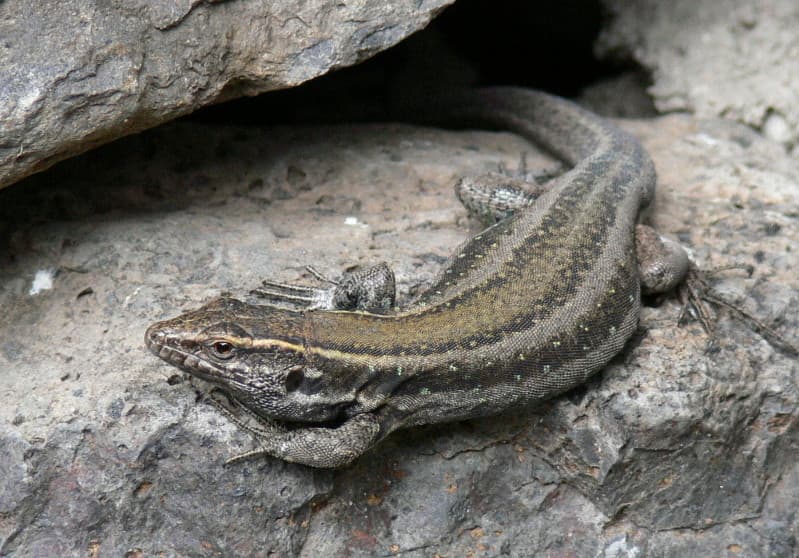
Boettger's lizard
Boettger's lizard (Gallotia caesaris) is a species of wall lizard endemic to the western Canary Islands, specifically El Hierro and La Gomera. This oviparous reptile inhabits rocky areas, shrubland, and forests, and is known for its capacity to lay multiple clutches of eggs per year. It is closely related to the Gallotia galloti species found on neighboring islands.
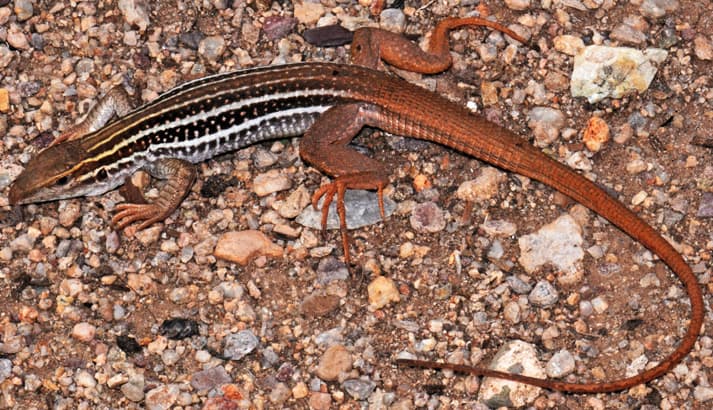
Canyon Spotted Whiptail
The Canyon Spotted Whiptail, also known as el huico manchado de cañón, is a lizard species found in northwestern Mexico and the southwestern United States. It inhabits forests, shrublands, and rocky areas, and is oviparous, laying eggs as its primary method of reproduction.

Danford's lizard
Danford's lizard (Anatololacerta danfordi) is a species of lizard belonging to the Lacertidae family, found in rocky areas within forests and shrublands across Greece and Turkey. This oviparous species is known to lay clutches of 3 to 8 eggs. It was named in honor of the zoologist Charles G. Danford.