
Uma notata
The Colorado Desert fringe-toed lizard (Uma notata) is a medium-sized, diurnal lizard found in the sandy habitats of the Colorado Desert in the United States and Mexico. This species is distinguished by its light pea-green coloration with darker green spots, a white underside, and unique orange/pinkish stripes on its flanks.
Key Facts
- ›Found in sand dunes of the Colorado Desert.
- ›Distinguished by orange/pinkish stripes on its underside.
- ›Original description noted a light pea-green color with darker spots.
- ›Occupies windblown sands in Imperial County, California, and Sonora, Mexico.
- ›A former subspecies, U. n. rufopunctata, is now considered a hybrid.

Colorado Desert Fringe-Toed Lizard
United States, Mexico
- Medium-Sized Lizard.
- Head Is Two-Fifths the Size of the Head and Body.
- Coloration Is Light Pea-Green, Spotted With Darker Green.
- Underside Is White.
- Possesses Orange/Pinkish Stripes On the Sides of Its Underside.
Diurnal
About Uma notata
Colorado Desert Fringe-toed Lizard (Uma notata)
The Colorado Desert fringe-toed lizard, scientifically known as Uma notata, is a medium-sized reptile adapted to the harsh, arid conditions of its desert environment. It is a diurnal species, meaning it is active during daylight hours, and is most commonly found inhabiting the vast windblown sand dunes characteristic of the Colorado Desert.
Habitat and Distribution
This lizard's primary domain is the sandy expanse of the Algodones Dunes, located in Imperial County, California. Its range extends south across the international border into Sonora, Mexico, where it thrives in these specific dune ecosystems. The species relies on the unique substrate of loose sand for its survival and behavior.
Physical Characteristics
First described in 1859, Uma notata was noted for its distinct coloration. Its head is proportionally large, measuring approximately two-fifths the length of its head and body combined. The lizard's upper body is typically a light pea-green, adorned with darker green spots. A notable feature that aids in its identification is the presence of orange or pinkish stripes along the sides of its white underside, differentiating it from closely related species.
Taxonomy
Historically, a subspecies named Uma notata rufopunctata was recognized. However, taxonomic studies conducted in 2016 revealed that this designation represented a hybrid population, resulting from interbreeding between Uma notata and Uma cowlesi, rather than a distinct subspecies. This finding has led to a revised understanding of the species' genetic landscape.
Source: Wikipedia ↗
Frequently Asked Questions
What are the distinguishing features of the Colorado Desert fringe-toed lizard?
The Colorado Desert fringe-toed lizard can be identified by its light pea-green body with darker green spots and a white underside. A key distinguishing feature is the presence of orange or pinkish stripes on the sides of its underside.
Where is the Colorado Desert fringe-toed lizard found?
This lizard species is primarily found in the vast, windblown sand dune systems of the Colorado Desert. Its range includes the Algodones Dunes in Imperial County, California, and it also extends across the border into Sonora, Mexico.
What was the original description of Uma notata?
The original description in 1859 noted that Uma notata had a head that was two-fifths the size of its head and body. It was described as being a light pea-green, spotted with darker green, and possessing a white underside.
Is the taxonomy of Uma notata straightforward?
The taxonomy for one of its former subspecies, Uma notata rufopunctata, has been unsettled. Recent findings in 2016 indicate that this group actually represents a hybrid population between Uma notata and Uma cowlesi.
Related Lizards
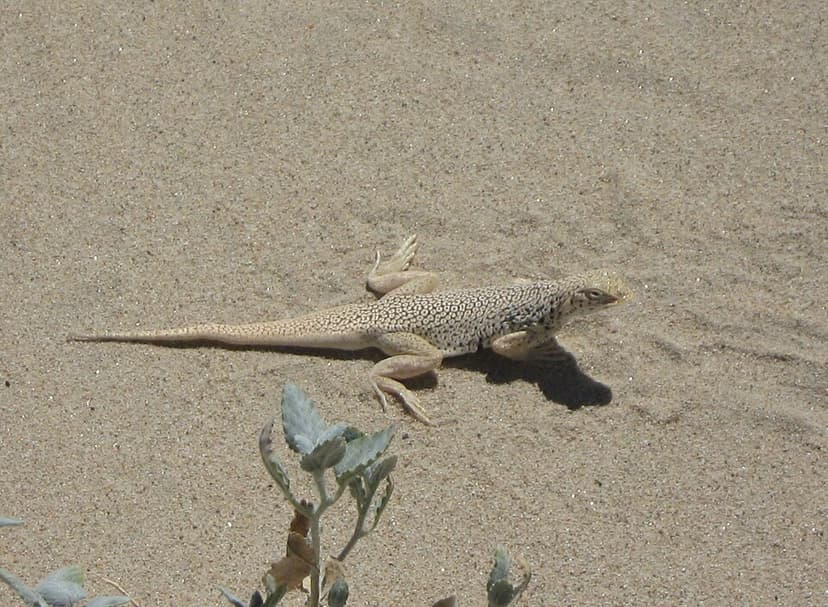
Uma scoparia
The Mojave fringe-toed lizard (Uma scoparia) is a medium-sized, diurnal lizard adapted to arid desert environments, particularly sand dunes. It is distinguished by unique fringed scales on its hind toes, which aid in locomotion across loose sand, and by its coloration, which camouflages it against its environment. This species exhibits distinct territorial behaviors in males and a diet that shifts seasonally between invertebrates and plant matter.
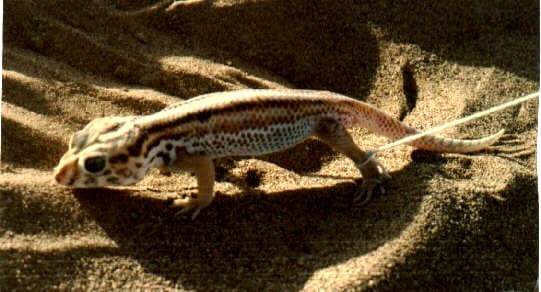
Teratoscincus scincus
Teratoscincus scincus, also known as the common wonder gecko or frog-eyed gecko, is a species of lizard native to the arid regions of Asia. It is well-adapted to desert life with specialized scales on its digits for sandy terrain and a broad head with large eyes. This nocturnal gecko primarily inhabits deserts and semi-arid areas, digging burrows to regulate its temperature and hydration.

Anguis veronensis
Anguis veronensis, also known as the Italian slow worm, is a legless lizard species found across Italy and parts of southeastern France. It is distinguished from similar species by its relatively longer tail, more subcaudal scales, and a more robust head, although genetic analysis is often required for definitive identification. This species inhabits a variety of environments, from forest-steppes and urban areas to Mediterranean shrublands, and is primarily active during the day or twilight.