
Uroplatus ebenaui
Uroplatus ebenaui, also known as Ebenau's leaf-tailed gecko, is the smallest species in the Uroplatus genus, reaching up to 4 inches in total length. This arboreal and nocturnal lizard is native to Madagascar and inhabits tropical rainforests and dry deciduous forests. It is well-camouflaged against tree bark and primarily feeds on insects.
Key Facts
- ›Smallest species within the Uroplatus genus.
- ›Native to Madagascar and Nosy Bé island.
- ›Arboreal and nocturnal, hiding on tree trunks during the day.
- ›Feeds on insects at night.
- ›Reproduces by laying two spherical eggs on the ground.

Ebenau's Leaf-Tailed Gecko, Nosy Be Flat-Tail Gecko, Spearpoint Leaf-Tail Gecko
Madagascar, Nosy Bé Island
Smallest Species of Uroplatus., Can Reach A Total Length of Up To 4 Inches ., Well-Camouflaged Against Tree Bark.
Insects
Arboreal, Nocturnal, Inactive During the Day, Camouflages By Flattening Against Tree Trunks
About Uroplatus ebenaui
Uroplatus ebenaui, commonly known as Ebenau's leaf-tailed gecko, is the smallest member of the Uroplatus genus of geckos. This species is native to the island of Madagascar and its adjacent island, Nosy Bé. It is a fascinating reptile distinguished by its remarkable camouflage and nocturnal habits.
Habitat and Distribution
Ebenau's leaf-tailed gecko inhabits tropical rainforests and dry deciduous forests. Its range extends across eastern and northern Madagascar, as well as Nosy Bé island, at altitudes from sea level up to 500 meters. This arboreal species is perfectly adapted to living amongst trees, where its appearance helps it blend into the bark.
Physical Characteristics and Behavior
Reaching a modest total length of up to 4 inches, Uroplatus ebenaui is characterized by its flattened body and tail, which aid in its camouflage. It is a nocturnal creature, spending daylight hours inactive and pressed flat against tree trunks. At night, it becomes active to hunt for its primary food source: insects. This behavior, coupled with its cryptic coloration, makes it exceptionally difficult to spot in its natural environment.
Reproduction
As an oviparous species, Uroplatus ebenaui reproduces by laying eggs. Females typically deposit a clutch of two spherical eggs on the ground. The specific details regarding incubation periods and parental care are not extensively documented in general accounts.
Taxonomy
While recognized as a distinct species, there is some scientific consideration that Uroplatus ebenaui might represent a complex of species, indicating potential further divisions or related species within this group that require additional study.
Source: Wikipedia ↗
Frequently Asked Questions
What is Uroplatus ebenaui commonly known as?
Uroplatus ebenaui is commonly known by several names, including Ebenau's leaf-tailed gecko, the Nosy Be flat-tail gecko, and the spearpoint leaf-tail gecko.
Where can Uroplatus ebenaui be found?
This species is native to Madagascar and is found on Nosy Bé island, as well as in eastern and northern parts of the mainland. It inhabits areas with altitudes ranging from sea level up to 500 meters.
What kind of habitat does Uroplatus ebenaui prefer?
Uroplatus ebenaui thrives in tropical rainforests and dry deciduous forests. Its camouflage allows it to blend in with tree bark in these environments.
What are the physical characteristics of Uroplatus ebenaui?
Uroplatus ebenaui is the smallest species of Uroplatus. It can grow to a total length of approximately 4 inches, including its tail, and is well-camouflaged to resemble tree bark.
How does Uroplatus ebenaui behave?
This gecko is arboreal, meaning it lives in trees, and is nocturnal, meaning it is active at night. During the day, it remains inactive, flattened against tree trunks to camouflage itself.
What does Uroplatus ebenaui eat?
The diet of Uroplatus ebenaui consists of insects. It hunts for these at night, its active period.
How does Uroplatus ebenaui reproduce?
Uroplatus ebenaui is oviparous, meaning it lays eggs. A clutch typically consists of two spherical eggs, which are laid on the ground.
Related Lizards

Uroplatus fimbriatus
The common flat-tail gecko (Uroplatus fimbriatus) is a large, nocturnal gecko native to the tropical rainforests of eastern Madagascar and its surrounding islands. It is distinguished by its flattened tail and fringed skin, adaptations that aid in camouflage against tree bark. This species possesses highly sensitive eyes, allowing for color vision even in low light conditions.
Uroplatus lineatus
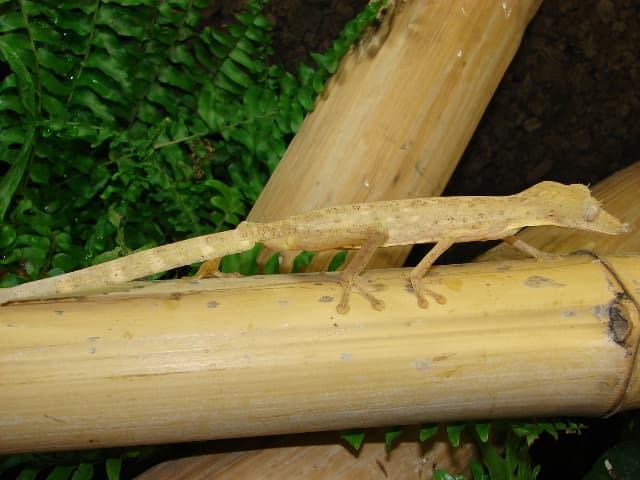
The lined flat-tail gecko (Uroplatus lineatus) is a species of gecko native to eastern Madagascar and the island of Nosy Bohara. These lizards are arboreal, inhabiting tropical rainforests and bamboo plants, and are characterized by their total length of up to 270 mm and distinctive longitudinal stripes. Unfortunately, deforestation and the illegal pet trade pose significant threats to their survival.

Argentine black and white tegu
The Argentine black and white tegu (Salvator merianae) is a large, omnivorous lizard native to South America, inhabiting tropical rainforests, savannas, and semideserts. Known for its intelligence and docile nature, this species is also notable for its unique partly endothermic behavior during the breeding season. It can reach lengths of up to 1.4 meters and is recognized by its distinctive black and white or green and black coloration.