
Urosaurus graciosus
The western long-tailed brush lizard (Urosaurus graciosus) is a species of lizard found in the southwestern United States and northern Mexico, inhabiting desert environments. It is distinguished by its exceptionally long tail, which can be more than twice its body length, and its habit of perching on branches rather than burying itself at night. Its coloration provides camouflage against shrubbery where it hunts for insects.
Key Facts
- ›Native to the Mojave and northwestern Sonoran deserts.
- ›Characterized by a tail more than twice the length of its body.
- ›Spends nights on branch tips, unlike many related species that burrow.
- ›Possesses gray or tan coloration for camouflage on branches.
- ›Distinguishable from close relatives by tail length and scale patterns.
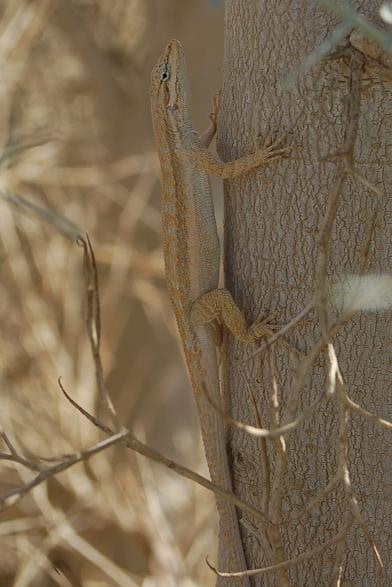
Western Long-Tailed Brush Lizard, Long-Tailed Brush Lizard
Southwestern United States, Northern Mexico
- Tail Is More Than Twice the Body Length .
- Gray Or Tan Coloration For Camouflage.
- Distinguishable From Urosaurus Ornatus By Tail Length and Specific Dorsal Scale Arrangement.
- Transitional Dorsal Scales Abruptly Into Granular Lateral Scales.
Insects
Spends Nights On the Tips of Branches., Well Camouflaged Against Branches., Waits For Insects On Branches.
About Urosaurus graciosus
Urosaurus graciosus: The Western Long-Tailed Brush Lizard
The western long-tailed brush lizard, scientifically designated as Urosaurus graciosus, is a distinctive reptile native to the arid landscapes of the southwestern United States and adjacent northern Mexico. This species is most readily identified by its remarkably elongated tail, which significantly surpasses twice the length of its body, and its characteristic perch on trees or shrubs. Its survival is closely tied to these elevated positions, as it utilizes them both for camouflage and for ambushing its insect prey.
Habitat and Range
Urosaurus graciosus predominantly inhabits the Mojave Desert and the northwestern reaches of the Sonoran Desert. Within the United States, its range encompasses parts of California, Arizona, and Nevada. In Mexico, it is found in the states of Baja California and Sonora. These desert environments provide the necessary arid conditions and shrubby vegetation that this lizard thrives in.
Physical Characteristics and Behavior
The lizard's coloration, typically gray or tan, allows it to blend seamlessly with the branches it inhabits, making it well-camouflaged from both predators and prey. A key behavioral distinction of Urosaurus graciosus from many of its relatives in the Phrynosomatidae family is its nightly resting habit. While other species in its family often burrow into the sand for protection and warmth during the night, the western long-tailed brush lizard prefers to spend its nights on the tips of branches, a behavior that sets it apart.
Identification and Taxonomy
Distinguishing Urosaurus graciosus from closely related species, such as Urosaurus ornatus (tree lizard) and Urosaurus nigricauda (black-tailed brush lizard), involves careful observation of its tail length and scale morphology. Its tail is consistently more than twice its snout-vent length. Furthermore, it lacks the specific arrangement of smaller scales down the middle of its enlarged dorsal scales found in U. ornatus. Compared to U. nigricauda, U. graciosus possesses relatively large dorsal scales that transition more abruptly into granular lateral scales. The species is oviparous, meaning it reproduces by laying eggs. Two subspecies are recognized: Urosaurus graciosus graciosus and Urosaurus graciosus shannoni.
Source: Wikipedia ↗
Frequently Asked Questions
What is the western long-tailed brush lizard?
The western long-tailed brush lizard, scientifically known as Urosaurus graciosus, is a species of lizard native to the southwestern United States and northern Mexico. It is recognized for its long tail and its preference for dwelling on shrubs and trees.
Where does the western long-tailed brush lizard live?
This lizard is found in the Mojave Desert and the northwestern Sonoran Desert. Its range includes parts of California, Arizona, and Nevada in the United States, and Baja California and Sonora in Mexico.
What makes the western long-tailed brush lizard unique?
Its most striking feature is its tail, which is more than twice the length of its body. Additionally, unlike many other lizards in its family that bury themselves in sand at night, Urosaurus graciosus typically stays on the tips of branches.
How can I identify a western long-tailed brush lizard?
Key identifiers include its tail length, which is significantly longer than its snout-vent length, and its scale patterns. It can be distinguished from its close relative, Urosaurus ornatus, by the absence of a specific arrangement of smaller scales along its back.
What does the western long-tailed brush lizard eat?
The western long-tailed brush lizard primarily feeds on insects. Its coloration helps it remain camouflaged on branches while it waits for prey.
How does this lizard behave at night?
Most other lizards in the Phrynosomatidae family bury themselves in the sand to spend the night, especially during warm weather. However, Urosaurus graciosus has a distinct behavior of resting on the tips of branches throughout the night.
Related Lizards

Brachysaura minor
Hardwicke's bloodsucker, also known as Calotes minor, is a small, stocky agamid lizard found across South Asia. It is characterized by its pot-belly, short tail, and distinct olive-brown coloration with dark-brown spots. Primarily terrestrial and diurnal, this harmless species inhabits dry forests, arid environments, and barren deserts.
Hardwicke's bloodsucker
Hardwicke's bloodsucker (Calotes minor) is a small, stocky agamid lizard native to South Asia. It is characterized by its pot-belly appearance, large head, and distinctively patterned olive-brown coloration with dark-brown, light-edged spots. This terrestrial and sometimes arboreal species inhabits arid environments and dry forests, playing a role in its ecosystem by consuming insects.

Ctenophorus fordi
The Mallee dragon (Ctenophorus fordi) is a small lizard native to the arid regions of southern Australia, characterized by its reddish-orange coloration and pale, black-bordered stripes. It inhabits shrubland and hummock grass environments, particularly in Mallee woodlands and spinifex areas, often near vegetated sand dunes. This species is primarily an ant specialist, employing a sit-and-wait strategy to ambush its prey.