
Varanus gilleni
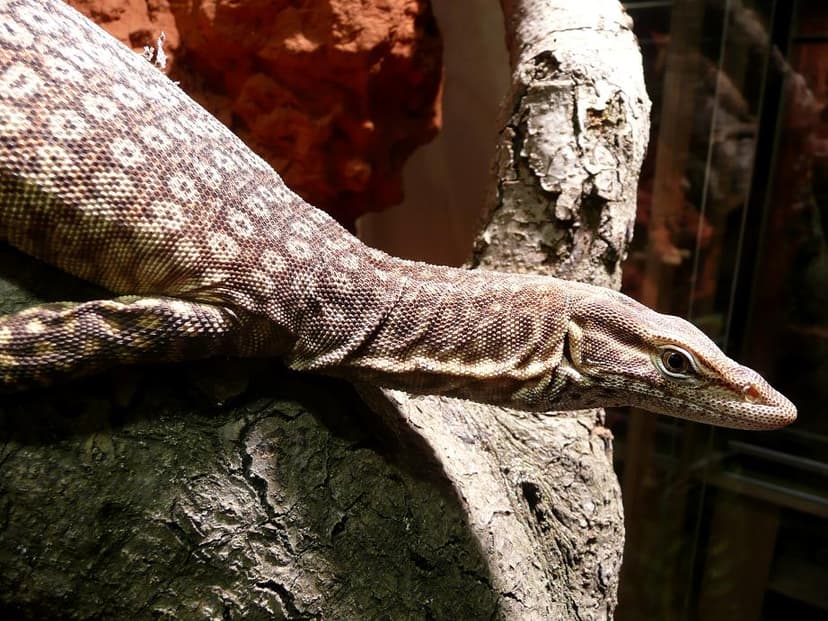
The pygmy mulga monitor (Varanus gilleni) is an arboreal lizard native to Australia, recognized by its prehensile tail and a total length of around 40 cm. This species is exceptionally adapted to arid conditions and possesses remarkable endurance. It primarily inhabits spinifex sandplains and is often found in the bark or hollows of various trees.
Key Facts
- ›Endemic to Australia, found in spinifex sandplains of the northwest and center.
- ›Arboreal with a prehensile tail, reaching up to 40 cm in total length.
- ›Possesses very high endurance and is well-adapted to arid conditions, losing water at a reduced rate.
- ›Diet consists mainly of spiders, orthopterans, beetles, and other lizards, with a preference for geckos.
- ›Males and females can be distinguished by spines on the sides of the male's vent.
- ›Clutches of up to seven eggs are laid in burrows, hatching after approximately three months.

Gillen's Monitor, Mulga Monitor, Pygmy Mulga Monitor
Australia
Spinifex Sandplains, Woodlands, Arid Environments
- Arboreal Lizard With A Prehensile Tail.
- Total Length of Around 40 cm .
- Upper Surface Is Brown, Grading To Grey On the Sides.
- Nostrils Are Located On the Sides of the Muzzle, Halfway Between the Snout Tip and the Eye.
- Average Weight of 60–80 Grams .
- Males Have Spines On the Sides of Their Vent, Which Females Lack.
Spiders, Orthopterans, Beetles, Other Lizards, Bird Eggs, Small Mammals, Ant-Sized Prey
- Arboreal
- Forages On the Ground For Prey
- Ritualized Fighting Between Males Involving Grappling and Rolling
- High Endurance
- Adapted To Arid Conditions
Insectivore, Carnivore, Squamate-Eater
Birds of Prey, Snakes, Larger Monitors
About Varanus gilleni
The Pygmy Mulga Monitor
The pygmy mulga monitor, scientifically classified as Varanus gilleni and also commonly known as Gillen's monitor or simply the mulga monitor, is a distinctive species of lizard found exclusively in Australia. This arboreal reptile is characterized by its prehensile tail and a total length that typically reaches around 40 centimeters. Its upper body is brown, transitioning to a grey hue on its sides, and it possesses nostrils positioned laterally on its muzzle.
Habitat and Distribution
Varanus gilleni is native to the spinifex sandplains of northwestern and central Australia. It makes its home in various tree hollows and under the loose bark of desert she-oaks, eucalyptus, mulga, and myall trees, demonstrating a strong adaptation to arid woodland environments.
Diet and Behavior
Despite its arboreal lifestyle, the pygmy mulga monitor frequently forages on the ground for sustenance. Its diet is varied, consisting primarily of spiders, orthopterans, beetles, and other lizards, with a particular predilection for geckos. The species also supplements its diet with bird eggs, small mammals, and even very small, insect-like prey. Males of the species are known to engage in ritualized fighting, a behavior involving grappling with all four limbs and rolling on the ground.
Unique Adaptations
This lizard is renowned for its exceptional endurance, exhibiting one of the highest factorial aerobic scopes recorded in vertebrates. Furthermore, Varanus gilleni is remarkably well-adapted to arid conditions, capable of conserving water by losing it at approximately half the rate of other Australian monitor species. These traits underscore its successful survival in challenging desert landscapes.
Reproduction
Breeding activity for the pygmy mulga monitor likely occurs during September and October. Females are capable of laying clutches of up to seven eggs, which are deposited in burrows approximately 30 centimeters deep and then sealed with sand. The incubation period for these eggs lasts for about three months before hatching.
Predators
As a smaller monitor lizard species, Varanus gilleni faces predation from a number of animals. Common natural predators include birds of prey, various snake species, and larger monitor lizards, such as Gould's monitors.
Source: Wikipedia ↗
Frequently Asked Questions
What is the pygmy mulga monitor?
The pygmy mulga monitor, scientifically known as Varanus gilleni, is a species of lizard endemic to Australia. It is characterized by its arboreal nature, prehensile tail, and remarkable adaptation to arid environments. It is also commonly referred to as Gillen's monitor or the mulga monitor.
Where does the pygmy mulga monitor live?
This species is native to the spinifex sandplains of northwestern and central Australia. It typically resides in the loose bark of desert she-oaks or within the hollows of eucalyptus, mulga, and myall trees.
What does the pygmy mulga monitor eat?
Despite being an arboreal lizard, it forages on the ground for much of its food. Its diet primarily includes spiders, orthopterans, beetles, and smaller lizards, with a particular fondness for geckos. Bird eggs, small mammals, and even tiny, ant-sized prey are also consumed.
How large does a pygmy mulga monitor get?
The pygmy mulga monitor grows to a total length of approximately 40 cm, including its tail. Adults typically weigh between 60 and 80 grams.
How does the pygmy mulga monitor reproduce?
Breeding likely occurs between September and October. Males may engage in ritualized fighting, grappling with all four limbs. Females can lay clutches of up to seven eggs in a burrow, which hatch after about three months.
What are the predators of the pygmy mulga monitor?
The pygmy mulga monitor is preyed upon by various animals, including birds of prey, snakes, and larger monitor lizard species such as Gould's monitors.
What makes the pygmy mulga monitor unique?
This species is notable for its exceptional endurance, possessing one of the highest aerobic scopes among vertebrates. It is also highly adapted to arid conditions, losing water at half the rate of other Australian monitor species.
Related Lizards

Sceloporus magister
The Sceloporus magister, commonly known as the desert spiny lizard, is a species found in the Chihuahuan and Sonoran Deserts of North America. Adult males display striking blue/violet patches on their underside, while females and juveniles have less vibrant coloring. This lizard is primarily arboreal and known for its thermoregulatory behavior of changing skin color.

Varanus caudolineatus
The stripe-tailed goanna (Varanus caudolineatus) is a semi-arboreal monitor lizard native to Western Australia. It is characterized by its relatively small size, reaching up to 32 cm in total length, and a lack of sexual dimorphism. This species inhabits grasslands, woodlands, and shrublands, often found in tree crevices or rock outcrops, and primarily feeds on small arthropods and geckos.
Varanus tristis
The black-headed monitor (Varanus tristis) is a relatively small monitor lizard found across mainland Australia and some northern islands. Known for its speed and ability to inhabit diverse environments from forests to deserts, this species exhibits distinct subspecies with variations in coloration and size. It is an opportunistic predator with a varied diet and a notable reproductive cycle.