
Varanus kingorum
Kings' monitor, also known as Varanus kingorum, is a small monitor lizard native to northwestern Australia. It is characterized by its reddish-brown coloration with a black reticulum that breaks down into flecks with age, and it inhabits rocky outcrops and grasslands. This shy species is oviparous and primarily feeds on insects.
Key Facts
- ›Native to the Northern Territory and Western Australia.
- ›One of the smallest species in the Varanus genus, reaching up to 40 cm in total length.
- ›Inhabits rocky outcrops, rock exfoliations, and adjacent grasslands.
- ›Displays a shy behavior, retreating into crevices when approached.
- ›Reproduction is oviparous, with incubation periods ranging from 89 to 126 days.
- ›Diet consists exclusively of insects, including locusts and termites.
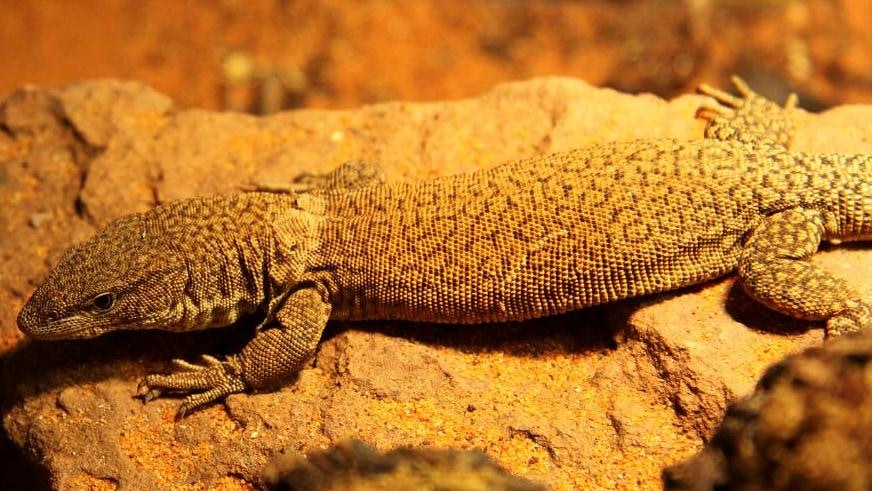
Kings' Goanna, Kings' Rock Monitor, Pygmy Rock Monitor
Northern Territory, Australia, Western Australia, Australia
Rocky Outcrops, Grasslands, Open Bushland, Shrubland
- Small Species of Monitor Lizard.
- Total Length Up To 40 cm .
- Reddish-Brown Coloration.
- Juveniles Have A Black Reticulum That Breaks Down With Age Into Dark Flecks.
- Small Blackish Spots On the Dark Upper Body.
- Creamy Colored Underparts, Throat, and Near the Vent.
Insects, Locusts, Termites, Insect Eggs
- Extremely Shy.
- Retreats Into Holes, Rock Fissures, and Small Crevices When Approached.
- Uses Its Long Tail To Prod Prey Out of Tight Crevices.
- Behavior of Using Tail To Prod Prey Is Instinctual and Demonstrated By Both Adults and Hatchlings.
About Varanus kingorum
Varanus kingorum: Kings' Monitor
Kings' monitor, scientifically known as Varanus kingorum, is a small lizard species belonging to the Varanidae family and is native to Australia. Commonly referred to as Kings' goanna or Kings' rock monitor, this species is distinguished by its relatively small size, reaching up to 40 cm in total length. Its coloration is primarily reddish-brown, with juveniles exhibiting a black reticulum that matures into dark flecks as the lizard ages.
Habitat and Distribution
Varanus kingorum is endemic to the northwestern parts of the Northern Territory and the northeastern regions of Western Australia. Its preferred habitat includes rocky outcrops, areas with rock exfoliations, slopes with open bushland and shrubs, and grasslands, where boulders and crevices provide essential shelter and microhabitats.
Behavior and Diet
This species is characterized by its extremely shy nature, typically retreating into rock fissures and small crevices when it senses a threat. A notable behavioral trait is the use of its long tail to prod insects out of inaccessible hiding places, a behavior observed in both adult and young monitors, suggesting it is instinctual.
Reproduction and Diet
Kings' monitor is oviparous, reproducing by laying eggs. The incubation period for these eggs can range significantly, from 89 to 126 days, particularly when maintained at temperatures around 29°C. Their diet appears to consist exclusively of insects, including common prey such as locusts and termites, as well as insect eggs.
Source: Wikipedia ↗
Frequently Asked Questions
What are the common names for Varanus kingorum?
Varanus kingorum is commonly known as Kings' monitor, Kings' goanna, Kings' rock monitor, and the pygmy rock monitor.
Where is Varanus kingorum found?
This species is endemic to the northwestern part of the Northern Territory and the adjacent northeastern part of Western Australia.
What is the typical habitat for Kings' monitor?
Kings' monitor inhabits rocky outcrops, areas with rock exfoliations or slopes with open bushland and shrubs, and grasslands where suitable microhabitats like boulders and outcrops are available.
What does Varanus kingorum eat?
The diet of Varanus kingorum appears to consist exclusively of insects, such as locusts, termites, and insect eggs.
How large does Varanus kingorum get?
This species is relatively small, reaching a total length, including its tail, of up to 40 cm (16 inches).
What are the physical characteristics of a Kings' monitor?
Kings' monitor is reddish-brown in color. Juveniles have a black reticulum which develops into dark flecks with age. Small blackish spots are present on the dark upper body, with a creamy underpart and throat.
How does Varanus kingorum reproduce?
Varanus kingorum is oviparous, meaning it reproduces by laying eggs. The incubation period for its eggs typically ranges from 89 to 126 days when kept at a temperature of 29 +/- 2 °C.
What is the behavior of Kings' monitor like?
Kings' monitor is described as extremely shy and will retreat into holes, rock fissures, and small crevices when approached. Both adults and hatchlings are known to use their long tails to prod prey out of inaccessible crevices.
Related Lizards

Iberolacerta horvathi
Horvath's rock lizard (Iberolacerta horvathi) is a reptile endemic to Europe, distinguished by its pale greyish-brown upper body, dark brown sides, and unspotted white or yellowish belly. It inhabits temperate forests, shrublands, and rocky areas, often at higher altitudes. This agile lizard is a rock specialist, noted for its ability to leap while hunting small invertebrates.

Diplodactylus conspicillatus
The variable fat-tailed gecko (Diplodactylus conspicillatus) is a small to medium-sized lizard endemic to arid and semi-arid regions of Australia. Characterized by its stout body, short limbs, and a broad, flat tail, it typically displays a fawn to reddish-brown coloration with a reticulated pattern and pale speckles. This nocturnal insectivore primarily feeds on termites and is known for its unique burrow-plugging behavior, though much of its ecology remains under-researched.

Egernia stokesii
Egernia stokesii, also known as the Gidgee skink or spiny-tailed skink, is a gregarious lizard species native to Australia. It is distinguished by its spiny tail and complex social structures, forming stable, long-term aggregations. This diurnal species inhabits semi-arid environments and exhibits an omnivorous diet. While the species as a whole is listed as Least Concern, one subspecies is considered endangered.