
Varanus storri
Storr's monitor (Varanus storri) is a small, terrestrial lizard endemic to Australia, known for its dull coloration and colony-dwelling behavior. It inhabits rocky areas, open woodlands, and grasslands across the tropical regions of the continent. This species is characterized by its U-shaped burrows and a varied diet of invertebrates and smaller reptiles.
Key Facts
- ›Endemic to Australia, found in seasonal tropical regions.
- ›Inhabits rocky environments, open woodlands, grasslands, and spinifex.
- ›A small species, growing up to just over 40 cm in total length.
- ›Lives in colonies, with individuals occupying U-shaped burrows.
- ›Primarily preys on invertebrates, including orthopterans, ants, beetles, and spiders, as well as small lizards.
- ›Breeding occurs throughout the year, with clutches of up to 6 eggs.

Storr's Monitor
Australia
- Smaller and Duller Colored Than the Spiny-Tailed Monitor.
- Grows Up To Just Over 40 cm In Total Length.
- Subspecies V. S. Ocreatus Has A Longer Tail and Limbs Than V. S. Storri.
- V. S. Ocreatus Has Enlarged Scales On the Bottom of the End of Its Hindlegs.
- Does Not Display Sexual Dimorphism; Spiny Scales Near the Vent Are Present In Both Sexes.
- Invertebrates, Especially Orthopterans, Ants, Beetles, and Spiders
- Lizards Such As Skinks and Geckos
- Terrestrial
- Lives In Colonies
- Each Individual Inhabits Its Own U-Shaped Burrow Under A Large Rock Or Spinifex.
- Individuals Sometimes Wave Their Tails At Each Other.
- Most Active Between February and March, and Between July and November, During Mornings and Late Afternoons.
- Retreats To Its Burrow During the Hottest Time of the Day.
- Remains Active During Cooler Parts of the Day, Except In Cold Winter Months.
About Varanus storri
Storr's Monitor (Varanus storri)
Storr's monitor, scientifically known as Varanus storri, is a species of monitor lizard native to Australia. This terrestrial lizard is characterized by its relatively small size and dull coloration, distinguishing it from similar species like the spiny-tailed monitor.
Habitat and Distribution
Varanus storri is found in the seasonal tropical regions of Australia. It thrives in rocky environments, open woodlands, grasslands, and areas dominated by spinifex. The species exhibits subspecies with distinct distributions: V. storri storri is found in eastern Australia, while V. storri ocreatus inhabits Western Australia and the Northern Territory. Both subspecies share similar climates and habitats.
Physical Description and Behavior
Storr's monitor grows to a maximum total length of just over 40 cm. A notable difference between subspecies is that V. s. ocreatus possesses a longer tail and limbs compared to V. s. storri, with the former's tail being approximately 1.6 times its snout-to-vent length, and the latter's being 1.4 times. Enlarged scales are also present on the hindlegs of V. s. ocreatus. The species does not exhibit sexual dimorphism, meaning males and females share similar physical characteristics, including the cluster of spiny scales near the vent, which is present in both sexes.
These lizards are highly social, living in colonies where up to 50 individuals may coexist in a small area of 0.75 km². Each monitor establishes its own U-shaped burrow, typically situated under a large rock or within spinifex. Interactions between individuals can include tail waving. Storr's monitor is most active during the mornings and late afternoons, particularly between February and March, and again from July to November. They retreat to their burrows during the hottest parts of the day but remain active during cooler periods, except for the winter months.
Diet and Reproduction
The diet of Varanus storri consists primarily of invertebrates, with a particular fondness for orthopterans (grasshoppers and crickets), as well as ants, beetles, and spiders. They also supplement their diet with small lizards, such as skinks and geckos. This diet is seasonal, and individuals build up significant fat reserves to sustain them through the winter months when they become inactive.
Sexual maturity is achieved when the lizard reaches approximately 9 cm in snout-to-vent length. Breeding can occur throughout the year, with enlarged testes observed mainly in November, marking the transition from the late dry to the early wet season. Females lay up to 6 eggs, which are incubated at temperatures between 27–29 °C (81–84 °F) for a period of 100 to 129 days. They can attain sexual maturity approximately 18 months after hatching.
Source: Wikipedia ↗
Frequently Asked Questions
What is Varanus storri commonly known as?
Varanus storri is commonly known as Storr's monitor. It was named in honor of the Australian herpetologist Glen Milton Storr.
Where is Storr's monitor found?
Storr's monitor is found in the seasonal tropical regions of Australia. The subspecies V. storri storri is in eastern Australia, while V. storri ocreatus is located in Western Australia and the Northern Territory.
What kind of habitat does Varanus storri prefer?
Varanus storri prefers rocky environments, open woodlands, grasslands, and areas with spinifex. They are terrestrial and less arboreal than related monitor lizards.
How large does Storr's monitor get?
Varanus storri is a smaller monitor lizard, growing up to just over 40 cm (1.3 ft) in total length. It is described as smaller and duller colored than the spiny-tailed monitor.
What does Storr's monitor eat?
Storr's monitor primarily preys on invertebrates, such as orthopterans, ants, beetles, and spiders. They also consume smaller lizards like skinks and geckos. Their diet is seasonal, and they build up fat reserves for leaner periods.
What are the behavioral traits of Varanus storri?
Varanus storri is terrestrial and lives in colonies, with up to 50 individuals sharing a relatively small area. They inhabit individual U-shaped burrows and sometimes wave their tails at each other. They are most active in the mornings and late afternoons.
When does Varanus storri reproduce?
Breeding for Varanus storri takes place throughout the year. Females lay up to 6 eggs, which require incubation at 27–29 °C (81–84 °F) for 100–129 days. Sexual maturity is reached around 9 cm SVL.
Related Lizards

Varanus caudolineatus
The stripe-tailed goanna (Varanus caudolineatus) is a semi-arboreal monitor lizard native to Western Australia. It is characterized by its relatively small size, reaching up to 32 cm in total length, and a lack of sexual dimorphism. This species inhabits grasslands, woodlands, and shrublands, often found in tree crevices or rock outcrops, and primarily feeds on small arthropods and geckos.

Ctenophorus fordi
The Mallee dragon (Ctenophorus fordi) is a small lizard native to the arid regions of southern Australia, characterized by its reddish-orange coloration and pale, black-bordered stripes. It inhabits shrubland and hummock grass environments, particularly in Mallee woodlands and spinifex areas, often near vegetated sand dunes. This species is primarily an ant specialist, employing a sit-and-wait strategy to ambush its prey.
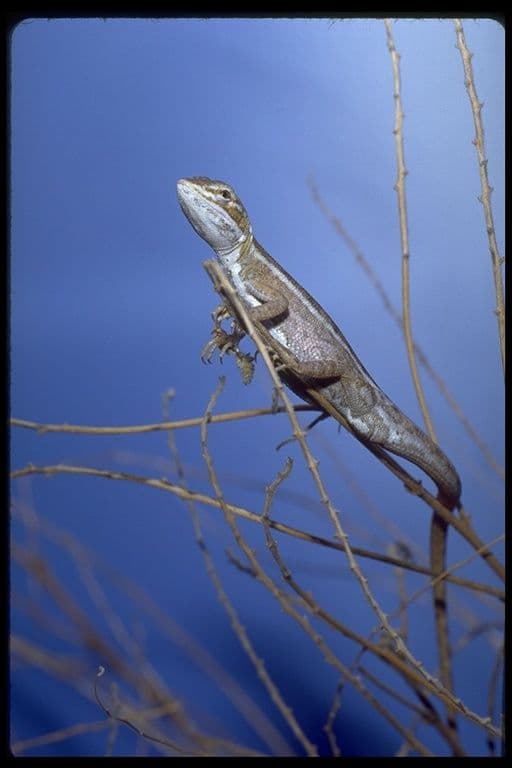
Diporiphora winneckei
The Canegrass Dragon (Diporiphora winneckei) is a small, terrestrial lizard endemic to the arid zones of Australia. Characterized by its slim build, long tail and limbs, and distinctive grey or pale brown coloration with prominent ventral and lateral stripes, this diurnal species is well-camouflaged within its sandy habitat. It is an insectivore, though it may occasionally consume plant matter, and plays a role in the food web of its environment.