
White-bellied lizard
The White-bellied lizard, scientifically known as *Darevskia unisexualis*, is a species of lizard found in Armenia, Georgia, and Turkey. This species is notable for its ability to reproduce asexually through parthenogenesis, where females produce offspring without fertilization. It belongs to the genus *Darevskia* and is part of a larger group of lizards known for their unique reproductive strategies.
Key Facts
- ›Found in Armenia, Georgia, and Turkey.
- ›Capable of parthenogenetic reproduction.
- ›Reproduction occurs through oogenesis in female-only lineages.
- ›Involves synapsis of homeologous chromosomes during meiosis.
- ›The protein MLH1 plays a role in its meiotic process.

White-Bellied Lizard
Armenia, Georgia, Turkey
About White-bellied lizard
White-bellied Lizard (Darevskia unisexualis)
The White-bellied lizard, scientifically designated as Darevskia unisexualis, is a notable species within the Darevskia genus. Its natural range encompasses parts of Armenia, Georgia, and Turkey. This lizard is particularly distinguished by its remarkable capacity for parthenogenetic reproduction, a form of asexual reproduction occurring exclusively in female lineages through oogenesis.
Reproductive Biology
The reproductive mechanism of Darevskia unisexualis involves a fascinating meiotic process. During the prophase I stage of meiosis, homeologous chromosomes—those originating from different parental species—engage in synapsis. Further contributing to this unique biological function, the protein MLH1, typically involved in DNA mismatch repair, also plays a role in the meiotic events of this species.
Source: Wikipedia ↗
Frequently Asked Questions
What is the scientific name of the White-bellied lizard?
The scientific name of the White-bellied lizard is *Darevskia unisexualis*. This binomial nomenclature identifies it within the genus *Darevskia*.
Where can the White-bellied lizard be found?
The White-bellied lizard is naturally found in the countries of Armenia, Georgia, and Turkey. These regions form its primary geographic distribution.
How does the White-bellied lizard reproduce?
The White-bellied lizard is capable of parthenogenetic reproduction. This means that females can produce offspring through oogenesis without the need for fertilization by a male.
What is unique about its reproductive process?
During meiosis, homeologous chromosomes, which were originally inherited from two different parental species, undergo synapsis. The protein MLH1, involved in DNA mismatch repair, also appears to participate in this specialized meiotic process.
Related Lizards

Aspidoscelis laredoensis
The Laredo striped whiptail (Aspidoscelis laredoensis) is a lizard species native to southern Texas and northern Mexico. It is known for its dark green or brown coloration, distinguished by seven yellow or white stripes extending from head to tail, and a white underside. This species is parthenogenic, meaning females reproduce without fertilization, and it is a fast-moving, diurnal insectivore.
Aspidoscelis neomexicana
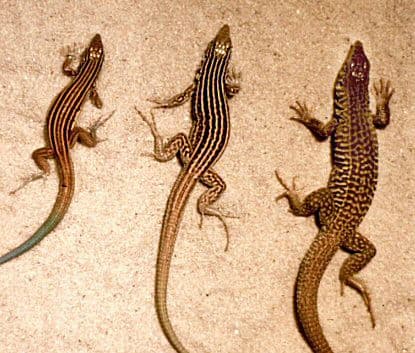
The New Mexico whiptail (Aspidoscelis neomexicana) is a unique, all-female lizard species native to the southwestern United States and northern Mexico, notable for its parthenogenetic reproduction. Characterized by its slender body, seven pale yellow stripes, and a blue or blue-green throat, this diurnal lizard inhabits a variety of semi-arid environments.

Aspidoscelis uniparens
The desert grassland whiptail lizard (Aspidoscelis uniparens) is an all-female reptile native to North America, known for its unique parthenogenetic reproduction. These slender lizards are characterized by six yellowish lines running the length of their olive or brown bodies, which fade to a blue or gray tail. They inhabit desert grasslands and low valleys in Arizona, New Mexico, and northern Mexico.