
Xantusia gracilis
The sandstone night lizard (Xantusia gracilis) is a small reptile endemic to a specific rocky area in California's Santa Rosa Mountains. Characterized by its slender form and distinctive white to yellow back with small black dots, it typically inhabits sandstone crevices and burrows. This species is notable for its limited geographic range and has been classified as vulnerable.
Key Facts
- ›Endemic to Truckhaven Rocks in the Santa Rosa Mountains, California.
- ›Adults typically have a snout-to-vent length of 60–71 mm.
- ›Features a white to yellow back with small, uniform black dots.
- ›Inhabits sandstone crevices and burrows.
- ›Listed as vulnerable on the IUCN Red List due to its limited habitat.

Sandstone Night Lizard
California, United States
- Adult Snout-To-Vent Length Typically 60–71 mm .
- Back Is White To Yellow With Small, Uniform Black Dots.
- Underside Is White With Minor Black Dotting In Some Areas.
- Possesses A Greatly Enlarged Temporal Scale.
- Has A Narrower Head Compared To Relatives.
- Spends More Time On the Ground Than Climbing, Compared To Its Relatives.
Limited Extent of Habitat
About Xantusia gracilis
Sandstone Night Lizard (Xantusia gracilis)
The sandstone night lizard, scientifically known as Xantusia gracilis, is a species of lizard found exclusively in a small, rocky region of California called Truckhaven Rocks. This area, situated in the southeastern Santa Rosa Mountains, comprises sandstone and siltstone formations and provides the lizard with its specialized habitat.
Physical Characteristics
Adult sandstone night lizards typically measure between 60 to 71 millimeters in snout-to-vent length. A distinguishing feature is their coloration: a white to yellow dorsal side adorned with small, consistent black dots, contrasted by a white underside that may exhibit minor dotting. Morphologically, they are recognized by a notably enlarged temporal scale and a more slender head in comparison to related species.
Habitat and Distribution
The entire known population of Xantusia gracilis resides within the approximately 3 square kilometer area of Truckhaven Rocks. This habitat is characterized by sandstone crevices and burrows, often found within the deep canyons of the region, at elevations ranging from 240 to 305 meters. Their preference for terrestrial environments is evident, as they are observed to spend more time on the ground than their close relatives.
Conservation
Due to its highly restricted range and reliance on a specific, limited habitat, the sandstone night lizard was assessed and listed as vulnerable on the IUCN Red List. The extent of its habitat is the primary concern for its conservation status.
Source: Wikipedia ↗
Frequently Asked Questions
What is the scientific name of the sandstone night lizard?
The scientific name of the sandstone night lizard is Xantusia gracilis. It was first described by Lee Grismer and Mark Galvan in 1986 and later recognized as a distinct species in 2001.
Where is the sandstone night lizard found?
This lizard is exclusively found in a small region known as Truckhaven Rocks, located in the southeastern part of the Santa Rosa Mountains in California, United States. Its habitat is limited to approximately 3 square kilometers.
What does the sandstone night lizard look like?
The sandstone night lizard is typically slender, with a snout-to-vent length of 60–71 mm as an adult. Its back is white to yellow and marked with small, uniform black dots, while its underside is white with some minor dotting.
What kind of habitat does the sandstone night lizard prefer?
The sandstone night lizard prefers habitats consisting of sandstone and siltstone, specifically in and around sandstone crevices and burrows. These are commonly found within the canyons of Truckhaven Rocks.
What is the conservation status of Xantusia gracilis?
The sandstone night lizard is listed as vulnerable on the IUCN Red List. This classification is a result of a 2007 assessment, primarily due to the extremely limited extent of its natural habitat.
Related Lizards

Paroedura rennerae
Paroedura rennerae is a species of gecko endemic to Madagascar, distinguished by its spiny scales and brown dorsal coloration with lighter crossbands. It inhabits a variety of environments, including dry forests, caves, and human settlements, and is believed to be a nocturnal species. This gecko is known for its defensive biting behavior and its ability to autotomize its tail.
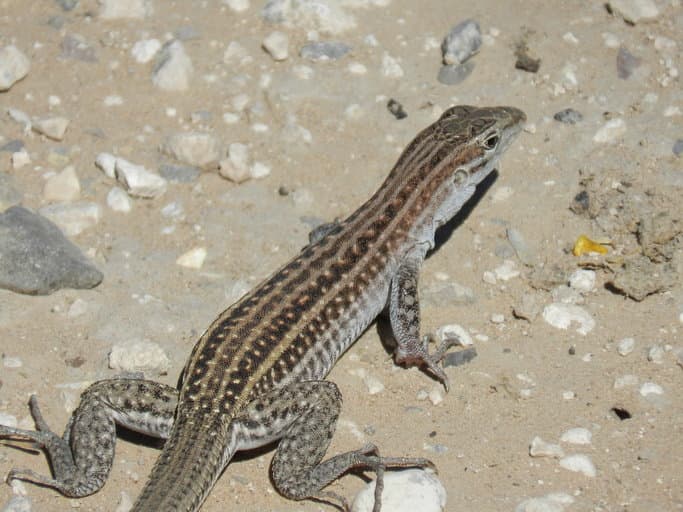
Aspidoscelis exsanguis
The Chihuahuan spotted whiptail (Aspidoscelis exsanguis) is a parthenogenetic lizard native to arid regions of the southwestern United States and northern Mexico. It is characterized by its reddish-brown coloration, six lighter stripes running the length of its body with spotting in between, and a slender build with a long tail. This diurnal and insectivorous species inhabits various dry environments, including deserts and woodlands.

Aspidoscelis gularis
The Texas spotted whiptail (Aspidoscelis gularis) is a long-tailed lizard native to the south-central and southwestern United States and northern Mexico. Characterized by its tan brown or green-brown coloration with seven distinct stripes and light spots, it is highly active and found in diverse habitats. This diurnal and insectivorous species is known for its quick movements and ability to shed its tail as a defense mechanism.