
Yarrow's spiny lizard
Yarrow's spiny lizard, scientifically known as *Sceloporus jarrovii*, is a species found in the southwestern United States and northern Mexico. This lizard is characterized by its keeled scales, a crosshatch-patterned torso, and a distinctive black collar with a white inferior border. Its preferred habitats include forests and rocky areas, though its range is being impacted by climate change.
Key Facts
- ›Native to the southwestern United States and northern Mexico.
- ›Possesses keeled scales and a crosshatch-patterned torso.
- ›Males exhibit a blue throat and belly.
- ›Distinguished by a complete black collar with a white inferior border.
- ›Reproduces viviparously (gives birth to live young).
- ›Two subspecies are recognized.

Yarrow's Spiny Lizard
United States, Mexico
- Grows To A Snout-To-Vent Length of 10.5 cm .
- Possesses Keeled Scales.
- Features A Crosshatch-Patterned Torso.
- Coloration Includes Tints of Pink, Green, Blue, and Copper.
- Top of the Head Is Dark Gray.
- Males Have A Blue Throat and A Blue Belly.
- Distinguished By A Complete Black Collar With A White Inferior Border.
Climate Change
About Yarrow's spiny lizard
Yarrow's Spiny Lizard (Sceloporus jarrovii)
Yarrow's spiny lizard, scientifically known as Sceloporus jarrovii, is a species of lizard native to the southwestern United States and northern Mexico. This reptile is part of the Phrynosomatidae family and is recognized for its distinctive physical characteristics and specific habitat preferences.
Description and Identification
The lizard typically grows to a snout-to-vent length of approximately 10.5 cm (4.1 inches). Its body is covered in keeled scales, giving it a rough texture, and its torso features a crosshatch pattern. The coloration of Yarrow's spiny lizard can vary, incorporating tints of pink, green, blue, and copper, with a dark gray head. A notable distinguishing feature is a complete black collar that is bordered by white on its inferior side. Males of the species are further identified by the presence of a blue throat and a blue belly.
Geographic Range and Habitat
Yarrow's spiny lizard is found in the United States within the states of Arizona and New Mexico. Its range extends into Mexico, including the states of Chihuahua, Durango, Sonora, northern Tamaulipas, and western Zacatecas. The preferred natural habitats for this species are forests and rocky areas. However, its environment is facing challenges, as evidenced by the shrinking habitat in Arizona's Mule Mountains due to climate change, which may prompt future conservation efforts.
Reproduction
This species is viviparous, meaning that females give birth to live young rather than laying eggs. This reproductive strategy is a key biological trait of Yarrow's spiny lizard.
Subspecies
Two subspecies of Sceloporus jarrovii are currently recognized as valid. These are the nominotypical subspecies, Sceloporus jarrovii jarrovii, and Sceloporus jarrovii lineolateralis, which is also known as the lined spiny lizard.
Source: Wikipedia ↗
Frequently Asked Questions
What is Yarrow's spiny lizard?
Yarrow's spiny lizard, *Sceloporus jarrovii*, is a species of lizard belonging to the family Phrynosomatidae. It is native to the southwestern United States and northern Mexico.
What are the key physical characteristics of Yarrow's spiny lizard?
This lizard can reach a snout-to-vent length of up to 10.5 cm (4.1 inches). It has keeled scales and a torso with a crosshatch pattern. Its coloration can include pink, green, blue, and copper, with a dark gray head. Males are identifiable by their blue throats and bellies.
Where is Yarrow's spiny lizard found?
Its geographic range includes the United States in Arizona and New Mexico, and in Mexico in the states of Chihuahua, Durango, Sonora, northern Tamaulipas, and western Zacatecas. A second subspecies is found only in Durango and Zacatecas, Mexico.
What kind of habitats does Yarrow's spiny lizard prefer?
Yarrow's spiny lizard prefers natural habitats such as forests and rocky areas. However, its habitat in the Mule Mountains of Arizona is experiencing shrinkage due to climate change.
How does Yarrow's spiny lizard reproduce?
Yarrow's spiny lizard is viviparous, meaning it gives birth to live young rather than laying eggs.
Are there different types of Yarrow's spiny lizard?
Yes, two subspecies of *Sceloporus jarrovii* are recognized. These are the nominotypical subspecies, *Sceloporus jarrovii jarrovii*, and *Sceloporus jarrovii lineolateralis*, also known as the lined spiny lizard.
Related Lizards

Chalcides colosii
Chalcides colosii, also known as the Riffian skink, is a moderate-sized lizard native to Morocco and some Spanish territories in northwestern Africa. Distinguished from similar species by its lack of ocelli and dark lateral bands, it inhabits semi-arid to sub-humid rocky areas, stone heaps, slopes with loose soil and grass cover, and coastal sand dunes. Females of this viviparous species give birth to live young.
Chalcides viridanus
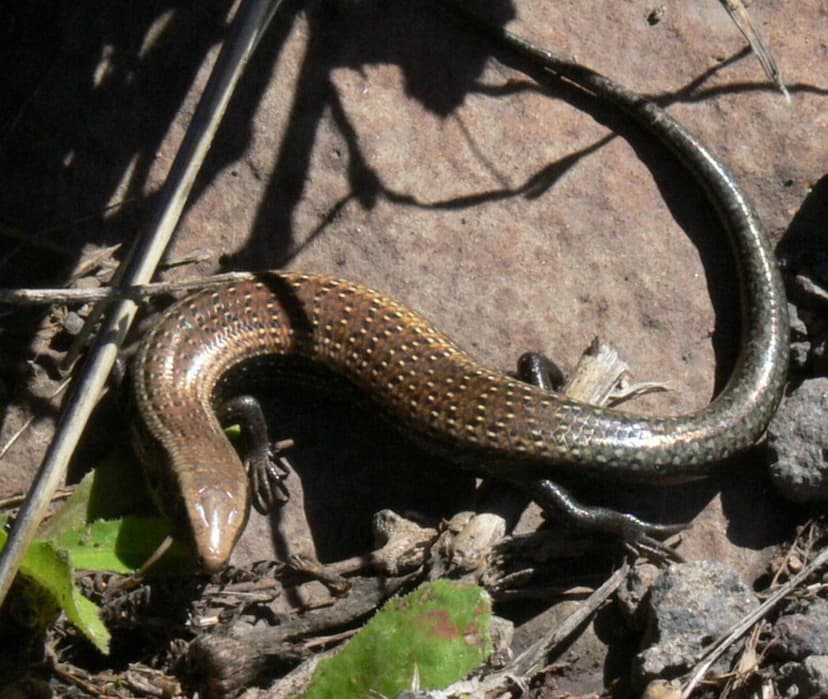
The West Canary skink, scientifically known as Chalcides viridanus, is a species of lizard endemic to the Canary Islands. This skink inhabits a diverse range of environments, from temperate forests and grasslands to urban areas, and can be found at elevations up to 2,000 meters. It is characterized by its cylindrical body and can reach a total length of approximately 18 cm.

West Canary skink
The West Canary skink, also known as the Canaryan cylindrical skink, is a species of lizard endemic to the Canary Islands. It inhabits a variety of environments, from temperate forests to urban areas, and can be found at altitudes up to 2,000 meters. This viviparous lizard is active during the day and at dusk, reaching a total length of about 18 cm.