
Arundina
Arundina
Arundina graminifolia, commonly known as the bamboo orchid, is a terrestrial orchid species native to tropical Asia. It is distinguished by its reedy stems, grass-like leaves, and showy, lilac and white flowers with a purple lip. This species has also naturalized in various regions worldwide and holds medicinal value in traditional Chinese medicine.
Key Facts
- ›Arundina graminifolia is a terrestrial orchid with reedy stems, growing in large clumps.
- ›Its flowers are typically rosy lilac and white with a prominent purple lip.
- ›The species is found across a wide range of tropical Asia, from India to New Guinea.
- ›It has been naturalized in many other tropical and subtropical regions globally.
- ›Arundina graminifolia possesses soothing, anti-inflammatory, anti-bacterial, and anti-pain properties.
- ›The orchid blooms in summer and autumn, with flowers appearing in succession on terminal racemes.

Bamboo Orchid, Bird Orchid, Grass-Like Leaf Arundina, Tapah
Myanmar, India, Sri Lanka, Nepal, Thailand, Vietnam, Ryukyu Islands, Malaysia, Singapore, China, Indonesia, Philippines, New Guinea
Terrestrial
Summer, Autumn
About Arundina
Arundina graminifolia
Arundina graminifolia, widely recognized as the bamboo orchid, is a species of terrestrial orchid that forms the foundational accepted species within the genus Arundina. This tropical Asiatic native is characterized by its reedy stems, which grow into substantial clumps and can reach heights ranging from 70 centimeters to 2 meters. Its leaves are linear and plaited, oblong-lanceolate in shape, measuring between 9 to 19 cm in length and 0.8 to 1.5 cm in width, with an acuminate apex. The plant also features amplexicaul sheathing stipules that clasp the stem.
Flowering and Reproduction
The bamboo orchid typically blooms during the summer and autumn seasons. It produces rather open clusters of showy terminal flowers, with up to ten blooms appearing in succession on the terminal racemes. The flowers themselves measure 5 to 7 cm in diameter and are a striking combination of rosy lilac and white, accented by a distinct purple lip. The inflorescence is subtended by broadly triangular bracts. For reproduction, Arundina graminifolia is pollinator-dependent, requiring successful pollination to produce seed capsules. The occasional fertilized seed pods contain minute, powdery seeds, and small plantlets often develop near the cane ends after flowering, suggesting a natural propagation method through vegetative means if they reach suitable soil conditions.
Distribution and Habitat
Native to a broad swath of tropical Asia, Arundina graminifolia's natural distribution extends across countries including Myanmar, India, Sri Lanka, Nepal, Thailand, Vietnam, the Ryukyu Islands, Malaysia, Singapore, China, Indonesia, the Philippines, and New Guinea. It has demonstrated a capacity for naturalization, establishing itself in diverse locations such as Réunion, Fiji, French Polynesia, Micronesia, the West Indies, Costa Rica, Panama, Belize, and Hawaii. In Malaysia, it is commonly called tapah and is frequently found in secondary forests, at forest fringes, and notably in disturbed areas like road cuts, where it can be the most common flowering plant seen, often thriving in full sun. In some tropical regions, including Hawaii, Mauritius, and Puerto Rico, it has exhibited invasive tendencies.
Conservation and Cultivation
Historically, Arundina graminifolia faced near extinction in Singapore, with only about 200 plants recorded naturally due to habitat destruction, primarily of rainforests and mangrove forests. However, significant replanting efforts have led to its current status as a common cultivated plant. The species also holds recognized medicinal benefits within Chinese medicine, possessing properties that are soothing, anti-inflammatory, anti-bacterial, and analgesic.
Varieties
Two varieties of Arundina graminifolia are currently recognized: Arundina graminifolia var. graminifolia and Arundina graminifolia var. revoluta, the latter originating from Assam and Sri Lanka eastward to Vietnam and southward to Java.
Source: Wikipedia ↗
Frequently Asked Questions
What is the common name for Arundina graminifolia?
Arundina graminifolia is commonly known as the bamboo orchid. It is also referred to as bird orchid and grass-like leaf arundina.
Where does Arundina graminifolia naturally occur?
This orchid species is native to tropical Asia, with its range extending from Myanmar, India, Sri Lanka, and Nepal to Vietnam, Malaysia, the Philippines, and New Guinea. It has also become naturalized in many other parts of the world.
What are the physical characteristics of Arundina graminifolia?
Arundina graminifolia is a perennial orchid with reedy stems that form large clumps, reaching heights of 70 cm to 2 meters. It has plaited, linear leaves that are oblong-lanceolate, measuring 9 to 19 cm in length and 0.8 to 1.5 cm in width.
When does Arundina graminifolia bloom?
This orchid typically blooms during the summer and autumn months. The flowers appear in open clusters on terminal racemes, with blooms opening in succession.
What are the medicinal uses of Arundina graminifolia?
Components of Arundina graminifolia are utilized for their medicinal benefits, including soothing, anti-inflammatory, anti-bacterial, and anti-pain properties. It is frequently employed in traditional Chinese medicine.
What is the conservation status of Arundina graminifolia?
While once critically endangered in Singapore due to habitat destruction, replanting efforts have led to it being listed as a common cultivated plant. Its invasive tendencies are noted in areas like Hawaii and Puerto Rico.
Related Orchid species
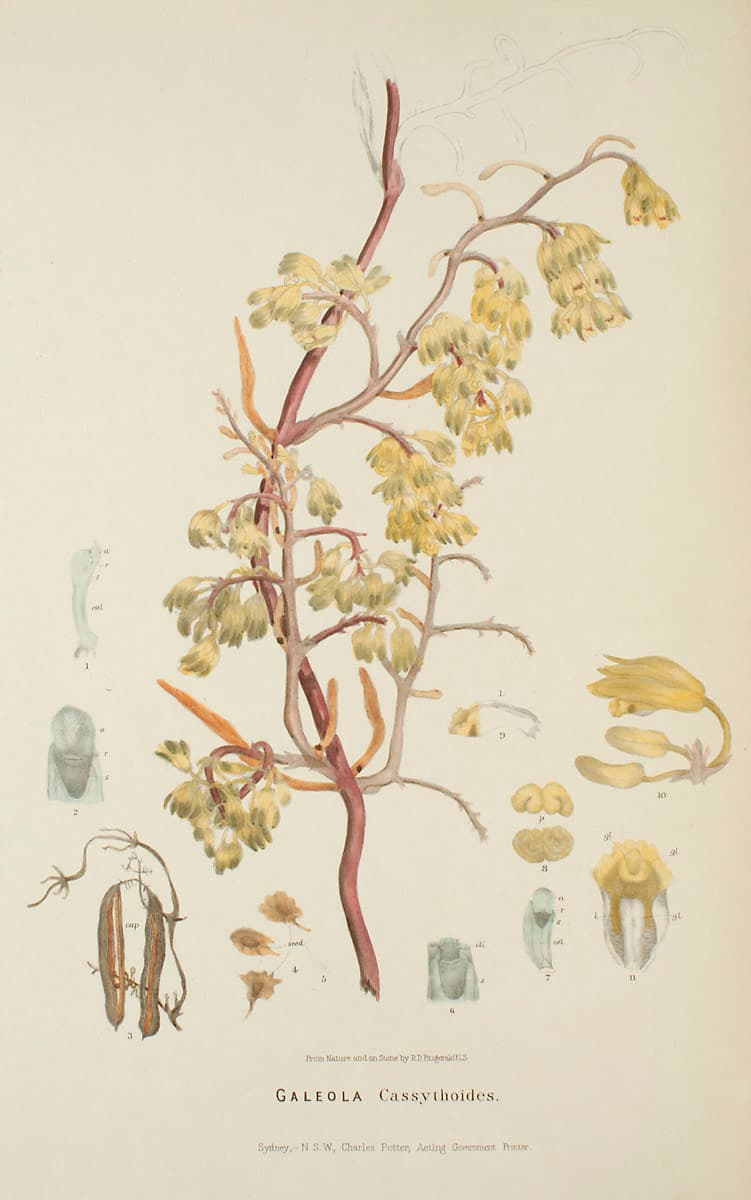
Erythrorchis
Erythrorchis, also known as bootlace orchids or by its Chinese name 倒吊兰属 (dao diao lan shu), is a genus of two species of climbing, leafless orchids in the Orchidaceae family. These myco-heterotrophic vines cling to tree trunks with small roots and produce densely crowded flowers on branched stems, distinguished by their fleshy sepals and petals and a wide labellum.
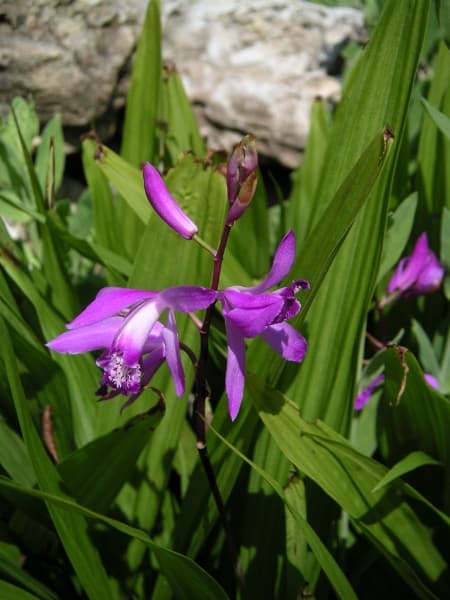
Bletilla
Bletilla, commonly known as the urn orchid, is a temperate, terrestrial orchid genus found across East Asia and Southeast Asia. Its pseudobulbs resemble spreading corms, and the plants are characterized by pleated leaves and racemes of flowers that emerge in spring and early summer, varying in color from white to purple. Bletilla striata, the most common species, is particularly noted for its hardiness and ease of cultivation.
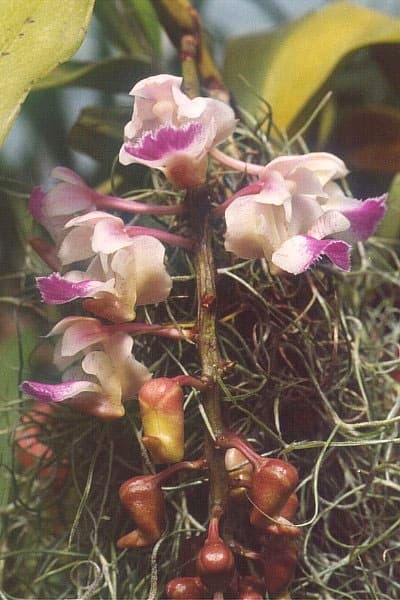
Aerides
Aerides, commonly known as cat's-tail orchids and fox brush orchids, is a genus of tropical epiphytic orchids native to Asia. These orchids are highly valued in horticulture for their showy, fragrant, and long-lasting flowers, which typically appear in racemes and are often white with colorful edges.