
Amesiella
Amesiella
Amesiella is a genus of miniature epiphytic orchids native exclusively to the island of Luzon in the Philippines. These orchids are characterized by their short stems, leathery leaves arranged in two ranks, and white flowers with prominent spurs, suggesting pollination by moths.
Key Facts
- ›A genus of orchids endemic to Luzon, Philippines.
- ›They are classified as miniature epiphytes.
- ›Flowers are white with distinctive spurs, indicative of moth pollination.
- ›The genus is named in honor of Oakes Ames, founder of the orchid herbarium at Harvard University.
- ›Three species were recognized as of May 2014: a. minor, a. monticola, and a. philippinensis.

Luzon, Philippines
Epiphytic
Moths
About Amesiella
Amesiella is a genus of orchids that is native exclusively to the island of Luzon in the Philippines. These orchids are recognized for their diminutive size and their epiphytic growth habit, meaning they grow on other plants, typically trees, rather than in soil.
Taxonomy and Naming
Historically, species now placed in the Amesiella genus were once considered part of the broader genus Angraecum. The genus Amesiella itself was established to accommodate these distinct species. It is named in honor of Oakes Ames (1874–1950), a prominent American orchidologist and the founder of the orchid herbarium at Harvard University.
Description
Plants in the Amesiella genus are characterized by their short stems and distinctive leaves. The leaves are elliptic in shape, leathery in texture (coriaceous), and arranged in two opposite ranks along the stem (distichous). The flowers are typically white and feature pronounced spurs, a morphological trait that strongly suggests a co-evolutionary relationship with moth pollinators.
Species
As of May 2014, the Amesiella genus encompassed three recognized species:
- Amesiella minor
- Amesiella monticola
- Amesiella philippinensis
These species contribute to the unique orchid biodiversity found only within Luzon.
Source: Wikipedia ↗
Frequently Asked Questions
What are Amesiella orchids?
Amesiella is a genus of orchids found only on the island of Luzon in the Philippines. They are small plants that grow on other plants and are known for their white flowers with notable spurs.
Where do Amesiella orchids come from?
The Amesiella genus is endemic to the island of Luzon, which is part of the Philippines. This means they are found naturally nowhere else in the world.
What are the characteristics of Amesiella flowers?
The flowers of Amesiella orchids are typically white and possess pronounced spurs. This spur structure is a strong indicator that these orchids are pollinated by moths.
How are Amesiella orchids classified?
Amesiella orchids are classified as miniature epiphytes, meaning they are small plants that grow on other plants, such as trees, rather than in the ground. They have short stems and tough, leathery leaves arranged in two ranks.
How many species are in the Amesiella genus?
As of May 2014, three species were officially recognized within the Amesiella genus. These are Amesiella minor, Amesiella monticola, and Amesiella philippinensis.
Related Orchid species
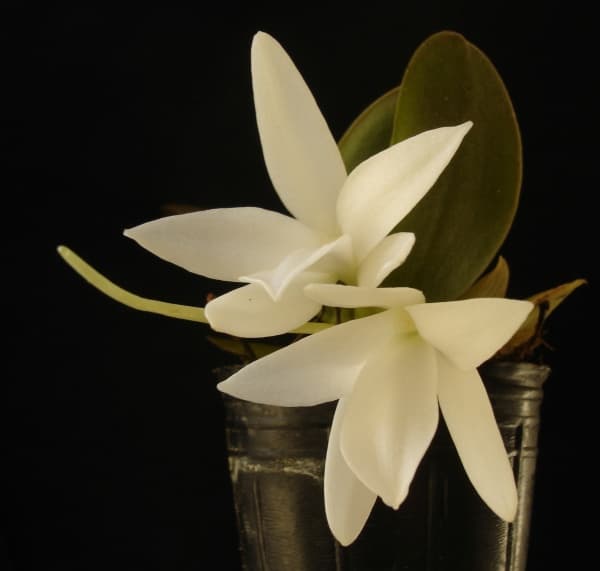
Aerangis
Aerangis is a genus of orchids within the Orchidaceae family, named from Greek words for "air" and "urn" due to the lip's shape. Native to tropical Africa, Madagascar, the Comoro Islands, and Sri Lanka, these orchids are distinguished by their large, waxy, star-shaped flowers, typically white, cream, or yellow, often featuring a long spur and a pleasant nocturnal fragrance.
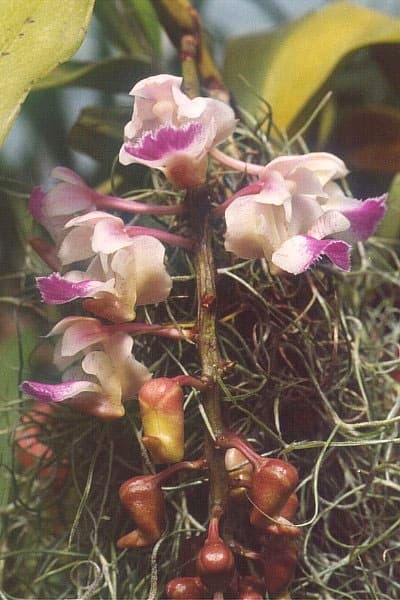
Aerides
Aerides, commonly known as cat's-tail orchids and fox brush orchids, is a genus of tropical epiphytic orchids native to Asia. These orchids are highly valued in horticulture for their showy, fragrant, and long-lasting flowers, which typically appear in racemes and are often white with colorful edges.

Angraecum
Angraecum, commonly known as the comet orchid, is a diverse genus of orchids native to tropical and South Africa, Madagascar, and Sri Lanka. These plants are characterized by their fleshy leaves, adapted to dry tropical woodlands, and their distinctive flowers, often white with a long spur at the base of the lip, which can be up to 30 centimeters long in some species. This unique morphology has led to fascinating co-evolutionary relationships with specific pollinators, most famously the hawk moth with Angraecum sesquipedale.