
Aplectrum
Aplectrum·none
Aplectrum hyemale, commonly known as putty root or Adam and Eve, is a unique orchid species found in eastern North America. It is distinguished by its singular, season-spanning leaf with striking silvery-white and green stripes, and its small, spurless flowers that bloom in late spring. The species is notable for its ability to self-pollinate and its underground tuber system that allows it to form large colonies.
Key Facts
- ›Native to eastern United States and Canada, with isolated populations in Arizona.
- ›Features a distinctive single leaf with parallel silvery-white and green stripes that appears in late autumn and lasts until spring.
- ›Flowers are very small, typically only a few millimeters across, and bloom in late may or early June.
- ›Can spread underground via tubers, forming extensive colonies.
- ›Known for its ability to self-pollinate, producing seeds asexually.
- ›The mucilaginous fluid from its tubers was historically used by Native Americans for mending pottery.

Putty Root, Adam and Eve
Eastern United States, Eastern Canada, Appalachian Mountains, Great Lakes Region, Ohio Valley, Upper Mississippi Valley, Arizona
Terrestrial
Late Spring, May, June
Bombus Separatus, Bombus Americanorum
About Aplectrum
Aplectrum hyemale
Aplectrum hyemale, commonly known as putty root or Adam and Eve, is a distinctive orchid species native to eastern North America. Its scientific name, derived from Greek, signifies "spurless," referring to a characteristic of its flowers. While it belongs to the Orchidaceae family, Aplectrum is the sole species within its genus, highlighting its unique evolutionary position.
Geographic Distribution and Habitat
This terrestrial orchid is found across a broad range in the eastern United States and Canada. Its natural range extends from Oklahoma eastward to the Carolinas and northward into areas such as Minnesota, Ontario, Quebec, and Massachusetts. It thrives particularly in the Appalachian Mountains, the Great Lakes Region, and the Ohio and Upper Mississippi Valleys. Isolated populations have also been documented in Arizona, suggesting a wider historical distribution or unique microhabitats.
Morphology and Growth
Aplectrum hyemale is renowned for its singular, striking leaf. This leaf emerges in late November and persists until March, a period that encompasses the dormant phase for many other plants. It is characterized by parallel, alternating stripes of silvery-white and green, creating a visually distinctive appearance. The plant spreads underground through the development of its tubers, which allows it to form large, interconnected colonies. The flower stalk emerges in late May or early June, bearing several small flowers, each only a few millimeters in size.
A variation, Aplectrum hyemale var. pallidum, is noted for differences in flower color.
Reproduction and Pollination
Reproductively, Aplectrum hyemale exhibits a capacity for self-pollination, enabling it to produce seeds asexually. The seeds are numerous, dust-like, and possess minimal nutrient reserves, making them challenging to germinate and propagate without a mycorrizal association. The pollination biology of Aplectrum hyemale is not extensively documented. Its late spring blooming period and lack of nectar mean that its flowers do not attract a wide array of pollinators. While bees such as Bombus separatus and Bombus americanorum have been observed as floral visitors, the species relies heavily on autogamy (selfing) for successful seed set.
Ecological Interactions
Two primary natural predators of Aplectrum hyemale have been identified. White-tailed deer (Odocoileus virginianus) are known to consume the plant, and their browsing activity may be a factor in the decline of Aplectrum in some regions. Additionally, the Spur-Throated Grasshopper (Melanoplus acrophilus) represents the only known instance of potential insect herbivory on this orchid species.
The mucilaginous fluid that can be extracted from the crushed tubers of Aplectrum hyemale was historically utilized by Native American tribes. This fluid served practical purposes, such as being used to mend pottery, showcasing an early example of indigenous resourcefulness and understanding of local flora.
Source: Wikipedia ↗
Frequently Asked Questions
What are the common names for Aplectrum hyemale?
Aplectrum hyemale is commonly referred to as putty root, a name derived from the mucilaginous fluid extracted from its tubers. It is also known as Adam and Eve, likely due to the paired tubers that can form.
Where is Aplectrum hyemale found naturally?
This orchid species is native to the eastern United States and Canada, extending from Oklahoma eastward to the Carolinas and north to Minnesota, Ontario, Quebec, and Massachusetts. It is particularly prevalent in the Appalachian Mountains and the Great Lakes Region.
What makes the leaf of Aplectrum hyemale distinctive?
The single leaf of Aplectrum hyemale is uniquely characterized by its pin-striped pattern, featuring parallel alternating silvery-white and green stripes. This leaf emerges in late autumn and persists through the winter until spring.
How does Aplectrum hyemale reproduce?
Aplectrum hyemale has the ability to self-pollinate, allowing it to produce seeds asexually. It spreads underground through the growth of its tubers, which can form large colonies.
What are the pollination challenges for Aplectrum hyemale?
The flowers of Aplectrum hyemale lack nectar and do not attract many pollinators, with only a few bee species reported as visitors. This limited pollination success makes it heavily reliant on self-pollination for reproduction.
Are there any known predators of Aplectrum hyemale?
Two natural predators have been identified for Aplectrum hyemale. White-tailed deer may contribute to its decline in certain areas, and the Spur-Throated Grasshopper is the only known potential insect herbivore.
Related Orchid species
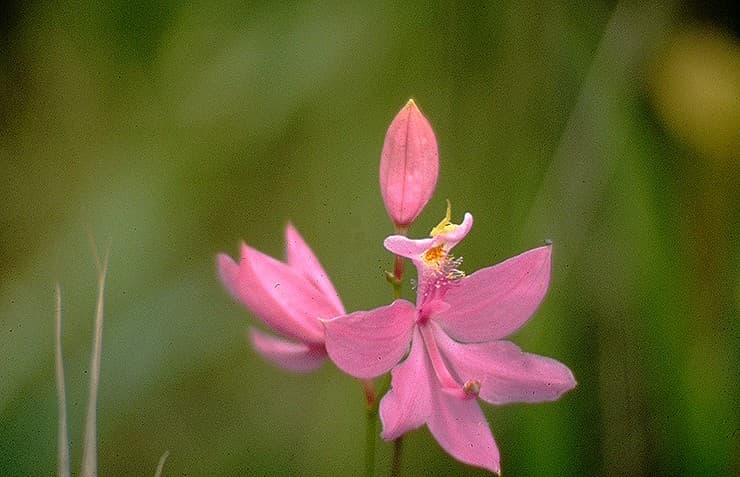
Calopogon
Calopogon, commonly known as grass pink, is a genus of terrestrial orchids native to eastern North America, Cuba, and the Bahamas. Its name, derived from Greek, translates to "beautiful beard," referencing the distinctive hairy structures on its labellum. A unique characteristic of Calopogon is its non-resupinate flowers, where the lip is positioned at the top, a departure from the typical orchid arrangement.
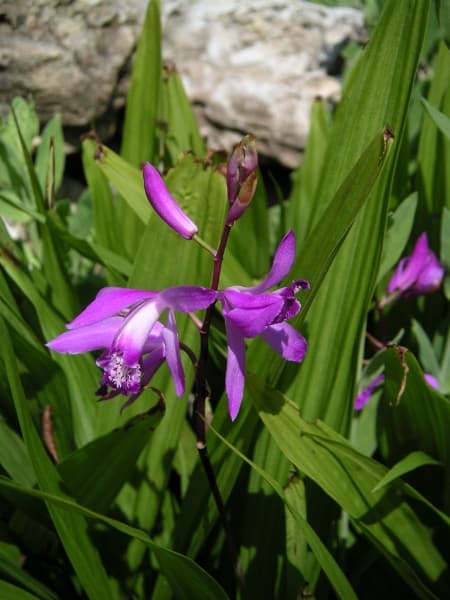
Bletilla
Bletilla, commonly known as the urn orchid, is a temperate, terrestrial orchid genus found across East Asia and Southeast Asia. Its pseudobulbs resemble spreading corms, and the plants are characterized by pleated leaves and racemes of flowers that emerge in spring and early summer, varying in color from white to purple. Bletilla striata, the most common species, is particularly noted for its hardiness and ease of cultivation.