
Calopogon
Calopogon
Calopogon, commonly known as grass pink, is a genus of terrestrial orchids native to eastern North America, Cuba, and the Bahamas. Its name, derived from Greek, translates to "beautiful beard," referencing the distinctive hairy structures on its labellum. A unique characteristic of Calopogon is its non-resupinate flowers, where the lip is positioned at the top, a departure from the typical orchid arrangement.
Key Facts
- ›Calopogon is a genus of terrestrial orchids.
- ›The genus name "Calopogon" means "beautiful beard" in Greek.
- ›These orchids are non-resupinate, meaning their lip is at the top of the flower.
- ›They are found in wet, sunny environments like swales, bogs, and marshy areas.
- ›Calopogon species are indicator species for high-quality ground and surface water.
- ›Their flowers employ deception, attracting pollinators with a "beard" but offering no nectar reward.
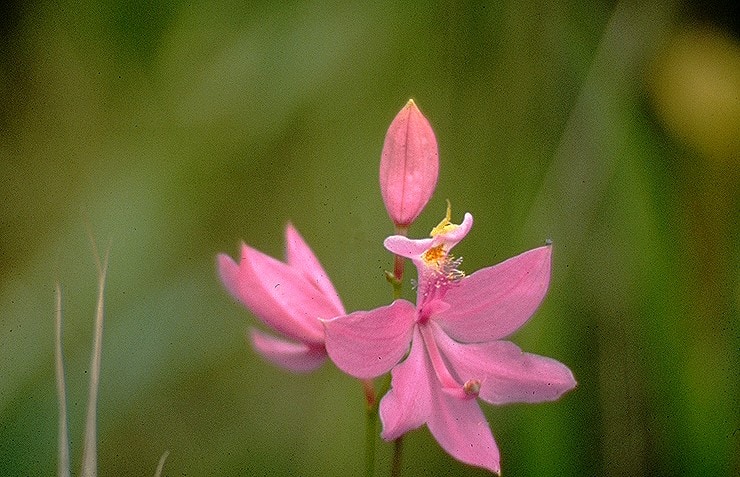
Grass Pink
Terrestrial
About Calopogon
Calopogon: The Grass Pink Orchid
Calopogon, commonly known as grass pink, is a genus of terrestrial orchids belonging to the family Orchidaceae. The name "Calopogon" originates from Greek, meaning "beautiful beard," a descriptor inspired by the cluster of hairs that adorn the flower's labellum. These orchids are native to the eastern United States, eastern Canada, Cuba, and the Bahamas. The genus is abbreviated as Cpg in trade journals.
Ecological Significance
Like many other orchids, Calopogon species serve as indicator species for healthy hydrological systems, signaling high-quality ground and surface water. They typically thrive in wet, sunny environments such as swales, bogs, and the margins of marshy areas, often found in association with ferns, sedges, grasses, and forbs. Notably, Calopogon oklahomensis has been observed in drier habitats than what Calopogon tuberosus prefers.
Unique Floral Characteristics
A distinguishing feature of the grass pinks is their non-resupinate flowers, a deviation from the norm in most orchid genera. In Calopogon, the lip is positioned at the top of the flower, not the bottom. The labellum is adorned with brushy, yellow protuberances, which are designed to attract pollinators. However, these structures do not provide a nectar reward. Instead, the flower employs a deceptive strategy: upon a potential pollinator landing, the flower snaps shut. The insect is then compelled to crawl out between the lip and the reproductive parts to escape, a process that hopefully leads to pollination.
Calopogon also utilizes mimicry by frequently growing near nectar-bearing flowers of similar colors. For instance, in the northern United States, they often associate with the magenta marsh phlox. While the phlox offers nectar as a reward, the deceptive yet visually striking Calopogon does not.
Source: Wikipedia ↗
Frequently Asked Questions
What does the name "Calopogon" mean?
The generic name Calopogon is derived from Greek words that translate to "beautiful beard." This name refers to the cluster of hairs found adorning the labellum, or lip, of the flower.
Where are Calopogon orchids found?
Calopogon orchids are native to the eastern United States, eastern Canada, Cuba, and the Bahamas. They typically inhabit wet, sunny locations such as swales, bogs, and the edges of marshy areas.
What is distinctive about Calopogon flowers?
A key feature of Calopogon flowers is that they are non-resupinate, meaning the lip is positioned at the top of the flower rather than the bottom, which is common in most other orchid genera. The labellum also features brushy, yellow protuberances.
How do Calopogon flowers attract pollinators?
Calopogon flowers attract pollinators through visual cues and deceptive structures. They have a "beautiful beard" of hairs on the labellum that tempts insects, and their flowers are often found near nectar-bearing plants of similar colors. The flower then snaps shut when a pollinator lands, forcing it to crawl out between the lip and reproductive parts, hopefully facilitating pollination.
What is the significance of Calopogon as an indicator species?
Calopogon orchids are considered indicator species for good remnant hydrology. Their presence signifies high-quality ground and surface water, making them valuable indicators of healthy aquatic environments.
Related Orchid species

Aplectrum
Aplectrum hyemale, commonly known as putty root or Adam and Eve, is a unique orchid species found in eastern North America. It is distinguished by its singular, season-spanning leaf with striking silvery-white and green stripes, and its small, spurless flowers that bloom in late spring. The species is notable for its ability to self-pollinate and its underground tuber system that allows it to form large colonies.

Broughtonia
Broughtonia is a genus of orchids native to the Bahamas and the Greater Antilles. The genus is abbreviated Bro in trade journals and currently comprises 6 accepted natural species and one recognized nothospecies.

Barbosella
Barbosella is a genus of creeping orchids comprising about 20 species, primarily found across the West Indies and Latin America, from Mexico down to Argentina. These orchids are distinguished by their solitary flowers, which feature a unique lip base that functions like a ball and socket joint. The genus was named in honor of João Barbosa Rodrigues, a notable investigator of Brazilian orchids.