
Apostasia
Apostasia
Apostasia, commonly known as grass orchids, is a genus of eight species of primitive orchids found in humid regions of Asia and Australia. These terrestrial, evergreen plants are characterized by their grass-like appearance, narrow leaves, and small, star-like yellow or white flowers, which possess unique floral structures distinct from more familiar orchids.
Key Facts
- ›Apostasia comprises eight species of primitive orchids.
- ›They are terrestrial, evergreen plants with a grass-like appearance.
- ›Flowers are typically small, yellow or white, and star-like.
- ›The genus is distributed across the Himalayan region, Southeast Asia, New Guinea, and Queensland.
- ›Apostasia differs from most orchids by having three stamens and pollen grains that do not adhere into pollinia.
- ›The genus name 'Apostasia' derives from the Greek word for 'defection' or 'departure,' referencing its distinct features.

Grass Orchids
Himalayan Region, China, India, Sri Lanka, Southeast Asia, New Guinea, Queensland, Nepal, Bhutan, Japan, Australia
Terrestrial
About Apostasia
Apostasia, commonly referred to as grass orchids, represents a genus of eight species of primitive orchids within the Orchidaceae family. These plants are characterized by their terrestrial, evergreen, and grass-like growth habit, often making them barely recognizable as orchids to the untrained eye. Their distribution spans humid areas across a wide geographical range, including the Himalayan region, China, India, Sri Lanka, Southeast Asia, New Guinea, and Queensland, Australia.
Description and Distinguishing Features
Plants in the genus Apostasia are evergreen and grow terrestrially, featuring a scaly rhizome with roots that may develop tubers. They possess thin stems adorned with numerous long, narrow, grass-like leaves arranged spirally. The flowers of Apostasia are small, typically yellow or white, and exhibit a star-like, non-resupinate form. These flowers are usually presented on a short, often branching, flowering stem.
What sets Apostasia apart from many more familiar orchids are its unique floral and reproductive structures. Unlike most orchids, which have a modified petal (labellum) and a distinct dorsal sepal, Apostasia species have three sepals and three petals that are similar in size, shape, and color. Furthermore, the column parts differ from other orchids, possessing three stamens (instead of two) that are separate from the style. Crucially, the pollen grains in Apostasia do not adhere to each other to form pollinia, a characteristic feature of most orchid species.
Taxonomy and Evolutionary Significance
The genus Apostasia was first formally described by Carl Ludwig Blume in 1825. The genus name itself is derived from the Ancient Greek word 'apostasis,' meaning "defection" or "departure from," a name chosen to reflect the genus's distinct features that deviate from the typical orchid morphology. Apostasia, along with the genus Neuwiedia, forms the subfamily Apostasioideae. These two genera share the primitive trait of having three stamens. Modern studies suggest that the species within these two genera, despite exhibiting "primitive" characteristics, are more accurately described as "sister" genera to other orchid families rather than direct ancestors, indicating a complex evolutionary history within the Orchidaceae.
Distribution and Habitat
Species within the Apostasia genus are found across a broad belt from north-eastern India, Nepal, and Bhutan, extending eastward to southern Japan, and southward through Southeast Asia to New Guinea and northern Australia. Within China, three species are documented, with one being endemic to the region. Similarly, Queensland, Australia, is home to an endemic species of Apostasia, highlighting localized evolutionary divergence within the genus.
Source: Wikipedia ↗
Frequently Asked Questions
What are Apostasia orchids?
Apostasia, commonly called grass orchids, is a genus of eight species of primitive orchids. They are terrestrial, evergreen plants that resemble grass and are found in humid areas across Asia and Australia.
Where are Apostasia orchids found?
Species in the Apostasia genus are distributed from northeastern India, Nepal, and Bhutan to southern Japan, and through Southeast Asia to New Guinea and northern Australia. Some species are endemic to China and Queensland.
What do Apostasia flowers look like?
Apostasia flowers are small, typically yellow or white, and have a non-resupinate, star-like appearance. They are usually arranged on a branched flowering stem and lack the distinct labellum found in many other orchids.
What makes Apostasia orchids primitive?
Apostasia orchids are considered primitive due to several distinct features, including having three stamens instead of the usual two in most orchids, and their pollen grains not forming pollinia. Their floral structure also differs significantly from more familiar orchid types.
What is the habitat of Apostasia orchids?
These orchids are terrestrial plants, meaning they grow in soil. They are found in humid regions within their distribution range, preferring environments where they can establish in the ground.
Related Orchid species

Galeola
Galeola is a genus of myco-heterotrophic orchids found across Southeast Asia, Madagascar, and the Comoros. These orchids are of particular biological interest due to their parasitic nature, relying entirely on fungi for sustenance, and their exceptionally large, winged seeds, which are the biggest among all orchid seeds.
Aerides
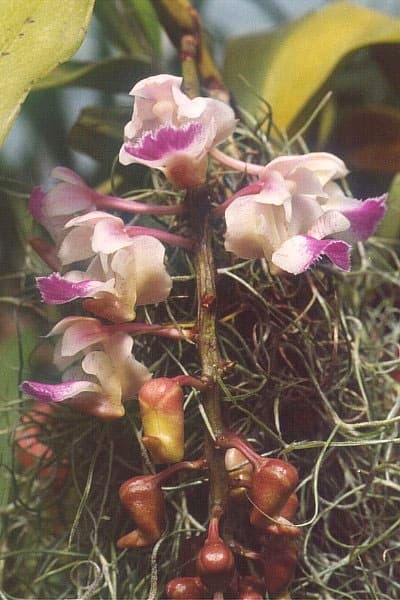
Aerides, commonly known as cat's-tail orchids and fox brush orchids, is a genus of tropical epiphytic orchids native to Asia. These orchids are highly valued in horticulture for their showy, fragrant, and long-lasting flowers, which typically appear in racemes and are often white with colorful edges.
Herminium
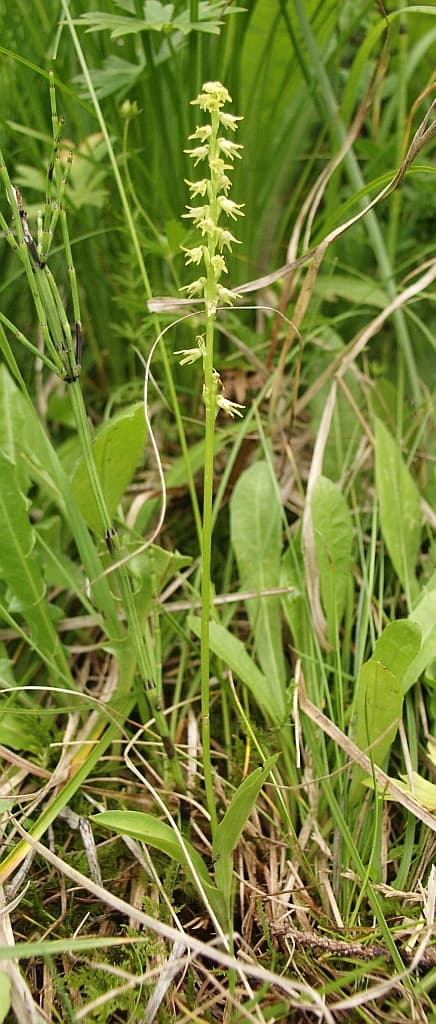
Herminium is a genus of orchids belonging to the Orchidaceae family, with a wide distribution across Europe and Asia. These terrestrial orchids are known for their diverse species found in various Himalayan regions and parts of China.