
Archivea
Archivea
Archivea kewensis is a monotypic orchid species known only from an 1823 watercolour illustration. Believed to be native to Brazil, it was formally described in 1996 based on this sole artistic representation. Its distinctive features include ovoid, ribbed pseudobulbs, lanceolate leaves, and white flowers with yellowish tips, resembling Cirrhaea species in habit.
Key Facts
- ›Archivea kewensis is the only species in the monotypic genus Archivea.
- ›Its existence is solely documented by a watercolour illustration from 1823.
- ›The species is believed to originate from Brazil.
- ›It was formally described in 1996 by botanists Eric a. Christenson and Rudolf Jenny.
- ›The flowers are white with petals and sepals that turn yellowish towards their tips.
- ›Morphological characteristics suggest placement in the subtribe Stanhopeinae.

Terrestrial
About Archivea
Archivea Kewensis: The Enigmatic Orchid
Archivea kewensis is a unique orchid species that currently exists solely as a subject of historical documentation. It is the only known member of the genus Archivea, a monotypic grouping established to classify this singular plant. The species is believed to have originated in Brazil, a fact supported by the journey of a live specimen from Brazil to the United Kingdom in 1816. Despite this provenance and its formal scientific description in 1996, Archivea kewensis has never been rediscovered in the wild, making it a subject of considerable botanical intrigue.
History and Description
The entire scientific understanding of Archivea kewensis is derived from a single watercolour illustration painted in 1823 by T. Duncanson. This artwork, which resides in the archives of the Royal Botanic Gardens, Kew, served as the type specimen for its description by botanists Eric A. Christenson and Rudolf Jenny. The illustration depicts a plant with ovoid, deeply vertically ribbed pseudobulbs, each supporting a single plicate leaf. The leaf blade is lanceolate with a pointed tip, roughly three times the length of its petiole.
The inflorescence arises from the base of the plant and grows upright, bearing approximately ten flowers. The flowers themselves are described as white, with their petals and sepals gradually turning yellowish towards their tips. Morphological characteristics, particularly the flower structure, led Christenson and Jenny to place Archivea within the subtribe Stanhopeinae, despite the impossibility of DNA analysis. The generic and specific epithets, Archivea kewensis, directly reference the location of the type specimen within the archives of Kew Gardens.
Source: Wikipedia ↗
Frequently Asked Questions
What is Archivea kewensis?
Archivea kewensis is a species of orchid that is known only from a single watercolour illustration created in 1823. It is the only species within its genus, Archivea. Despite being described in 1996, no living or pressed specimens have been found since the original illustration.
Where does Archivea kewensis come from?
Archivea kewensis is believed to be native to Brazil. A live specimen was brought from Brazil to the United Kingdom in 1816, and the subsequent illustration was made from this plant. However, it has not been documented in the wild beyond this initial record.
What are the distinctive features of Archivea kewensis?
Archivea kewensis is described as having ovoid, deeply vertically ribbed pseudobulbs, each bearing a single plicate leaf. The flowers are white with petals and sepals that become yellowish towards their tips. The labellum is notably three-lobed, with a prominent, elongated middle lobe.
Why is Archivea kewensis so poorly documented?
The primary reason for its poor documentation is that Archivea kewensis is known only from an 1823 watercolour illustration. No other specimens, living or pressed, have ever been found or recorded since that time, making detailed study and verification challenging.
When and by whom was Archivea kewensis described?
Archivea kewensis was formally described in May 1996 by botanists Eric A. Christenson and Rudolf Jenny. Their description was based on the 1823 watercolour illustration, which serves as the type specimen for the species.
Related Orchid species
Habenaria
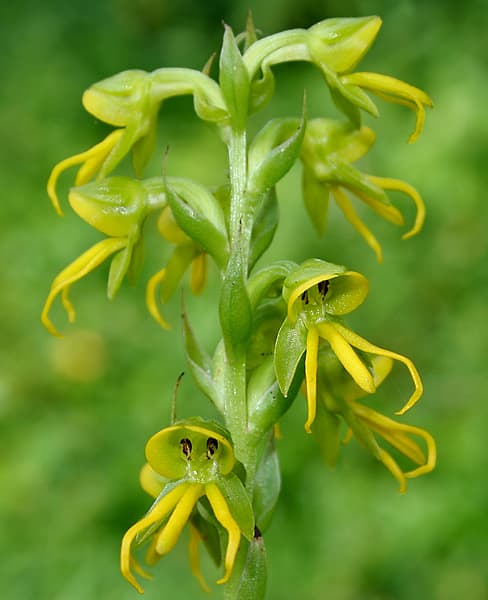
Habenaria, commonly known as rein orchids or bog orchids, is a widespread genus of approximately 880 orchid species found on every continent except Antarctica. These terrestrial plants are characterized by their fleshy tubers, upright stems, and flowers that are typically small, white, green, or yellowish, featuring a distinctive labellum with a spur and three lobes, and two club-shaped projections on the stigma.

Leptotes
Leptotes is a genus of nine small orchid species native to the dry jungles of south and southeast Brazil, Paraguay, and Argentina. These epiphytic plants are characterized by their thin, terete leaves and delicate, often showy flowers, some of which are used as a vanilla substitute. While some species are widely cultivated, many remain rare and recently described.
Cryptarrhena
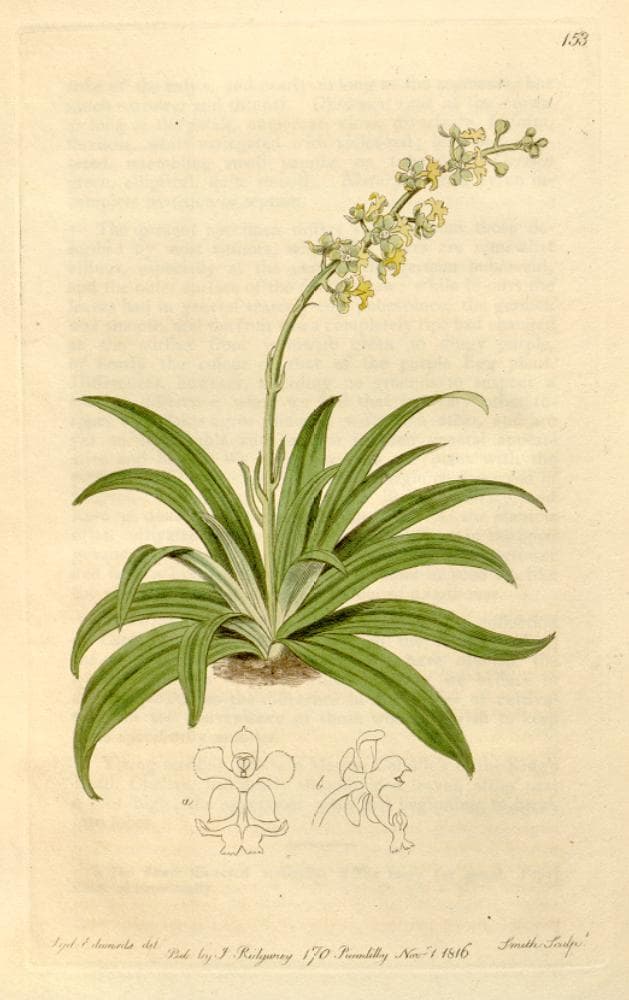
Cryptarrhena is a genus of orchids comprising three known species, all native to the New World Tropics. These orchids are found across Central and South America, including countries like Mexico, Colombia, Peru, Brazil, and the island of Trinidad. They are distinguished by their diverse geographical distribution within these tropical regions.