
Burnettia
Burnettia
Burnettia cuneata, commonly known as the lizard orchid, is the sole species within the genus Burnettia in the Orchidaceae family. This leafless, mycotrophic terrestrial herb is endemic to southeastern Australia, where it thrives in dense swamp thickets. Its distinctive flowers are brownish on the exterior and pink or white on the interior, often appearing after summer fires.
Key Facts
- ›It is the only species in the genus Burnettia.
- ›It is a leafless, mycotrophic terrestrial herb.
- ›Flowers are brownish on the back and pink or white inside.
- ›It is endemic to southeastern Australia.
- ›Found growing in dense thickets in swamps.
- ›Flowering typically occurs after summer fires.

Lizard Orchid
Southeastern Australia, New South Wales, Tasmania, Victoria
Terrestrial, Mycotrophic
September, October, November, December
About Burnettia
Burnettia cuneata: The Lizard Orchid
Burnettia cuneata, commonly known as the lizard orchid, holds the distinction of being the sole species within the flowering plant genus Burnettia, belonging to the Orchidaceae family. This unique plant is a leafless, mycotrophic terrestrial herb, meaning it derives its nutrients from fungi rather than through photosynthesis from leaves. It is characterized by one or two leaf-like bracts and produces up to seven flowers.
Description and Characteristics
The lizard orchid's flowers are notably distinctive, measuring 10–12 mm in length and 20–25 mm in width. The exterior of the flowers is brownish, while the interior displays shades of pink or white. The sepals and petals are lance-shaped, with the dorsal sepal forming a hood over the column. The labellum, or lip, is wedge-shaped, approximately 6–7 mm long, and features dark red stripes along with two longitudinal ridges.
Distribution and Habitat
Burnettia cuneata is endemic to southeastern Australia, found in the regions of New South Wales, Tasmania, and Victoria. Its preferred habitat is within dense thickets of Melaleuca and Leptospermum species, typically growing in near coastal swamps. In New South Wales, it is found south of the Blue Mountains, and in Victoria, it occurs between Portland and Mallacoota, with a separate population in the Grampians.
Blooming and Reproduction
The flowering season for Burnettia cuneata spans from September to December. A remarkable aspect of its life cycle is that blooming nearly always occurs after summer fires. This suggests a specific ecological trigger, likely related to the post-fire environment, for its reproductive phase.
Source: Wikipedia ↗
Frequently Asked Questions
What are the common names for Burnettia cuneata?
Burnettia cuneata is commonly known as the lizard orchid. It is also referred to as Burnettia cuneata in some contexts.
Where is Burnettia cuneata found?
This orchid species is endemic to southeastern Australia. It grows in near coastal swamps in New South Wales, Tasmania, and Victoria.
What is the habitat of Burnettia cuneata?
Burnettia cuneata grows in dense thickets of Melaleuca and Leptospermum species, typically found in near coastal swamps.
When does Burnettia cuneata bloom?
Flowering occurs between September and December. Blooming is nearly always observed after fires in the preceding summer.
What do the flowers of Burnettia cuneata look like?
The flowers are 10–12 mm long and 20–25 mm wide. They are brownish on the back and pink or white inside, with the labellum featuring dark red stripes.
Related Orchid species

Glossodia
Glossodia, commonly known as waxlip orchids, is a genus of mostly purple orchids originating from Australia. First described by Robert Brown in 1810, the genus is characterized by its distinct floral morphology. While some studies have proposed its inclusion within the genus Caladenia, the Australian Plant Census currently recognizes Glossodia as a distinct genus.

Leporella
Leporella fimbriata, commonly known as the hare orchid or fringed hare orchid, is the sole species within the genus Leporella in the Orchidaceae family. It is endemic to mainland southern Australia and is distinguished by its unusual labellum, lack of hairy leaves, and unique pollination mechanism involving bull-ants. This terrestrial orchid typically blooms from March to June.
Erythrorchis
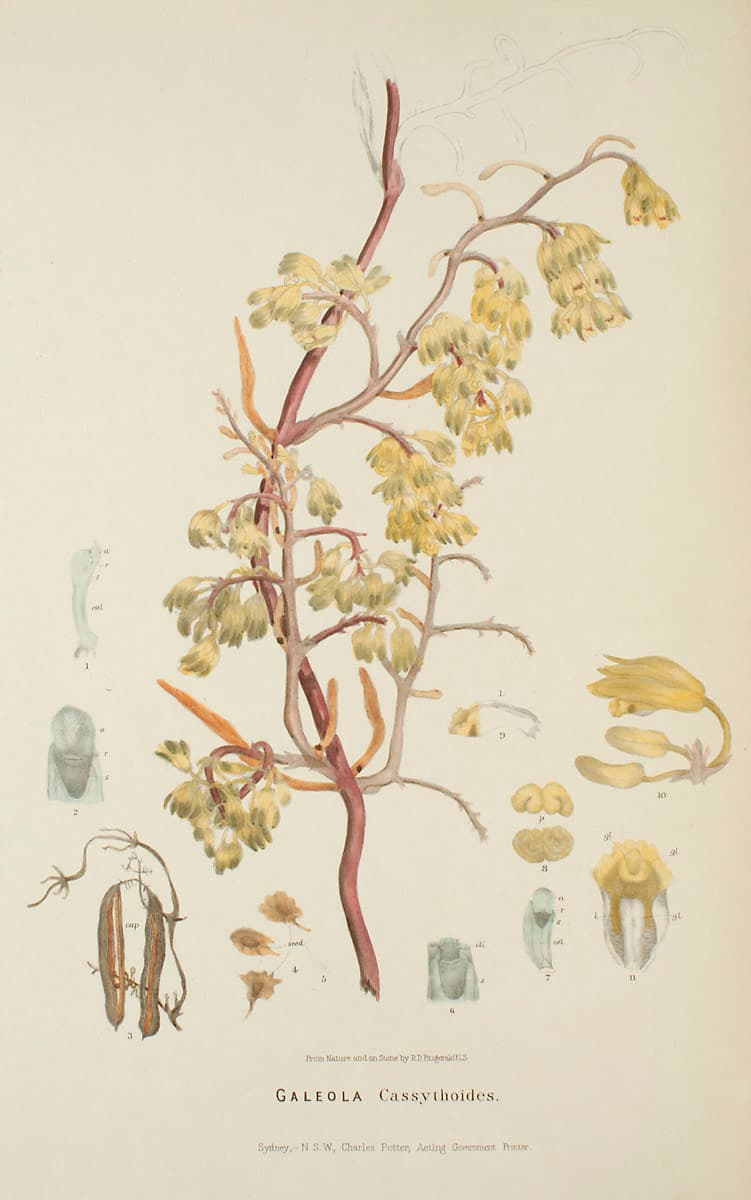
Erythrorchis, also known as bootlace orchids or by its Chinese name 倒吊兰属 (dao diao lan shu), is a genus of two species of climbing, leafless orchids in the Orchidaceae family. These myco-heterotrophic vines cling to tree trunks with small roots and produce densely crowded flowers on branched stems, distinguished by their fleshy sepals and petals and a wide labellum.