
Leporella
Leporella
Leporella fimbriata, commonly known as the hare orchid or fringed hare orchid, is the sole species within the genus Leporella in the Orchidaceae family. It is endemic to mainland southern Australia and is distinguished by its unusual labellum, lack of hairy leaves, and unique pollination mechanism involving bull-ants. This terrestrial orchid typically blooms from March to June.
Key Facts
- ›Endemic to southern Australia mainland.
- ›Flowers are 1-3 cm long and feature a fringed, greenish labellum with reddish-brown spots.
- ›Pollinated by male bull-ants attempting to copulate with the labellum.
- ›Leaves are egg-shaped to lance-shaped and glabrous (smooth).
- ›Blooms from March to June, with remains sometimes visible until September.
- ›The genus name 'Leporella' means 'little hare'.

Hare Orchid, Fringed Hare Orchid
Southern Australia Mainland, Western Australia, South Australia, Victoria
Terrestrial
Greenish, Reddish-Brown Spots
March, April, May, June
Male Bull-Ant
About Leporella
What is Leporella fimbriata?
Leporella fimbriata, commonly known as the hare orchid or fringed hare orchid, is the sole species within the flowering plant genus Leporella. It belongs to the orchid family, Orchidaceae, and is endemic to the southern regions of the Australian mainland. This terrestrial orchid is distinguished by its unique labellum, which is fringed and spotted, and it notably lacks hairy leaves, a characteristic found in some related orchid genera.
Description and Characteristics
As a terrestrial, perennial, and deciduous herb, Leporella fimbriata possesses fine, inconspicuous roots and an oval-shaped tuber. The tuber produces two 'droppers' that develop into daughter tubers in subsequent years, utilizing long, root-like stolons to spread away from the parent tuber. The plant typically bears one or two egg-shaped to lance-shaped leaves at the base of its stem. These leaves, often small at the time of flowering, mature to a bluish-green color with reddish veins and can reach up to 40 mm in length and 20 mm in width.
The wiry stem of the hare orchid can grow to a height of 10–25 cm and supports up to three resupinate flowers. Each flower measures approximately 1–3 cm in length and 1 cm in width. The dorsal sepal is dished and curves over the labellum, while the two lateral sepals are narrow and reflexed against the ovary. The petals are erect, linear, and have club-like, glandular-haired ends. The central labellum is about 5 mm long and 10 mm wide, characterized by its hairy texture, greenish color, reddish-brown spots, and a prominent comb-like fringe. The reproductive parts are fused to the column, which has wing-like lateral structures.
Taxonomy and Naming
The species was first formally described in 1840 by John Lindley as Leptoceras fimbriata. It was later placed into its current genus, Leporella, by Alex George in 1971. The genus name Leporella is derived from the Latin word 'lepus' (hare) with the diminutive suffix '-ella,' translating to 'little hare.' The specific epithet 'fimbriata' is Latin for 'fringed,' referring to the distinctive labellum.
Distribution and Habitat
Leporella fimbriata is found across the southern Australian mainland, specifically in the western half of Victoria, throughout southern South Australia, and into southern Western Australia. Its range in Western Australia extends from Shark Bay in the north to Israelite Bay on the south coast. In South Australia, it is present in the south-east, including the Yorke and Eyre Peninsulas. In Victoria, it occurs in the south-west, with noted populations near Anglesea and in the outer suburbs of Melbourne.
This orchid typically inhabits woodland and shrubland environments. It also thrives in heathland and areas that experience winter wetness, often near swampy conditions.
Ecology and Pollination
Leporella fimbriata is a myrmecophyte, meaning it has a relationship with ants. Its pollination is achieved through a fascinating process involving male bull-ants (Myrmecia urens). The ants are attracted to the labellum, and in their attempt to copulate with it, they inadvertently transfer pollen, thus enabling the orchid's reproduction.
Flowering Period
Flowering for Leporella fimbriata generally occurs between March and June. However, the remnants of the flowers can often be observed well into September.
Source: Wikipedia ↗
Frequently Asked Questions
What is Leporella fimbriata commonly called?
Leporella fimbriata is commonly known as the hare orchid or the fringed hare orchid. These names likely refer to the shape of its flowers or possibly its habitat.
Where is the hare orchid found?
The hare orchid is endemic to the southern Australia mainland. Its distribution includes the western half of Victoria, southern South Australia, and southern Western Australia, extending from Shark Bay to Israelite Bay.
What makes the pollination of Leporella fimbriata unusual?
Leporella fimbriata has an unusual pollination mechanism where male bull-ants (Myrmecia urens) attempt to copulate with the labellum, thereby facilitating pollination. This is a form of pseudocopulation.
What are the characteristics of the hare orchid's flowers?
The flowers are resupinate, measuring 1–3 cm in length, and feature a greenish labellum with reddish-brown spots and a distinctive comb-like fringe. The dorsal sepal curves over the labellum, and the lateral sepals are narrow and turned back.
What is the habitat of Leporella fimbriata?
This terrestrial orchid typically grows in woodland or shrubland environments. It can also be found in heath areas and near locations that are swampy during the winter months.
What is the meaning of the genus name 'Leporella'?
The genus name 'Leporella' is derived from the Latin word 'lepus,' meaning 'hare,' combined with the diminutive suffix '-ella.' Therefore, 'Leporella' translates to 'little hare'.
Related Orchid species

Glossodia
Glossodia, commonly known as waxlip orchids, is a genus of mostly purple orchids originating from Australia. First described by Robert Brown in 1810, the genus is characterized by its distinct floral morphology. While some studies have proposed its inclusion within the genus Caladenia, the Australian Plant Census currently recognizes Glossodia as a distinct genus.

Geodorum
Geodorum is a genus of eight deciduous, terrestrial orchid species found across southern Japan, tropical Asia, Australia, and the southwest Pacific islands. These orchids are distinguished by their underground pseudobulbs, broad pleated leaves, and small to medium-sized, bell-shaped or tube-shaped flowers that hang downwards on a drooping flowering stem.
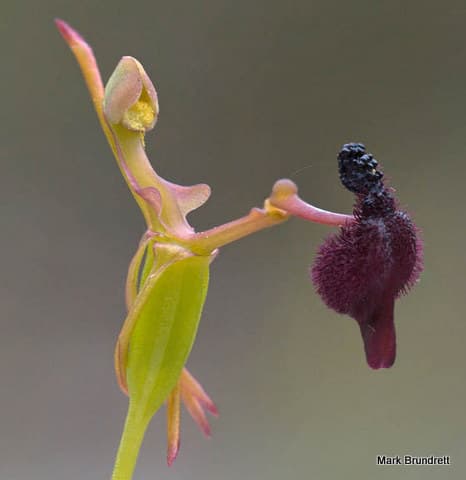
Drakaea
Drakaea, commonly known as hammer orchids, is a genus of 10 orchid species native exclusively to the southwest of Western Australia. These orchids are distinguished by a remarkable pollination mechanism involving an insectoid labellum that mimics the shape, color, and scent of female thynnid wasps, tricking male wasps into attempting to mate with the flower and thus facilitating pollination.