
Calochilus
Calochilus
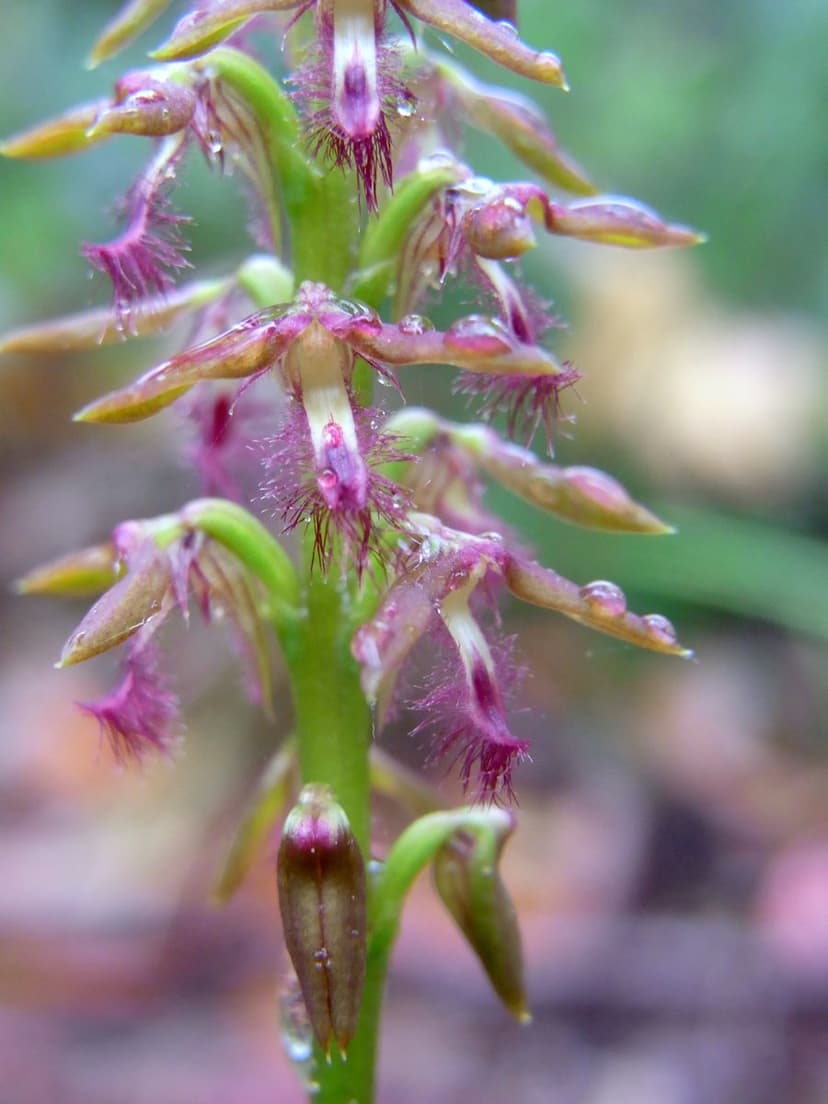
Calochilus, commonly known as beard orchids, is a genus of approximately 30 terrestrial orchid species belonging to the family Orchidaceae. These orchids are distinctive for their densely hairy labellum, which gives them their common name. Primarily found in Australia, with some species extending to New Zealand, New Guinea, and New Caledonia, they are terrestrial herbs that typically have a single leaf or are leafless, and reproduce through self-pollination if cross-pollination fails.
Key Facts
- ›Genus comprises about 30 species of terrestrial orchids.
- ›Characterized by a densely hairy labellum, earning them the name 'beard orchids'.
- ›Primarily found in Australia, with extensions to New Zealand, New Guinea, and New Caledonia.
- ›Terrestrial herbs with a single basal leaf or are leafless.
- ›Reproduce via self-pollination when cross-pollination is unsuccessful.
- ›Flowers have a distinctive labellum covered in purple or metallic-colored hairs.

Beard Orchids
Terrestrial
Purple, Metallic-Coloured
Spring, Early Summer
Male Campsomeris Wasps
About Calochilus
The genus Calochilus, commonly referred to as beard orchids, represents a group of approximately 30 species within the orchid family, Orchidaceae. These plants are characterized by their terrestrial growth habit, typically featuring a single basal leaf or, in some cases, being entirely leafless. The most distinctive attribute of beard orchids is their labellum, which is densely covered with hairs, giving rise to their common name.
Distribution and Habitat
Beard orchids are primarily distributed across Australia, with species found in all Australian states. Their geographical range extends beyond Australia to include New Zealand, New Guinea, and New Caledonia, with one species being endemic to New Caledonia. In temperate regions of Australia and New Zealand, these orchids commonly grow on slopes and ridges within forests, woodlands, shrublands, heaths, and wet swamps. In contrast, species found in tropical Australia and New Guinea inhabit wet, grassy areas.
Description and Reproduction
Orchids in the genus Calochilus are perennial, deciduous, sympodial herbs. They possess fine roots and a pair of egg-shaped tubers that lack a protective fibrous sheath. The inflorescences are racemes bearing one to many resupinate flowers. The dorsal sepal is broad and erect, often forming a hood over the column, while lateral sepals are similar but narrower. Petals are shorter and narrower than the sepals, frequently with a hook-like tip. The labellum is modified as the central petal and is notably longer than other floral parts, oblong at the base, triangular at the tip, and densely adorned with purple or metallic-colored hairs that increase in length towards the tip. The sexual organs are fused to a short, broad column with prominent wings. The base of the column surrounds the stigma with rounded collars, often marked with eye-like spots. Flowering times vary depending on the climatic region, and fruit development results in a dehiscent capsule containing up to 500 seeds. Unlike some other Australian orchids, Calochilus species do not reproduce via daughter tubers but rely on self-pollination when cross-pollination is not achieved. While few studies have been conducted on their pollination, male Campsomeris wasps have been observed collecting pollinia from some flowers, mistaking the labellum for a mate.
Source: Wikipedia ↗
Frequently Asked Questions
What is the common name for orchids in the genus Calochilus?
Orchids in the genus Calochilus are commonly known as beard orchids. This name is derived from the densely hairy appearance of their labellum, which is a prominent feature of their flowers.
Where are Calochilus orchids naturally found?
The majority of Calochilus species are found in Australia, occurring in all Australian states. Some species also extend their range to New Zealand, New Guinea, and New Caledonia.
What is distinctive about the flowers of Calochilus orchids?
The most striking feature of Calochilus flowers is their labellum, which is densely covered with purple or metallic-colored hairs. This hairy labellum is the characteristic that gives the genus its common name, beard orchids.
How do Calochilus orchids reproduce?
Calochilus orchids reproduce through self-pollination if cross-pollination does not occur. Unlike some other Australian orchids, they do not reproduce using daughter tubers. The fruit that follows flowering is a dehiscent capsule containing up to 500 seeds.
What is the typical habitat of Calochilus orchids?
Calochilus orchids are terrestrial herbs. In temperate regions of Australia and New Zealand, they inhabit slopes and ridges within forests, woodlands, shrublands, heaths, and wet swamps. In tropical Australia and New Guinea, they are found in wet, grassy areas.
Related Orchid species
Genoplesium
Genoplesium, commonly known as midge orchids, is a genus of approximately 50 flowering plant species belonging to the Orchidaceae family, native to Australia, New Zealand, and New Caledonia. These terrestrial herbs are characterized by a single basal leaf and small, often scented flowers that are attractive to insect pollinators. There is ongoing taxonomic debate, with some scientists proposing that most Genoplesium species should be reclassified under the genus Corunastylis.

Corybas
Corybas, commonly known as helmet orchids, is a genus of about 120 species of small, perennial, terrestrial herbs in the orchid family. Native to a wide range including Australia, New Zealand, Southeast Asia, and the Himalayas, these orchids are distinctive for their single, fungus-like flower, dominated by a large dorsal sepal and labellum, often resembling a helmet.

Dipodium
Dipodium, commonly known as hyacinth orchids, is a genus of approximately forty orchid species native to tropical, subtropical, and temperate regions across Southeast Asia, New Guinea, the Pacific Islands, and Australia. This genus is distinguished by its large, often colorful flowers borne on tall stems, and includes species that are either terrestrial or climbing, some with leaves and some leafless.