
Cochleanthes
Cochleanthes
Cochleanthes is a genus of orchids native to Mexico, Central America, the West Indies, and South America, comprising four recognized species. These orchids are distinctive for their large, single-flowered inflorescences, which lack pseudobulbs and grow in a fan-like manner, with the flower's prominent labellum serving as a nectar guide.
Key Facts
- ›The genus Cochleanthes is found in Mexico, Central America, the West Indies, and South America.
- ›The name Cochleanthes derives from Greek words for 'shell' and 'flower', referring to the flower's shape.
- ›These orchids typically lack pseudobulbs and grow in a fan-like, tufted habit.
- ›Flowers are often large relative to the plant size and can appear at any time of year, with a slight peak in summer cultivation.
- ›The prominent labellum (lip) of the flower features longitudinal markings that act as nectar guides for pollinators.
- ›Cochleanthes orchids are epiphytes that grow in cloud forests at elevations up to 1500 meters.

Epiphytic
Any Time of Year, Summer
Insects
About Cochleanthes
The genus Cochleanthes encompasses a group of orchids native to diverse regions spanning Mexico, Central America, the West Indies, and South America. The scientific name, Cochleanthes, is derived from Greek words meaning "shell" and "flower," aptly describing the distinctive shape of its blooms.
Description and Growth
Orchids within the Cochleanthes genus typically lack pseudobulbs, a common feature in many orchid species. Instead, they exhibit a sympodial growth pattern, producing tufted, fan-like growths of fairly erect, narrow leaves. A notable characteristic of this genus is its production of single-flowered inflorescences, where the flowers are often disproportionately large compared to the overall size of the plant. These blooms can appear at any time of the year, though they may be slightly more concentrated during the summer months when cultivated.
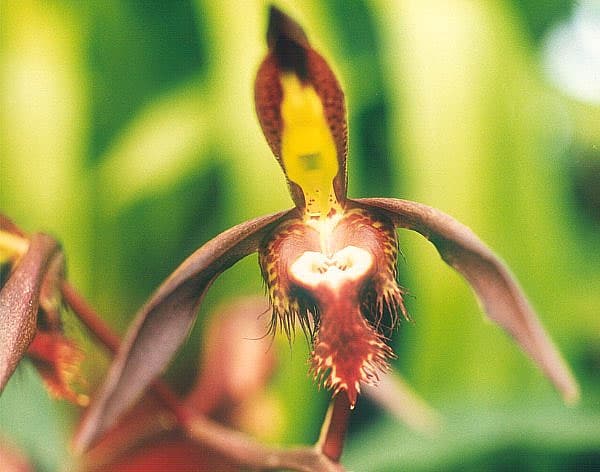
The flowers of Cochleanthes are dominated by a prominent labellum, or lip, which frequently displays longitudinal markings. These markings serve as nectar guides, directing pollinating insects towards the flower's nectar source. The flowers possess four pollinia, which are essential for their reproductive process.
Habitat and Cultivation
Cochleanthes orchids are primarily epiphytes, meaning they grow on other plants, typically trees, in their natural environment. They are found in cloud forests at elevations reaching up to 1500 meters. For successful cultivation, these orchids generally require intermediate temperature conditions and fairly high humidity levels. A crucial aspect of their care is to ensure they are never allowed to dry out completely, indicating a need for consistent moisture.
Source: Wikipedia ↗
Frequently Asked Questions
What does the name Cochleanthes mean?
The name Cochleanthes is derived from the Greek words 'cochlos', meaning 'shell', and 'anthos', meaning 'flower'. This name refers to the characteristic shape of the orchid's bloom.
What are the general growth characteristics of Cochleanthes orchids?
Cochleanthes orchids typically lack pseudobulbs, instead forming tufted, fan-like growths of narrow, erect leaves. They conform to a sympodial growth method and produce single-flowered inflorescences.
What is distinctive about Cochleanthes flowers?
The flowers of Cochleanthes are often quite large in proportion to the plant size. A key feature is the large labellum, or lip, which usually displays longitudinal markings that serve as nectar guides for pollinating insects.
Where do Cochleanthes orchids naturally grow?
This genus is native to a wide range of regions, including Mexico, Central America, the West Indies, and South America. They are specifically found growing as epiphytes in cloud forests.
What are the ideal growing conditions for Cochleanthes orchids?
Cochleanthes orchids thrive under intermediate temperature conditions and require fairly high humidity. It is important to ensure that the plants are never allowed to dry out completely.
How large are Cochleanthes flowers?
The flowers of Cochleanthes are often described as being quite large relative to the size of the plant itself. Specific measurements are not provided, but their prominent labellum is a notable characteristic.
Related Orchid species

Brassavola
Brassavola is a genus of 21 orchid species, named in honor of Antonio Musa Brassavola, an Italian nobleman and physician. These orchids are widespread across Mexico, Central America, the West Indies, and South America, distinguished by their succulent leaves and fragrant, nocturnal blooms. They are primarily epiphytic, with a few also growing as lithophytes.
Catasetum
Catasetum is a genus of showy epiphytic orchids belonging to the family Orchidaceae. Native to regions spanning from Mexico to Argentina, many species are highly valued in horticulture for their striking flowers. A distinctive characteristic of Catasetum is its unisexual flowers, with male and female blooms often appearing on separate plants, a phenomenon that historically puzzled botanists until explained by Charles Darwin.

Campylocentrum
Campylocentrum is a genus of rare orchids belonging to the family Orchidaceae. These plants are native to Mexico, the West Indies, Central America, and South America, with one species extending into Florida. They are distinctive for their often leafless growth habit and are typically pollinated by small moths and bees.