
Coryanthes
Coryanthes, commonly known as bucket orchids, is a genus of neotropical epiphytic orchids native to South America, Central America, Mexico, and Trinidad. These orchids are renowned for their intricate coevolutionary relationship with male orchid bees, which are essential for their reproduction through a unique pollination mechanism involving a fluid-filled bucket-shaped lip.
Key Facts
- ›Bucket orchids exhibit a remarkable coevolutionary relationship with male orchid bees (tribe Euglossini).
- ›The flowers possess a distinctive bucket-shaped lip that secretes a fluid, often intoxicating.
- ›Male orchid bees are attracted by a strong scent and can fall into the fluid-filled bucket during their collection of aromatic oils.
- ›A specialized escape route forces bees to contact the orchid's pollen packets, ensuring pollination.
- ›Some species can produce flowers up to 30 cm wide, making them among the largest in the Orchid Family.
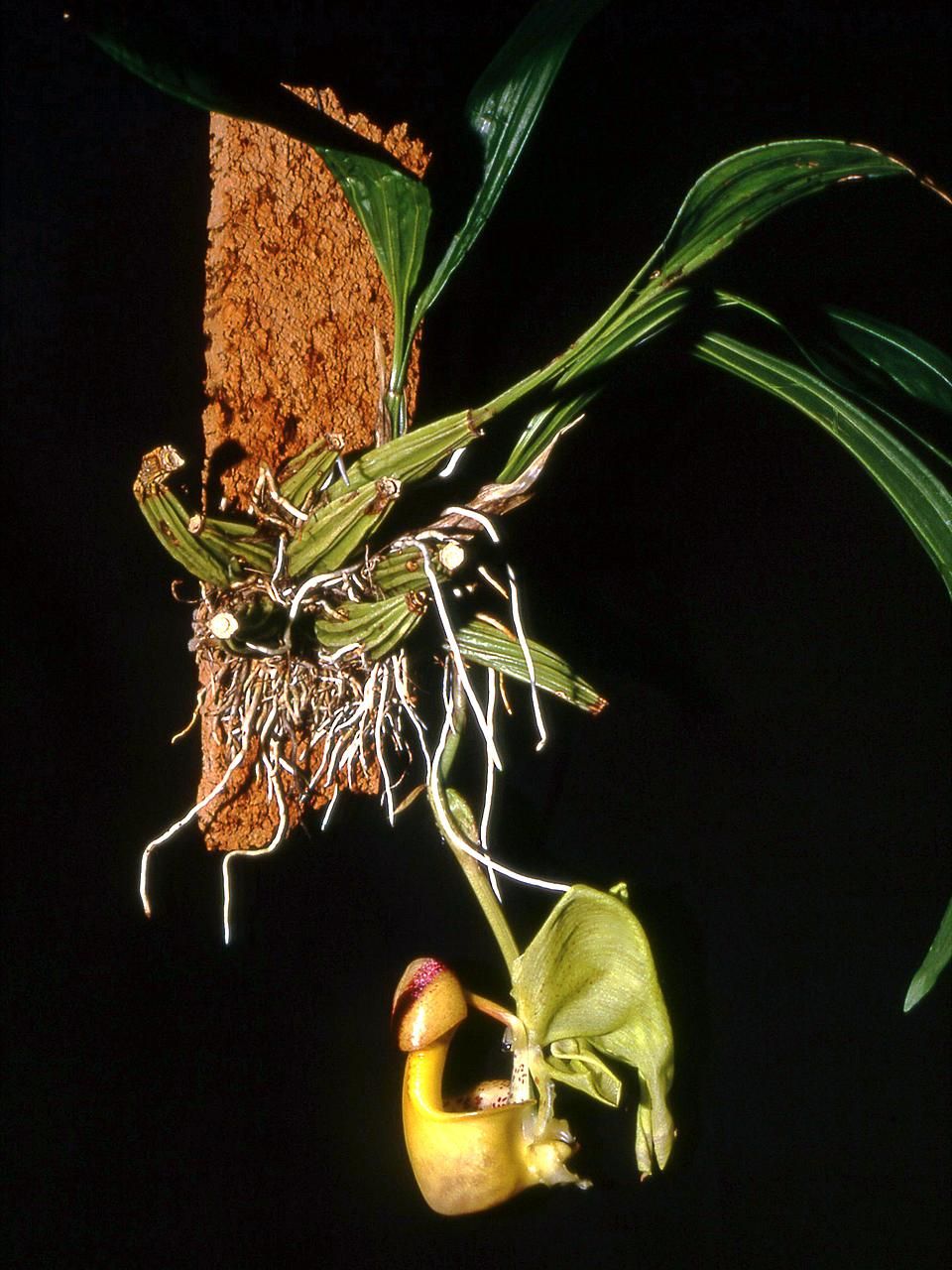
Bucket Orchids
Epiphytic
Male Orchid Bees
About Coryanthes
Coryanthes, commonly referred to as bucket orchids, is a genus of neotropical orchids belonging to the family Orchidaceae. These orchids are found natively across South America, Central America, Mexico, and Trinidad. The genus is abbreviated as Crths in the horticultural trade.
A Remarkable Mutualism
Bucket orchids are a prime example of coevolution and mutualism, having evolved in tandem with orchid bees of the tribe Euglossini (family Apidae). This relationship is crucial for the reproduction of both the orchids and the bees. The flowers, typically borne one to three on a pendant stem, are characterized by a unique, bucket-shaped lip that secretes a fluid. This fluid is believed by some to contain an intoxicating substance.
The Unique Pollination Mechanism
Male orchid bees are attracted to the Coryanthes flower by a powerful scent emanating from aromatic oils, which they store in specialized pouches on their hind legs for use in courtship. While attempting to gather the waxy substance containing the scent, these bees can inadvertently fall into the fluid-filled bucket. To escape, they must climb onto small knobs that lead to a spout. As the bee navigates this escape route, the spout constricts, pressing the orchid's pollen packets against the bee's thorax. The glue on these packets does not set immediately, keeping the bee trapped until the glue hardens, which can take up to 45 minutes. Once released, the bee can dry its wings and fly off. Pollination is successful if the bee, carrying the now-set pollen packets, visits another Coryanthes flower of the same species, where the pollen then adheres to the stigma, leading to seed pod development.
Flower Size and Historical Study
Coryanthes flowers are notable for their considerable size, ranking among the largest in the Orchid Family. Some species can reach up to 30 cm (12 inches) in width and 16 cm (6 inches) in height. The species C. bruchmuelleri is often cited as the largest, with even unopened buds measuring 11.7 cm (5 inches) long by 8 cm (3 inches) wide.
Early scientific investigations into Coryanthes were published by Cruger in 1865. Charles Darwin also dedicated attention to these orchids in his book, 'The Various Contrivances by which Orchids are Fertilized by Insects,' detailing his experiments. However, Darwin mistakenly believed female bees were the primary pollinators; the vital role of male euglossine bees was not fully understood for nearly a century, with their function clarified in 1961.
Source: Wikipedia ↗
Frequently Asked Questions
What is special about Coryanthes orchids and bees?
Coryanthes orchids have a unique mutualistic relationship with male orchid bees. The bees are attracted to the flowers by a strong scent, and in their efforts to collect aromatic oils, they often fall into a fluid-filled bucket lip. This mechanism ensures pollination as the bees are trapped until pollen packets adhere to their bodies.
How does the pollination of Coryanthes orchids work?
Male orchid bees are lured to the flower by a strong scent and unique fluid. When attempting to escape a fluid-filled bucket lip, they are forced through a constricted spout. This process presses pollen packets against the bee's thorax, and the orchid holds the bee until the glue sets, after which it is released. If the bee visits another flower of the same species, pollination is completed.
What makes the flower of a bucket orchid distinctive?
The flower lip of Coryanthes orchids is shaped like a bucket and secretes a fluid into this structure. This bucket is a central element in its specialized pollination mechanism, trapping the male orchid bees.
Are bucket orchids large flowers?
Yes, Coryanthes flowers are among the largest in the Orchid Family. Some species can have flowers up to 30 cm wide and 16 cm from top to bottom, with the species C. bruchmuelleri noted for its particularly large buds.
Who studied Coryanthes orchids historically?
Early investigations into Coryanthes were published by Cruger in 1865. Charles Darwin also described his observations and experiments on some species in his book 'The Various Contrivances by which Orchids are Fertilized by Insects', though he initially misidentified the role of female bees in pollination.
Related Orchid species
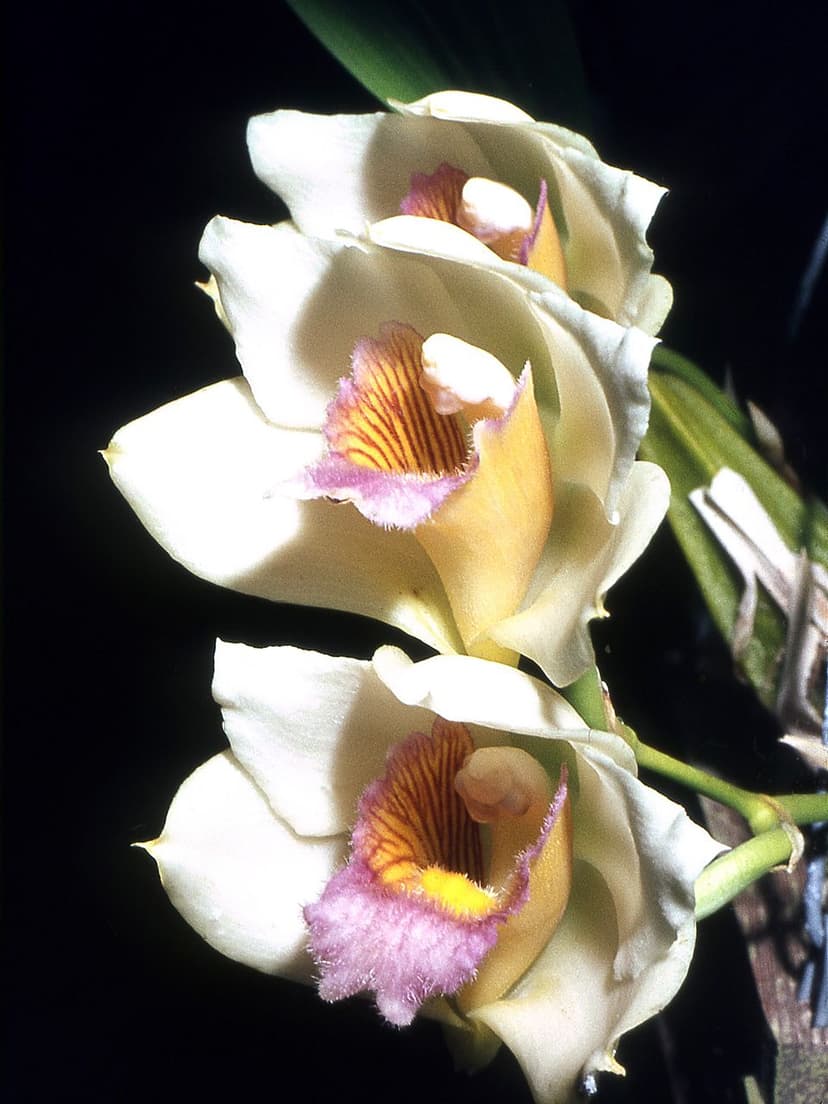
Bifrenaria
Bifrenaria is a genus of orchids comprising about twenty species native to Panama, Trinidad, and South America, primarily found in the Amazon and Atlantic Forests of Brazil. These orchids are admired by growers for their abundant and striking flowers, which are often strongly scented and possess a distinctive calcar at the base of the sepals.

Brassavola
Brassavola is a genus of 21 orchid species, named in honor of Antonio Musa Brassavola, an Italian nobleman and physician. These orchids are widespread across Mexico, Central America, the West Indies, and South America, distinguished by their succulent leaves and fragrant, nocturnal blooms. They are primarily epiphytic, with a few also growing as lithophytes.

Dendrophylax
Dendrophylax is a genus of leafless neotropical orchids native to Mexico, Central America, the West Indies, and Florida. These orchids are distinctive for their photosynthetic roots, which form the bulk of the plant, and ephemeral leaves reduced to scales. One notable species, Dendrophylax lindenii, gained prominence through its mention in "The Orchid Thief."