
Cyrtosia
Cyrtosia
Cyrtosia is a genus of flowering plants belonging to the orchid family, Orchidaceae. This genus encompasses five known species, which are naturally found across a broad geographical range, including East Asia, the Indian subcontinent, Southeast Asia, and New Guinea. The species within Cyrtosia are distinguished by their botanical classification within the Orchidaceae family.
Key Facts
- ›Cyrtosia is a genus of orchids containing 5 recognized species.
- ›The genus is native to a wide distribution including China, Japan, Korea, the Indian subcontinent, Southeast Asia, and New Guinea.
- ›Key species include Cyrtosia integra, Cyrtosia javanica, Cyrtosia nana, Cyrtosia plurialata, and Cyrtosia septentrionalis.
- ›Cyrtosia javanica is noted as having the widest distribution within the genus.
- ›The species are part of the large and diverse Orchidaceae family.

About Cyrtosia
Cyrtosia is a genus of flowering plants recognized within the Orchidaceae family, commonly known as the orchid family. This genus comprises five distinct species, each with its own specific geographical distribution.
Distribution
The natural habitat of Cyrtosia species spans a considerable portion of Asia and extends to New Guinea. The genus is native to China, Japan, and Korea in East Asia, the Indian subcontinent, and various regions within Southeast Asia. Among the five species, Cyrtosia javanica is noted for having the broadest distribution, occurring across most of the genus's geographical range.
Species
The five recognized species within the genus Cyrtosia are:
- Cyrtosia integra (Rolfe ex Downie) Garay, found in Laos, Thailand, and Vietnam.
- Cyrtosia javanica Blume, which has a wide distribution.
- Cyrtosia nana (Rolfe ex Downie) Garay, found in Manipur, Thailand, Vietnam, and the Chinese provinces of Guizhou and Guangxi.
- Cyrtosia plurialata Seidenf., native to Thailand.
- Cyrtosia septentrionalis (Rchb.f.) Garay, occurring in Japan, Korea, the Ryukyu Islands, and the Chinese provinces of Anhui, Henan, Hunan, and Zhejiang.
As a member of the Orchidaceae family, Cyrtosia represents a small part of a vast and diverse group of plants known for their often complex floral structures and specialized pollination strategies.
Source: Wikipedia ↗
Frequently Asked Questions
How many species are in the genus Cyrtosia?
The genus Cyrtosia currently contains 5 known species. These species are distributed across various regions in Asia and New Guinea.
Where can Cyrtosia orchids be found naturally?
Cyrtosia orchids are native to a wide geographical area. This includes countries like China, Japan, Korea, India, various parts of Southeast Asia, and New Guinea.
Which species of Cyrtosia has the largest natural range?
Cyrtosia javanica is the species within the genus that has the most extensive natural distribution. It is found across most of the genus's overall range.
What is the botanical family of Cyrtosia?
Cyrtosia belongs to the Orchidaceae family, which is commonly known as the orchid family. This family is one of the largest families of flowering plants.
Related Orchid species

Lecanorchis
Lecanorchis is a genus of leafless, terrestrial orchids belonging to the subfamily Vanilloideae. These myco-heterotrophic plants are found in the mountain forests of various Asian regions and New Guinea, distinguished by their dull-colored flowers with a distinctive hairy lip. They are characterized by a cup-like calyculus and an elongated gynostemium.

Cremastra
Cremastra is a genus of flowering plants belonging to the orchid family, Orchidaceae. It encompasses four recognized species, predominantly found in East Asia and Southeast Asia, including regions like China, Japan, Korea, Thailand, the Himalayas, and the Russian Far East. These orchids are distinguished by their botanical classification within the Orchidaceae family.
Bletilla
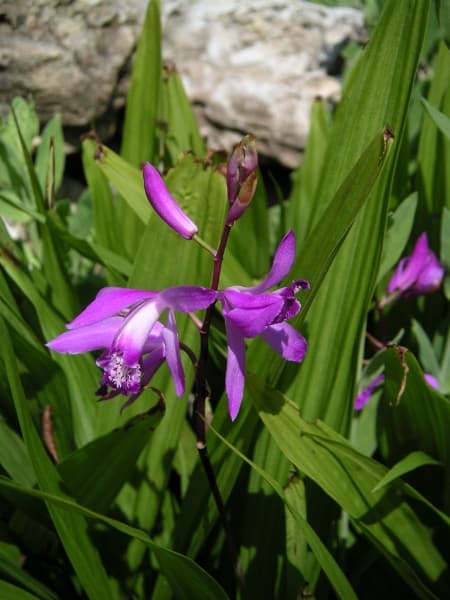
Bletilla, commonly known as the urn orchid, is a temperate, terrestrial orchid genus found across East Asia and Southeast Asia. Its pseudobulbs resemble spreading corms, and the plants are characterized by pleated leaves and racemes of flowers that emerge in spring and early summer, varying in color from white to purple. Bletilla striata, the most common species, is particularly noted for its hardiness and ease of cultivation.