
Dilochia
Dilochia
Dilochia is a genus of flowering plants belonging to the Orchidaceae family, comprising eight known species. These orchids are native to Southeast Asia and New Guinea, with distinct species found across various islands and mainland regions. The genus is characterized by its diverse geographical distribution within this tropical zone.
Key Facts
- ›Dilochia is a genus within the Orchidaceae family.
- ›It encompasses eight recognized species.
- ›The natural habitat of Dilochia species spans Southeast Asia and New Guinea.
- ›Species within this genus are found in locations such as Borneo, Indonesia, Philippines, Sulawesi, Thailand, Malaysia, Myanmar, and New Guinea.
- ›The genus was established with the classification of its species, with significant taxonomic contributions by researchers like J.J. Smith and P.J. Cribb.

About Dilochia
Dilochia is a genus of flowering plants recognized within the Orchidaceae family, commonly known as orchids. This genus comprises eight known species, all of which are native to the tropical regions of Southeast Asia and New Guinea. The distribution of these species is varied, with individual members found across islands and mainland areas within its broad geographical range.
Species Distribution
The eight recognized species of Dilochia have distinct geographical occurrences. For instance, Dilochia beamanii is found in Sabah, Borneo, while Dilochia cantleyi occurs in Indonesia and New Guinea. Other species, such as Dilochia carnosa, are native to Sumatra in Indonesia, and Dilochia celebica is documented in Sulawesi. The Philippines is home to Dilochia deleoniae and Dilochia elmeri. Further diversity is noted with Dilochia longilabris found in Sulawesi and Borneo, and Dilochia parviflora native to Borneo. Dilochia rigida is specifically recorded in Sabah, and Dilochia subsessilis is found in Myanmar. Lastly, Dilochia wallichii has a wider distribution across Thailand, Malaysia, Indonesia, New Guinea, and the Philippines.
Taxonomic Context
The classification and understanding of the Dilochia genus have been shaped by botanical research, with contributions from various taxonomists. Key references in orchidology, such as those edited by Pridgeon, Cribb, Chase, and Rasmussen, have cataloged and described genera within the Orchidaceae family, including Dilochia. The genus's taxonomic standing is supported by detailed studies on orchid nomenclature and classification.
Source: Wikipedia ↗
Frequently Asked Questions
What is the Dilochia genus?
Dilochia is a genus of flowering plants belonging to the orchid family, Orchidaceae. It is recognized for its collection of eight distinct orchid species.
Where are Dilochia orchids found naturally?
The natural distribution of Dilochia orchids is primarily in Southeast Asia and New Guinea. Specific species have been recorded in various countries and islands within these regions.
How many species are in the Dilochia genus?
There are eight known species within the Dilochia genus. These species have been identified and documented across their native ranges.
Which regions are home to Dilochia species?
Dilochia species are found across a wide area including Borneo (Sabah), Indonesia (Sumatra), New Guinea, Philippines, Sulawesi, Thailand, Malaysia, and Myanmar.
Related Orchid species

Hylophila
Hylophila is a genus of flowering plants belonging to the orchid family, Orchidaceae. These orchids are native to Southeast Asia, New Guinea, and Melanesia. The genus is distinguished by its placement within the Orchidaceae family and its specific geographic distribution.

Galeola
Galeola is a genus of myco-heterotrophic orchids found across Southeast Asia, Madagascar, and the Comoros. These orchids are of particular biological interest due to their parasitic nature, relying entirely on fungi for sustenance, and their exceptionally large, winged seeds, which are the biggest among all orchid seeds.
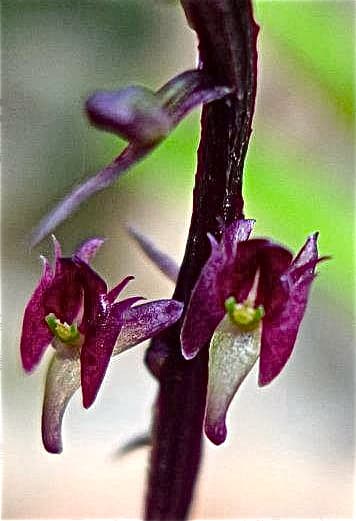
Crepidium
Crepidium, also known by its Chinese name 沼兰属 (zhao lan shu) and commonly as spur orchids, is a genus of approximately three hundred species of evergreen orchids. These plants are predominantly terrestrial, characterized by short, ground-hugging stems, large pleated leaves, and small, non-resupinate flowers with spreading sepals and petals. The genus is widely distributed across the tropics, with a significant diversity found in New Guinea.