
Diuris
Diuris
Diuris, commonly known as donkey orchids, is a genus of over sixty species of terrestrial orchids endemic to Australia, with one species found in Timor. They are distinctive for their ear-like petals and often brightly colored flowers, frequently yellow with darker markings, which are thought to mimic nectar-producing flowers to attract pollinators despite not producing nectar themselves.
Key Facts
- ›Diuris is a genus of terrestrial orchids found across Australia and one species in Timor.
- ›Common names include donkey orchids, bee orchids, nanny goat orchids, and pansy orchids.
- ›Flowers are often yellow with darker markings and possess distinctive ear-like petals.
- ›These orchids typically do not produce nectar and are thought to deceive insects.
- ›Flowering generally occurs between September and November, though some species bloom earlier or later.
- ›The genus name 'Diuris' refers to the two hanging lateral sepals, resembling tails.

Donkey Orchids, Bee Orchids, Nanny Goat Orchids, Pansy Orchids
Terrestrial
Yellow, Darker Markings
September, October, November, June, January
Wasps, Bees, Flies
About Diuris
Diuris: The Donkey Orchids
Diuris, commonly known as donkey orchids, bee orchids, nanny goat orchids, or pansy orchids, is a genus of over sixty species of flowering plants within the orchid family, Orchidaceae. This genus is largely endemic to Australia, with a single species found in Timor. The genus is named "Diuris" from the Greek words "dis" meaning "double" and "oura" meaning "tail," a reference to the two narrow lateral sepals that hang below the labellum.
Description and Characteristics
Orchids in the genus Diuris are terrestrial, perennial, deciduous, and sympodial herbs. They typically possess a few inconspicuous, fine roots and one or two tubers that lack a protective sheath. The stem is short, erect, and unbranched, featuring a leaf-like cataphyll at each node. The plant base has between one and ten grass-like leaves. The inflorescence is a raceme bearing a few to many brightly colored, resupinate flowers on a wiry stalk. A distinctive feature is the dorsal sepal, which is shorter but wider than the lateral sepals and forms a hood over the column. The long, narrow lateral sepals hang below the labellum, resembling a pair of tails. The petals are also distinctive, with a narrow base and a widely expanded main part, contributing to the "donkey ear" common name. The labellum is highly modified, differing markedly from the other petals and sepals, and is divided into three distinct parts. The column is short and has narrow wings. Flowering time varies by species, with most blooming between September and November, though some, like D. brumalis, flower as early as June, and D. emarginata may bloom as late as January. Following flowering, a thin-walled, dehiscent capsule develops, containing up to 100 winged seeds.
Distribution and Habitat
Donkey orchids are distributed across all Australian states, excluding the Northern Territory. The species D. fryana is found in Timor. In New South Wales, most species grow among grasses in sclerophyll forests. In Western Australia, they are commonly found in moist environments such as coastal swamps or areas near granite outcrops. Diuris orchids typically grow as individual plants or in loose colonies and are generally found at low altitudes, although D. monticola has been recorded growing at elevations up to 1,800 meters.
Ecology and Pollination
Many Diuris species have flowers that are colored similarly to flowers which attract pollinating insects like wasps, bees, and flies. However, very few Diuris species produce a scent, and most do not produce nectar. It is hypothesized that Diuris species deceive insects by falsely advertising the presence of food, a theory supported by experiments conducted on D. pardina. Some species, such as D. purdiei, only flower following a summer fire. In fire-prone regions, the tubers remain dormant in the soil and are unharmed by bushfires, allowing the plants to regenerate after such events.
Source: Wikipedia ↗
Frequently Asked Questions
What are donkey orchids?
Donkey orchids are terrestrial orchids belonging to the genus Diuris. They are known for their distinctive ear-like petals and are native to Australia and Timor.
What is the scientific name for donkey orchids?
The scientific name for this genus of orchids is Diuris. The name is derived from Greek words meaning 'double tail', referring to the orchid's two hanging lateral sepals.
Where do Diuris orchids grow?
Diuris orchids are found in all Australian states except the Northern Territory, and one species, D. fryana, is found in Timor. They typically grow in grassy areas within sclerophyll forests or in moist locations like coastal swamps and near granite outcrops.
How do Diuris orchids attract pollinators if they don't produce nectar?
Diuris orchids are thought to attract pollinators by mimicking the appearance of nectar-producing flowers. Their brightly colored flowers, often yellow with darker markings, deceive insects like wasps, bees, and flies into visiting them.
When do donkey orchids bloom?
The flowering time for Diuris species varies, but most bloom between September and November. Some species, like D. brumalis, flower as early as June, while others, such as D. emarginata, may bloom as late as January.
What is distinctive about Diuris flowers?
Diuris flowers are notable for their ear-like petals, which give them the common name 'donkey orchid'. Additionally, the two lateral sepals are long and narrow, hanging below the labellum like a pair of tails, and the dorsal sepal forms a hood over the column.
Related Orchid species
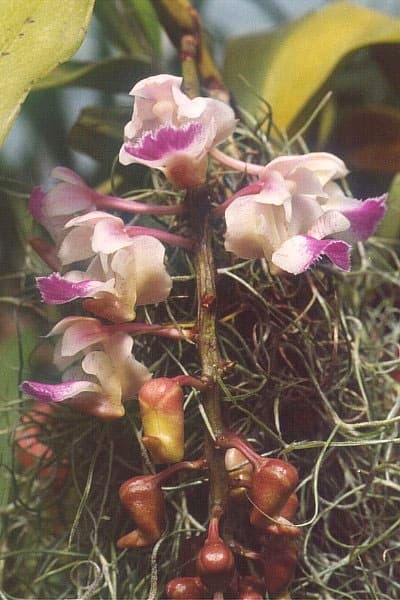
Aerides
Aerides, commonly known as cat's-tail orchids and fox brush orchids, is a genus of tropical epiphytic orchids native to Asia. These orchids are highly valued in horticulture for their showy, fragrant, and long-lasting flowers, which typically appear in racemes and are often white with colorful edges.

Cyanicula
Cyanicula, commonly known as blue orchids, is a genus of twelve plant species within the orchid family, Orchidaceae, all of which are endemic to Australia. These terrestrial orchids are distinguished by their tubers that replace themselves within the same cavity, unlike the "droppers" produced by related genera. While many species feature blue flowers, the genus name refers to the small, often blue blooms, with some variations exhibiting yellow or white petals.
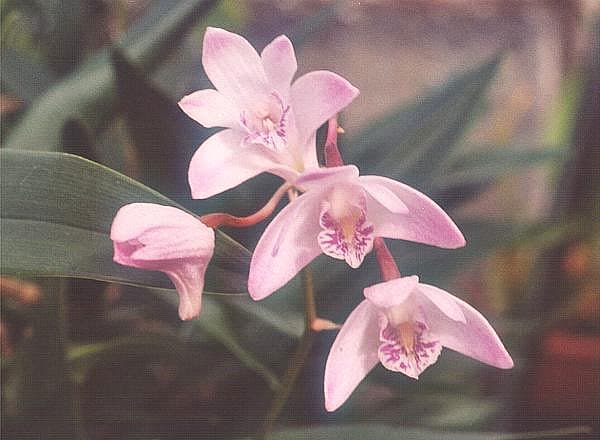
Dendrobium
Dendrobium is a vast genus of orchids, predominantly epiphytic or lithophytic, found across Asia and the Pacific. These orchids are characterized by their creeping roots and unique flower arrangements, often featuring contrasting labellums and a central callus. Many species are cultivated for their horticultural value and some are recognized for their air-purifying qualities and medicinal properties.